
The magic of cold air and how your AC makes it
How Your Air Conditioner Works Explained Simply: Start Here
How your air conditioner works explained simply: your AC pulls warm air from inside your home, removes the heat from that air using a special fluid called refrigerant, sends that heat outside, and blows the now-cooler air back into your rooms. It repeats this loop continuously until your home reaches the temperature you set.
Here is the basic process at a glance:
- Warm air is pulled in through your return vents
- Heat is absorbed from that air by refrigerant inside the indoor unit
- The refrigerant carries the heat to the outdoor unit
- Heat is released outside, and the cooled air is blown back into your home
- The cycle repeats until your thermostat says the job is done
Your AC also pulls moisture out of the air as it runs, which is why a well-cooled home feels less sticky and more comfortable — even on a humid day.
On a hot summer day, your home can feel like a different planet than the one your family wants to live in. Kids are cranky, routines fall apart, and nobody wants to be in the same room together. Understanding how your AC actually works is the first step to keeping it running well — and keeping your home the comfortable, happy place your family deserves.
I am Matthew Palmieri, founder of My Happy Home, and my background in HVAC, home services, and smart home technology has given me years of hands-on experience helping homeowners understand how your air conditioner works explained simply — so they can spot problems early and make confident decisions. In the sections below, I will walk you through everything you need to know, without the technical jargon.
What an air conditioner is and what it actually does
At its core, an air conditioner is a heat-removal system. Many people think of an AC as a machine that "creates" coldness, like a sink creating water. In reality, it works more like a sponge. It "soaks up" the heat from inside your house and "squeezes" it out into the backyard.
Beyond just cooling, your AC is a master of air circulation. It pulls air through a filter to catch dust and allergens, moves it across chilled metal coils, and pushes it back into your living spaces. This process also provides essential dehumidification. By removing excess moisture, the system makes the air feel crisp rather than heavy and swampy.
The big idea: your AC does not make cold, it removes heat
In physics, "cold" isn't actually a thing—it is simply the absence of heat. To make your home feel cool, we have to move that heat somewhere else. This is why you have two main parts to your system: a "cold side" inside your house and a "hot side" outside.
Think of it like an endless, elegant cycle. Your AC doesn't take air from outside and bring it in; it takes the air you already have, strips away the heat, and sends that heat on a one-way trip to the outdoors. It is a closed-loop system, meaning the refrigerant that carries the heat stays inside the pipes, moving back and forth between the indoor and outdoor units.
How an Air Conditioner Cools Your Home Step by Step
To understand the "magic" of cooling, we need to look at the main players: the evaporator coil (inside), the compressor (outside), the condenser coil (outside), and the expansion valve. These parts work together to change the state of the refrigerant from a liquid to a gas and back again.
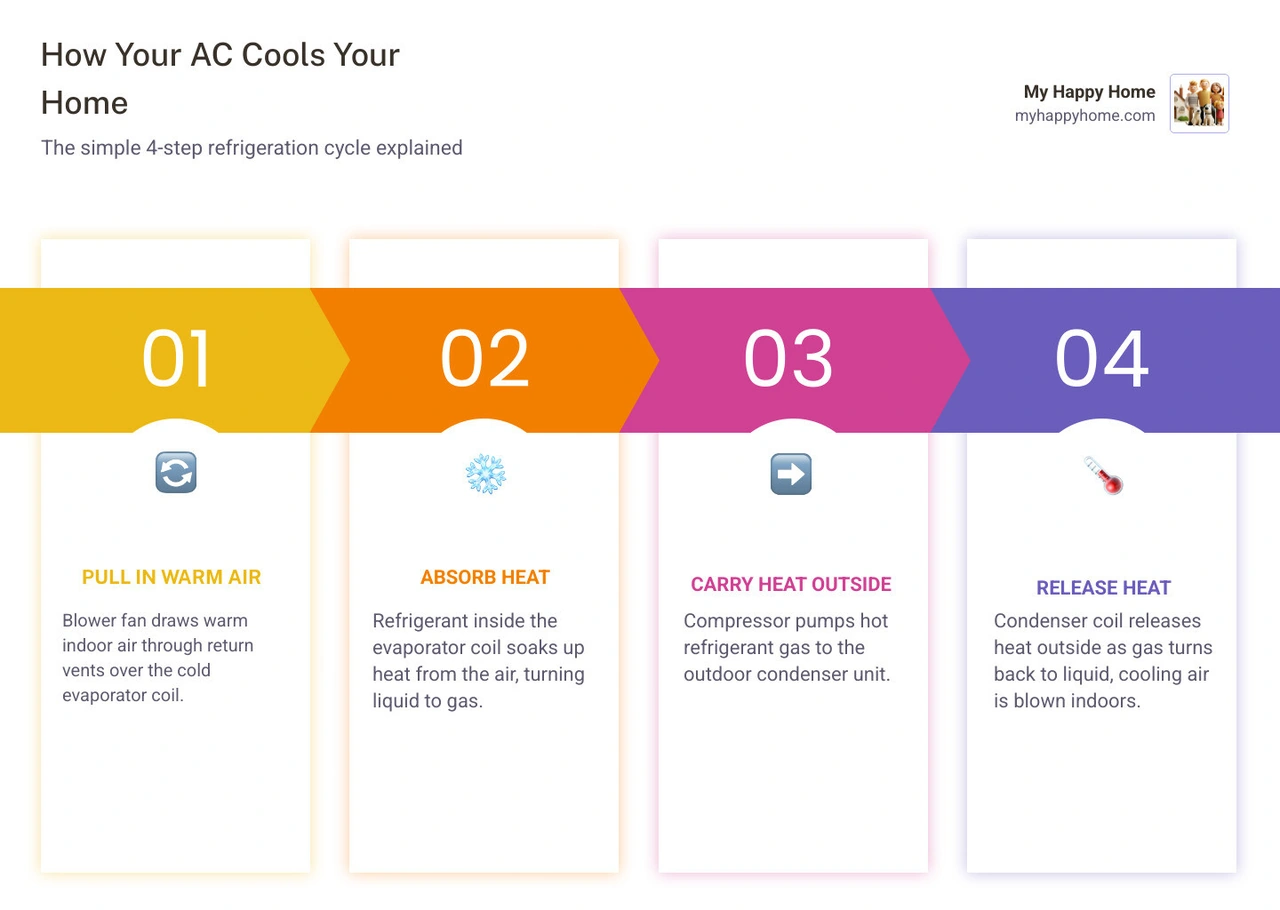
How your air conditioner works explained simply in 4 easy steps
- Absorption: The indoor blower fan pulls warm air over the cold evaporator coil. The refrigerant inside the coil absorbs the heat and turns into a warm gas.
- Compression: This gas travels to the outdoor unit, where the compressor squeezes it. Squeezing the gas makes it even hotter—much hotter than the outdoor air.
- Release: The hot gas passes through the condenser coil. Because the gas is hotter than the outside air, the heat naturally flows out of the coils and is blown away by the large outdoor fan.
- Cool Down: Now that the heat is gone, the refrigerant turns back into a liquid. It passes through an expansion valve that quickly cools it down before it heads back inside to start over.
The refrigeration cycle without the jargon
This whole process relies on a physical law: when a liquid converts to a gas (evaporation), it absorbs heat. When a gas converts back to a liquid (condensation), it releases heat. Your AC is essentially a "phase change" machine. By constantly switching the refrigerant between liquid and gas states, it can move massive amounts of heat out of your O'Fallon home very quickly.
Why refrigerant is so important
Refrigerant is the "blood" of your AC system. It is a specialized chemical—like R410A or the more modern R32—designed to have a very low boiling point. This allows it to turn into a gas even at relatively low temperatures, making it the perfect vehicle for carrying heat.
Because it is a sealed system, you should never "run out" of refrigerant. If your levels are low, it means there is a leak that needs to be addressed. Keeping this fluid contained and clean is vital for the efficiency and lifespan of your system.
The Parts of Your AC and How Indoor and Outdoor Units Work Together
A standard central air system is often called a "split system" because it is split between the inside and the outside of your home.
The indoor unit: where heat and humidity are removed
The indoor portion, usually located in a closet, attic, or basement, contains the evaporator coil and the blower fan. As the fan pulls air through your home’s return vents, it passes through an air filter to keep your system clean. The air then hits the cold evaporator coil. This is where the cooling happens.
As the air cools, moisture from the air clings to the coil—much like water beads up on a cold soda can on a humid day. This water drips into a drain pan and flows out through a condensate drain line. Regular AC Maintenance & Tune-Up ensures this drain doesn't clog and the coils stay clean enough to absorb heat efficiently.
The outdoor unit: where the heat gets dumped
The outdoor unit is the workhorse. It houses the compressor (the "heart" of the system) and the condenser coil. Its only job is to take the heat collected from your living room and dump it into the outdoor air. This is why the air blowing out of the top of your outdoor unit feels so hot—that is literally the heat from inside your house being evicted!
If your outdoor unit is struggling to breathe because of overgrown bushes or debris, it can't release heat properly. This leads to higher energy bills and potential breakdowns. If your system stops dumping heat, you may need to call for AC Repair Service.
How the thermostat tells the system when to run
The thermostat is the "brain" of the operation. It monitors the temperature in your home and compares it to your "set point." When the house gets too warm, it sends an electrical signal to the AC to start the cooling cycle.
Modern smart thermostats can even learn your habits to save energy. However, if your AC isn't turning on, the thermostat is often the first place to look. You can learn How to Check Your Thermostat Before Calling for AC Repair to save yourself time and stress.
Why Your AC Also Reduces Humidity and Why That Matters
In May 2026, as we look at modern home comfort, we realize that temperature is only half the battle. Humidity is what makes a 75-degree day feel "sticky" or "stuffy."
How condensation forms during cooling
As we mentioned, the evaporator coil is very cold. When warm, moist air from your home hits that coil, it can no longer hold all its moisture. That moisture turns into liquid water (condensation). This process effectively "dries" the air before it is sent back into your home.
How your air conditioner works explained simply when humidity drops
When the humidity drops, your sweat can evaporate off your skin more easily. This is your body's natural cooling method. By lowering the humidity, the AC makes you feel cooler even if the thermometer hasn't moved much. This also helps prevent mold growth and protects your home's wood furniture and flooring.
Does your AC bring in outside air or use water?
This is one of the most common myths. Most modern air conditioners do not bring in fresh air from the outside. They recirculate the air already in your home. They also do not use water to cool (unlike "swamp coolers" or evaporative coolers used in very dry climates). Your AC is a dry, closed-loop system that uses refrigerant to move heat.
Types of Air Conditioners and Basic Care Homeowners Should Know
Not every home uses the same cooling setup. Depending on your home's age and layout in O'Fallon, you might have one of several types.
- AC Type: Central Air; Best For: Whole homes with ducts; Pros: Consistent, hidden; Cons: Requires ductwork
- AC Type: Ductless Mini Split; Best For: Rooms without ducts, additions; Pros: Energy efficient, quiet; Cons: Visible indoor units
- AC Type: Window Unit; Best For: Single small rooms; Pros: Inexpensive; Cons: Noisy, blocks window
- AC Type: Heat Pump; Best For: Year-round heating/cooling; Pros: Very efficient; Cons: Higher initial setup
Which type of air conditioner is best for different homes?
If your home has existing ductwork, central air is usually the standard. However, the market for mini split systems is booming—projected to reach USD 2.4 billion by 2034—because they allow for "zoning." This means you can cool your home office to 68 degrees while keeping the guest room at 74.
For those looking for the ultimate in efficiency, heat pumps are a fantastic choice. They work exactly like an air conditioner in the summer but can reverse the cycle to provide heat in the winter. You can explore How Does a Heat Pump Work or see Is a Heat Pump Right for Your Home to learn more. If you're ready for an upgrade, we specialize in Heat Pump Installation & Replacement.
Simple maintenance that helps your AC work efficiently
A well-maintained air conditioner can last 15 to 20 years. To get that kind of longevity, you only need to follow a few simple steps:
- Change your filters: Do this every 1–3 months. A dirty filter chokes the system and forces it to work harder.
- Clear the outdoor unit: Keep a two-foot "buffer zone" around your condenser. Remove leaves, twigs, and tall grass.
- Keep vents open: Closing vents in unused rooms can actually increase pressure and cause leaks or coil freezing.
- Annual Tune-Ups: Professional inspections help catch small issues before they become expensive repairs. Check out our AC Tune-Up Guide: What to Expect and learn How Often Should You Schedule an AC Tune-Up.
Common myths about how air conditioners work
- Myth: Setting the thermostat to 60° cools the house faster.
- Fact: Your AC blows at the same "speed" regardless of the setting. It just runs longer to reach a lower temp.
- Myth: It's cheaper to leave the AC on all day.
- Fact: It is actually better to raise the temp 7–10 degrees when you're away. This reduces the total "work" the system does.
- Myth: Ice on the unit means it's cooling extra well.
- Fact: Ice is a sign of a problem, usually a dirty filter or low refrigerant. See Ice Forming on Your AC Unit: Causes and What to Do for help.
If your system is acting up, try these AC Troubleshooting Tips Before Calling a Pro. If the unit won't start at all, read AC Not Turning On: What to Check First or check your electrical panel if your AC Circuit Breaker Keeps Tripping. If it's running but not cooling, see Why Is My AC Blowing Warm Air.
Simple Answers to Common AC Questions
Does AC pull air from outside?
No. Your air conditioner recirculates the air already inside your home. It pulls air in through return vents, cools and filters it, and pushes it back out through supply vents. The only thing moving between the inside and outside is heat (carried by refrigerant) and condensation (carried by a drain line).
Why is water dripping from my AC?
Dripping is a normal part of the dehumidification process. The moisture pulled from your indoor air has to go somewhere. It should drip into a pan and travel down a drain line to the outside or a floor drain. If you see water leaking onto your floor or ceiling, that means the drain is clogged and needs attention.
How long can a well-maintained air conditioner last?
On average, an AC unit lasts between 10 and 20 years. In our experience, homeowners who schedule annual maintenance and change their filters regularly often see their systems last 15 to 20 years.
Conclusion: Understanding Your AC Makes Problems Easier to Spot
Now that you know how your air conditioner works explained simply, you are better equipped to keep your home comfortable and efficient. You know that your AC is a heat-moving machine, that refrigerant is its lifeblood, and that humidity control is just as important as temperature.
At My Happy Home, we believe homeownership shouldn't be stressful. That is why we offer comprehensive membership plans that cover your HVAC Services, plumbing, and electrical systems for one predictable monthly fee. Whether you need a quick AC Repair Service or a full AC Installation & Replacement, we are here to ensure your home remains a happy one.
Don't wait for a breakdown to think about your AC. Explore our membership plans today and give your family the peace of mind they deserve!