
Troubleshooting tips for when your AC turns into a heater

Is Your AC Blowing Warm Air? Here's What to Check First
If you're searching for why is my ac blowing warm air troubleshooting steps, here's a quick answer:
- Check your thermostat — Make sure it's set to "Cool" and "Auto," not "Fan On"
- Inspect your air filter — A clogged filter is one of the most common causes
- Check the circuit breaker — A tripped breaker can cut power to the outdoor unit
- Look at the outdoor condenser unit — Clear any debris and confirm the fan is running
- Check for frozen coils — Look for ice on the refrigerant lines near your indoor unit
- Listen for hissing or bubbling sounds — These can signal a refrigerant leak
- Call a professional — If basic checks don't fix it, a licensed technician should diagnose the rest
There's a special kind of frustration that hits when you walk into your home on a hot day expecting cool relief — and instead get a face full of warm air from your vents. You're not alone. This is one of the most common AC complaints homeowners face, especially during peak summer months.
The good news? Most of the time, the cause is something straightforward. In fact, roughly 90% of warm air issues trace back to the outdoor condenser unit — and many problems can be caught early with a few simple checks. Whether it's a dirty filter, a wrong thermostat setting, or something more serious like a refrigerant leak, knowing where to look can save you time, money, and a lot of discomfort.
This guide walks you through exactly what to check and what to do — step by step.
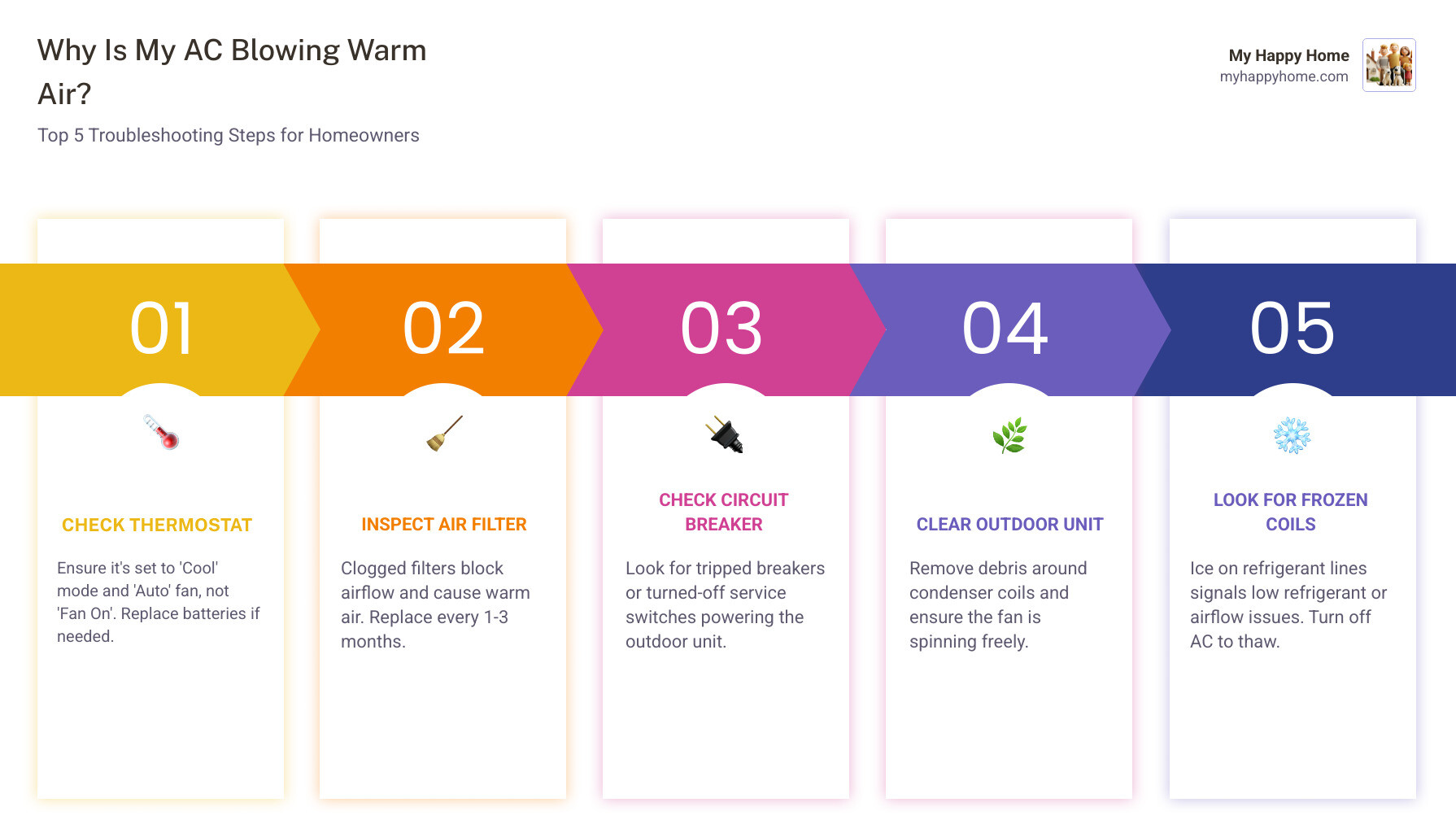
Why is my ac blowing warm air troubleshooting steps for homeowners
To understand why your air conditioner is acting more like a furnace, it helps to know how it’s supposed to work. An air conditioner doesn't actually "create" cold air; it removes heat from the air inside your home and moves it outside. This happens through a continuous cooling cycle involving a compressor, condenser coils, and evaporator coils.
When this cycle is interrupted—whether by a lack of airflow or a mechanical failure—the system continues to blow air, but that air remains at room temperature or even gets warmer as the blower motor generates its own heat.
One of the primary culprits in airflow restriction is a dirty air filter. When air can't pass through the filter, the system struggles to "breathe," which can lead to the evaporator coils freezing over. Additionally, we often see homeowners who have their thermostat set to "Fan On" instead of "Auto." In the "On" position, the fan blows 24/7, even when the cooling cycle isn't running. This means it’s just circulating uncooled air through your house. For consistent cooling, ensuring proper AC Maintenance Tune-up is essential to keep these basic components in check.
Why is my ac blowing warm air troubleshooting steps: Checking the Thermostat
It sounds simple, but the thermostat is the brain of your HVAC system, and sometimes it just needs a little attention. First, verify that the switch is actually set to "Cool." It’s surprisingly easy for a family member to accidentally bump it to "Heat" or "Off."
Next, check the temperature setting. It should be set at least five degrees below the current room temperature to trigger a cooling cycle. If your thermostat has a digital display that is blank or flickering, it may be time for a battery replacement. Most modern thermostats require AA or AAA batteries once a year. If you’re in a scorching climate and your settings are correct but the air is still lukewarm, you might need a professional AC Repair Service Phoenix AZ to look for a communication error between the thermostat and the control board.
Why is my ac blowing warm air troubleshooting steps: Inspecting the Air Filter
If you haven't changed your air filter in the last 90 days, there is a high probability this is your problem. A clogged filter blocks the return air that the system needs to function. Without enough air flowing over the evaporator coils, the refrigerant inside those coils gets too cold, causing moisture to turn into ice.
Once that ice builds up, it acts as an insulator, preventing the AC from cooling the air at all. We recommend checking your filters every month and replacing them every 1-3 months. This simple habit protects your evaporator coil and ensures your home stays comfortable. For residents in dusty or high-pollen areas, a regular AC Maintenance Tune-up Houston TX can help ensure your filtration system is optimized for local conditions.
Investigating the Outdoor Condenser Unit
When we look at why is my ac blowing warm air troubleshooting steps, we have to head outside. As mentioned earlier, about 90% of the time, the issue lies within your outdoor condenser unit. This unit is responsible for releasing the heat collected from inside your home into the outdoor air.
If the condenser is "choked" by debris, it cannot dissipate heat effectively. Think of it like trying to run a marathon while wearing a heavy winter coat—the system will overheat and stop cooling. If you notice the indoor fan is blowing but the outdoor unit isn't making any noise, or if the air coming out of the top of the outdoor unit is cool instead of hot, you likely have a condenser issue. If you're seeing these signs, it's time to call for AC Repair Service Houston TX.
Power Supply and Circuit Breakers
The outdoor unit and the indoor unit usually run on separate circuits. This means your indoor blower might be spinning happily while the outdoor compressor—the part that actually does the cooling—is sitting powerless.
Check your home’s main electrical panel for a tripped breaker. Look for a switch that is in the "middle" position or flipped the opposite way of the others. Flip it all the way to "Off" and then back to "On." Also, check the service switch (a small metal box) located on the wall near your outdoor unit. Ensure the "pull-out" fuse or toggle switch is in the "On" position. If your breaker trips again immediately after resetting it, do not try a third time; this indicates a serious electrical short that requires a professional AC Repair Service.
Cleaning the Condenser Coils
Over time, the metal fins on your outdoor unit get coated in dirt, grass clippings, and spider webs. This buildup acts as a blanket, trapping heat inside the system. To clean it, first turn off the power at the thermostat and the outdoor disconnect switch.
Use a garden hose with a gentle spray—never a power washer, which can flatten the delicate metal fins—and rinse the coils from the top down. Also, ensure there is at least two feet of clear space around the unit. Trim back any bushes or tall grass that might be blocking airflow. Keeping this area clear is a key part of any AC Maintenance Tune-up Charlotte NC, especially during the spring growing season.
Identifying Mechanical and Electrical Failures
If the simple fixes don't work, we have to look deeper into the mechanical heart of the machine. One of the most telling signs of a serious problem is the presence of ice. If you see ice on the copper lines leading into your house or on the indoor unit itself, you likely have frozen evaporator coils.
This is usually caused by either a severe airflow restriction or a refrigerant leak. Since refrigerant is a chemical that must stay in a closed loop, any loss of it means there is a hole or a crack in your lines. Signs of a leak include hissing or bubbling noises and air that feels lukewarm rather than cold. Because handling refrigerant requires EPA certification, you must call a professional AC Repair Service to handle any leaks.
Compressor and Capacitor Issues
The compressor is often called the "heart" of the AC. Its job is to pump refrigerant through the system. If you hear a loud clicking or chattering sound when the unit tries to start, or if you hear a humming noise but the fan isn't spinning, you might have a failed capacitor or a failing compressor motor.
A capacitor is like a large battery that gives the motor the "kick" it needs to start. These often fail during extreme heatwaves when the system is working its hardest. While a capacitor is a relatively common repair, a failed compressor is a major mechanical failure. In some cases, especially with older units, it may be more cost-effective to look into AC Installation Replacement rather than replacing the compressor itself.
Clogged Drain Lines and Float Switches
Your AC doesn't just cool the air; it removes humidity. That moisture turns into water (condensate) that drips into a pan and out a drain line. If this line gets clogged with algae or debris, the water backs up.
Most modern systems have a "float switch" or moisture sensor. When the water level gets too high, this switch triggers an emergency shutdown to prevent water damage to your home. If your system suddenly stops running and won't turn back on, check the drain pan. If it’s full of water, you’ve found your culprit. Regular cleaning of these lines is a standard part of an AC Maintenance Tune-up Philadelphia PA.
Frequently Asked Questions About AC Troubleshooting
- Symptom: Warm Air / Good Airflow; Potential Cause: Thermostat set to "Fan On"; Fix Level: DIY (Change to Auto)
- Symptom: Warm Air / Good Airflow; Potential Cause: Dirty Condenser Coils; Fix Level: DIY (Clean with hose)
- Symptom: Warm Air / Weak Airflow; Potential Cause: Clogged Air Filter; Fix Level: DIY (Replace filter)
- Symptom: No Airflow / System Dead; Potential Cause: Tripped Breaker; Fix Level: DIY (Reset once)
- Symptom: Warm Air / Hissing Sound; Potential Cause: Refrigerant Leak; Fix Level: Professional Required
- Symptom: Warm Air / Ice on Lines; Potential Cause: Low Refrigerant or Clog; Fix Level: Professional Required
Should I turn off my AC if it is blowing warm air?
Yes, absolutely. If your AC is blowing warm air, continuing to run it can cause catastrophic damage. For example, if the coils are frozen, the liquid refrigerant could "slug" back into the compressor and destroy it. If the unit is overheating due to a clog, the internal components could melt or short out.
Turn the system off at the thermostat and allow it to sit for at least 24 hours to thaw if you suspect ice. During this time, you can check your filters and clean the outdoor unit. Having an Air Conditioning Protection Plan can give you peace of mind during these downtime periods, ensuring that help is on the way without a massive surprise bill.
How do I know if my AC refrigerant is low?
Refrigerant doesn't get "used up" like gasoline in a car. If it's low, you have a leak. Common signs include:
- Air coming from the vents is lukewarm.
- The system runs constantly but the house never gets cool.
- You hear a hissing or whistling sound near the indoor or outdoor unit.
- Ice forms on the refrigerant lines or the evaporator coil.
If you suspect a leak, turn the unit off immediately and call an AC Repair Service. Adding more refrigerant without fixing the leak is a temporary fix that wastes money and harms the environment.
How often should I schedule professional AC tune-ups?
You should schedule a professional tune-up once a year, ideally in the spring before the heavy cooling season begins in April. These visits allow technicians to catch small issues—like a bulging capacitor or a slightly clogged drain line—before they turn into a mid-summer emergency.
Regular maintenance can extend the life of your system by several years and keep your energy bills lower by ensuring the system runs at peak efficiency. Residents in high-demand areas can benefit from a scheduled AC Maintenance Tune-up Los Angeles CA to ensure their system is ready for the intense West Coast heat.
Conclusion
Dealing with an AC that blows warm air is never fun, but by following these why is my ac blowing warm air troubleshooting steps, you can often identify the problem before it becomes a crisis. From checking your thermostat and air filters to clearing debris from your outdoor unit, many fixes are right at your fingertips.
However, homeownership shouldn't feel like a second job. That’s where My Happy Home comes in. Our comprehensive membership plans are designed to take the stress out of home maintenance. With one affordable monthly payment, you get coverage for your HVAC, plumbing, electrical, and major appliances. No more hunting for "vetted" technicians or worrying about the cost of a surprise repair—we handle the logistics and the labor.
Whether you need a seasonal tune-up or an emergency repair, our 24/7 support is here to ensure your home remains the comfortable sanctuary it's meant to be. Explore our comprehensive AC Repair Service and join the My Happy Home family today for total peace of mind.