
AC dehumidification: how your unit fights the frizz
Why Humidity Matters More Than Most Homeowners Realize
How your AC handles humidity in your home is just as important as how it cools the air — and most homeowners don't realize the two are connected until something feels wrong. You've probably noticed it: the AC is running, the temperature reads fine, but the air still feels thick, sticky, and uncomfortable. That's humidity at work.
Here's the short answer to how your AC removes humidity:
- Warm, humid air from inside your home is pulled across the AC's cold evaporator coil
- Water vapor in that air condenses on the coil — just like moisture forms on a cold glass on a hot day
- Those water droplets fall into a drain pan and exit through the condensate drain line
- The drier, cooler air is then sent back into your home
- This process brings indoor relative humidity down into the comfortable 40–60% range
This moisture removal is a natural side effect of the cooling process, not a dedicated feature. That distinction matters — because it means your AC has real limits when humidity levels climb too high.
At 80°F with 80% humidity, it can feel like 86°F inside your home. At the same temperature with 40% humidity, it feels exactly like 80°F. That difference is what separates a comfortable home from a miserable one — and your AC is the first line of defense.
Humidity that climbs above 60% doesn't just feel bad. It creates conditions where mold grows, wood warps, allergies worsen, and your AC works harder than it should. For busy families trying to keep a home comfortable and healthy, understanding how your system manages moisture is one of the most practical things you can know.
I'm Matthew Palmieri, founder of My Happy Home, and my background in HVAC systems and home services has given me a front-row seat to how how your AC handles humidity in your home directly shapes everyday family comfort. In this guide, I'll walk you through exactly how the process works, where it breaks down, and what you can do about it.
How Your AC Handles Humidity in Your Home
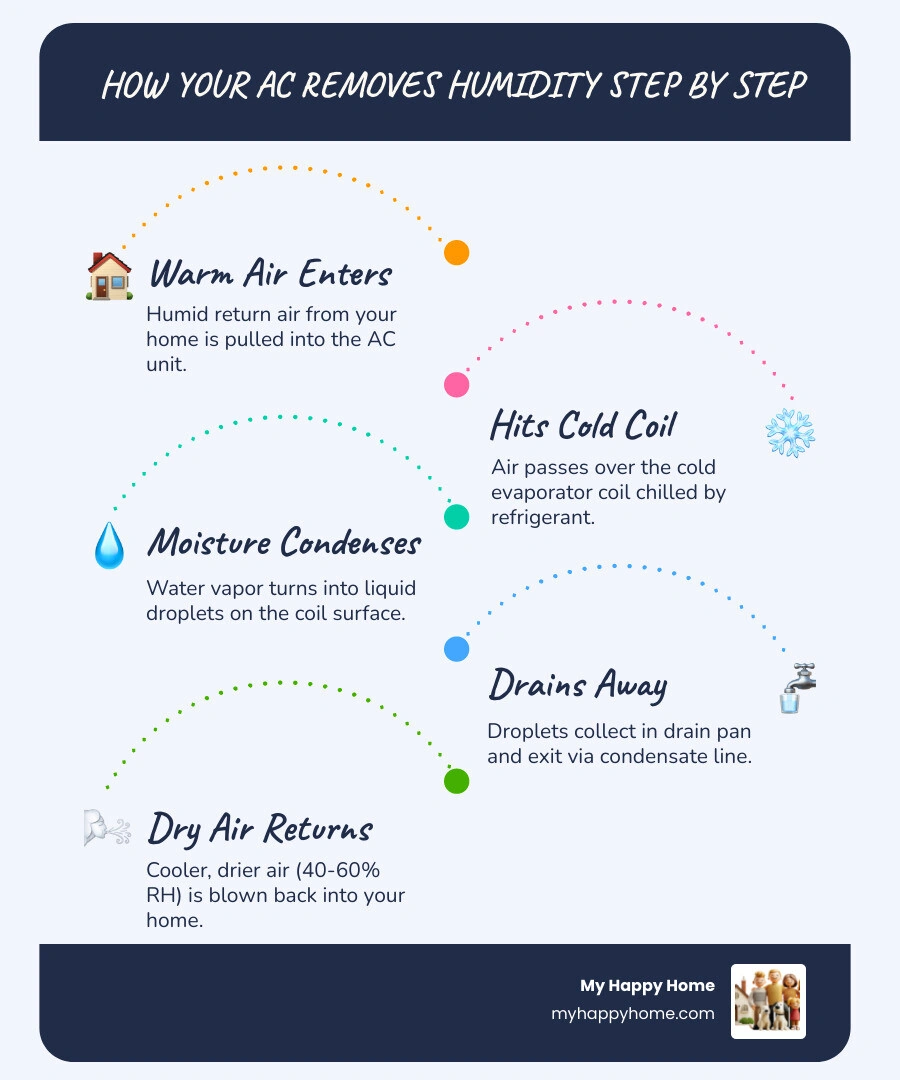
Your air conditioner removes humidity during the same cycle it uses to cool your home. As return air moves through the system, it passes over the evaporator coil, which is kept cold by refrigerant. When warm indoor air hits that cold coil, two things happen:
- Sensible heat is removed, which lowers air temperature
- Latent heat is removed, which pulls moisture out of the air
That moisture turns into liquid water on the coil, drips into the drain pan, and leaves through the condensate line. The air that comes back through your vents is not just cooler. It is also drier.
In many homes, a standard central AC can keep indoor humidity in the 40% to 60% range. For best comfort, many homeowners feel best around 45% to 55% relative humidity.
How your ac handles humidity in your home during a normal cooling cycle
A normal cooling cycle looks like this:
- Warm air from your rooms is pulled into return vents.
- That air passes over the cold evaporator coil.
- Water vapor condenses into droplets on the coil surface.
- Droplets collect in the drain pan.
- The condensate drain carries that water away.
- The blower sends cooler, drier supply air back into the home.
It is the same basic science as a cold drink sweating on a summer day. The difference is your AC is doing it on purpose, over and over, to improve comfort.
For this process to work well, the system needs enough run time. If the unit shuts off too quickly, it may lower the temperature before it removes much moisture.
How your ac handles humidity in your home affects comfort, not just temperature
Humidity changes how temperature feels on your skin. Your body cools itself by evaporating sweat. When indoor air is too humid, sweat does not evaporate as easily, so you feel warmer and stickier even if the thermostat says the house is cool.
That is why humidity can make 80 degrees feel very different:
- 80 degrees with 80% humidity can feel like 86 degrees
- 80 degrees with 40% humidity feels much closer to the actual temperature
So if your home feels clammy, the issue may not be temperature at all. It may be moisture.
What indoor humidity range feels best for comfort and health
The general healthy range indoors is 30% to 60% relative humidity. For most households, the sweet spot is about 45% to 55%.
A good seasonal guide is:
- Summer: 40% to 50%
- Winter: often a bit lower, commonly 25% to 40%
- Year-round general target: 30% to 60%
- Avoid below 30% because air can feel overly dry
- Avoid above 60% because mold, musty odors, and discomfort become more likely
When humidity drops too low, you may notice dry skin, chapped lips, itchy eyes, or static electricity. When it rises too high, comfort and indoor air quality go downhill fast.
Signs Your House Is Too Humid Even When the AC Is Running
If your AC is on but your home still feels swampy, your system may not be removing enough moisture.
Common signs of excessive indoor humidity include:
- Condensation on windows or mirrors
- A musty smell, especially in closets, bathrooms, or basements
- Visible mildew or mold spots
- Damp or sticky-feeling air
- Warped wood or swelling doors
- Peeling paint or bubbling finishes
- More allergy symptoms from mold or dust mites
- Rooms that feel cool but uncomfortable
Why your AC may be cooling but not reducing humidity effectively
This is one of the most common homeowner complaints: "The house is cool, but it still feels humid."
Usually, one of these problems is behind it:
- The AC is oversized and short-cycles
- The thermostat fan is set to ON instead of AUTO
- The filter is dirty and airflow is off
- The evaporator coil is dirty
- Duct leaks are pulling in humid outdoor air
- Refrigerant levels or system operation are off
- The equipment is older and less effective at moisture removal
If this sounds familiar, it may be time for AC Repair Service.
When a standard AC is enough and when it is not
A standard AC is often enough when:
- Outdoor humidity is moderate
- The system is properly sized
- Filters, coils, and drains are clean
- The home is reasonably well sealed
A standard AC may not be enough when:
- Indoor humidity stays above 60%
- You have a very humid basement
- The home has major air leaks or duct leaks
- Bathroom and kitchen ventilation are poor
- The system is oversized or aging
- Outdoor moisture loads are consistently high
Here is the simple comparison:
- System: Standard AC; What it does well: Cools and removes some moisture during normal cooling; Limits: Humidity control is secondary, not its main job
- System: Whole-house dehumidifier; What it does well: Removes moisture directly and consistently; Limits: Usually added when AC alone cannot keep RH in range
If humidity regularly stays high, a whole-house dehumidifier can support your AC without overcooling the house.
The Main Reasons an AC Fails to Dehumidify Properly
When an AC struggles with humidity, the cause is usually not mysterious. It is usually one of a handful of system or setup issues.
The most common reasons include:
- Oversized equipment
- Airflow that is too high
- Dirty filters or dirty coils
- A clogged condensate drain
- Leaky ductwork
- Incorrect thermostat or fan settings
- Single-speed blower limitations
- Aging equipment
For persistent issues, our AC Repair Service team can inspect system performance and moisture control problems.
Why an oversized AC removes less moisture
Bigger is not always better in air conditioning.
An oversized unit cools your home too fast. That might sound nice, but it creates short run times. Since dehumidification works best after the coil gets cold and stays cold, fast on-off cycles mean less moisture removal.
So the house reaches the thermostat setting quickly, but the air still feels muggy. That is classic short-cycling behavior.
How airflow, fan speed, and thermostat settings change humidity control
Humidity removal depends heavily on airflow.
A common target for better dehumidification is about 350 CFM per ton of cooling. Higher airflow, such as 400 CFM per ton, can reduce dehumidification because the air moves too quickly across the coil.
Fan settings matter too:
- AUTO is usually best
- ON can make humidity worse
Why? When the fan is set to ON, the blower keeps moving air even after the cooling cycle ends. Some of the moisture sitting on the coil can re-evaporate and get blown back into your home. That is the HVAC version of taking one step forward and one damp step back.
A steady thermostat setting also helps. Large temperature swings and constant manual adjustments can interrupt the longer cycles that help remove moisture.
If you suspect your controls are part of the problem, see How to Check Your Thermostat Before Calling for AC Repair.
Maintenance issues that quietly reduce dehumidification
A lot of humidity problems come down to maintenance.
Watch for these issues:
- Clogged air filters restricting airflow
- Dirt buildup on the evaporator coil
- A blocked condensate drain line
- Low refrigerant or performance issues
- Duct leaks letting humid air in
- Deferred tune-ups
Routine service helps your system remove moisture the way it should. Learn more about AC Maintenance Tune-Up and AC Tune-Up Guide What to Expect.
How to Optimize Your Existing AC for Better Humidity Control
If your system is basically working but your home still feels sticky, there are several ways to improve performance without jumping straight to replacement.
Start with the basics:
- Measure indoor humidity with a hygrometer
- Keep RH in the 40% to 50% range during summer if possible
- Set the thermostat fan to AUTO
- Avoid frequent thermostat changes
- Replace dirty filters on schedule
- Use bathroom and kitchen exhaust fans
- Seal obvious air leaks and have ducts checked
- Schedule regular maintenance
Best thermostat and fan settings for lower indoor humidity
For most homes, the best setup is simple:
- Use AUTO fan mode, not ON
- Hold a steady temperature
- If available, use a thermostat with humidity display or humidity control features
- Let the system run normal cooling cycles instead of constantly adjusting settings
Smart thermostats and variable-speed systems can do a better job fine-tuning comfort, especially in humid weather, because they can support longer, lower-output operation.
Maintenance habits that help your AC remove moisture efficiently
Good humidity control starts with boring maintenance. Convenient? Not always. Effective? Absolutely.
Helpful habits include:
- Change filters every 2 to 3 months, or more often with pets or allergies
- Keep the evaporator coil clean
- Make sure the condensate drain line is clear
- Schedule annual professional service
- Check the system before peak summer weather
These resources can help you stay ahead of problems:
When to consider a whole-house dehumidifier or AC replacement
It may be time to consider extra equipment or a system upgrade if:
- Indoor humidity stays above 60% for long periods
- Your basement always feels damp
- The AC is cooling but never quite drying the house
- Your system is older and struggling
- You have an oversized unit
- You want better humidity control from a variable-speed system
A whole-house dehumidifier is often the right add-on when the AC can cool the house but cannot keep moisture levels in check. If the root problem is poor sizing or aging equipment, AC Installation Replacement may make more sense. You can also explore broader HVAC solutions.
Benefits of Proper Humidity Control for Comfort, Health, and System Performance
Good humidity control does more than make the house feel better.
It can help with:
- Better sleep and fewer sticky nights
- Less mold and mildew growth
- Improved comfort at higher thermostat settings
- Relief from some allergy triggers
- Protection for wood floors, trim, and furniture
- Less condensation around windows
- Better indoor air quality
- Reduced strain on HVAC equipment
When humidity is balanced, many homeowners can set the thermostat a bit higher and still feel comfortable. That can support energy savings while reducing the "cold but clammy" problem.
Why balanced humidity can lower strain on your AC
When indoor air is drier, your home feels cooler at the same temperature. That means your AC does not have to fight both heat and heavy moisture as aggressively.
Balanced humidity can contribute to:
- More comfortable indoor conditions
- Fewer long, frustrating comfort complaints
- Lower system strain
- Better efficiency
- Less wear from poor cycling behavior
Over time, that can mean fewer breakdown surprises and more reliable comfort.
For ongoing protection, homeowners may also want to look at the Air Conditioning Protection Plan or HVAC Protection Plan.
When to call for professional help with humidity problems
Call for help if you notice:
- Persistent clammy air even with the AC running
- Indoor humidity readings above 60%
- Musty odors that do not go away
- Visible mold or mildew
- Short-cycling
- Water leaks around the air handler
- Ice on the system
- Rising energy use with poor comfort
If you want to rule out simple issues first, start here:
- AC Troubleshooting Tips Before Calling a Pro
- Ice Forming on Your AC Unit Causes and What to Do
- Why Is My AC Blowing Warm Air Troubleshooting Steps
- AC Not Turning On What to Check First
- AC Circuit Breaker Keeps Tripping What It Means
Conclusion: Keep Indoor Humidity in the Comfort Zone Year-Round
Once you understand how your AC handles humidity in your home, a lot of comfort problems make more sense. Your AC does remove moisture, but only as part of the cooling process. That means proper sizing, clean components, correct fan settings, and regular maintenance all matter if you want your home to feel cool and dry instead of cool and sticky.
A good target for most homes is about 45% to 55% relative humidity, with summer indoor levels ideally around 40% to 50%. If your home keeps drifting above 60%, your system may need service, adjustments, or extra dehumidification support.
The good news: humidity problems are usually fixable. With proactive care and the right setup, you can improve comfort, protect your home, and help your AC work more efficiently.
If you want help keeping your system ready for the humid season, schedule an AC Maintenance Tune-Up.