
How to calculate the ROI of an AC replacement

Is AC Replacement Actually Worth the Money? Here's What Homeowners Need to Know
Understanding the ac replacement return on investment is one of the smartest financial moves a homeowner can make before committing to a major upgrade. A new system doesn't just cool your home — it can meaningfully increase your home's resale value, cut monthly energy bills, and remove a major red flag for buyers during home inspections.
Quick Answer: What Is the ROI of AC Replacement?
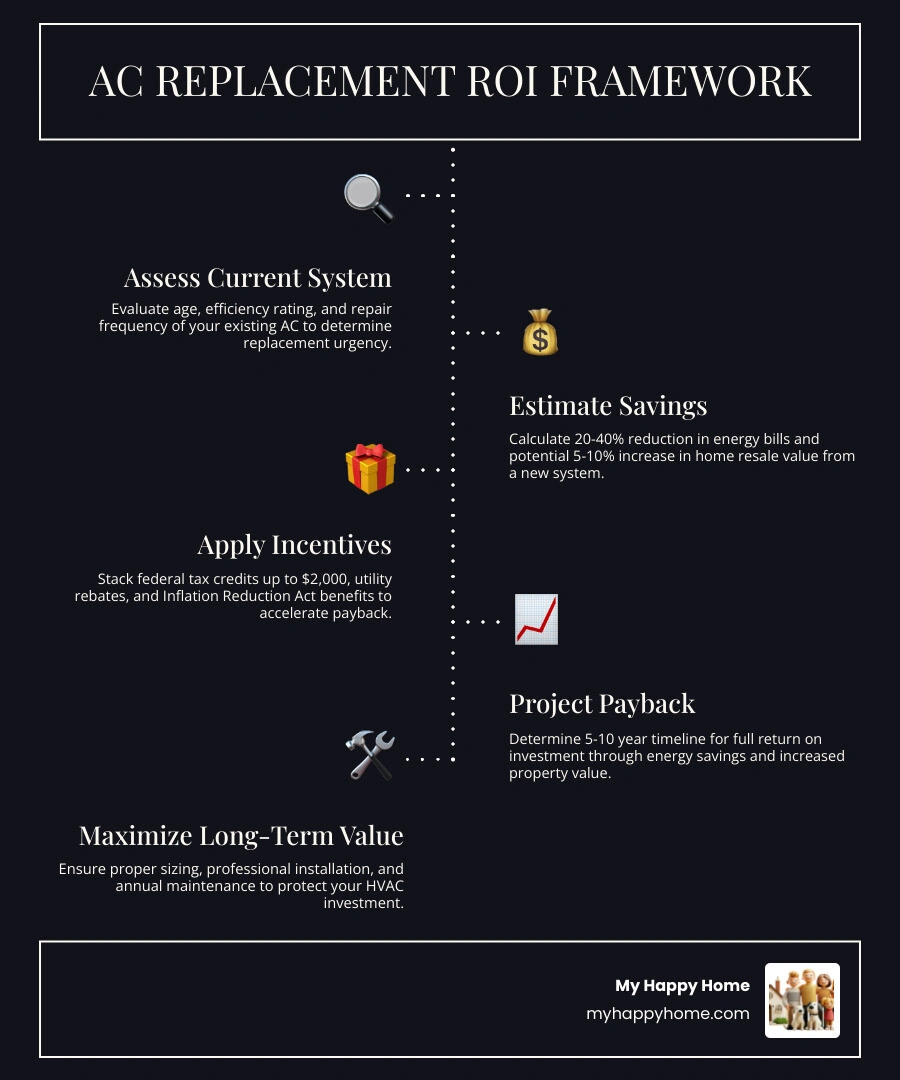
- Factor: Home value increase; What to Expect: 5% to 10% added resale value
- Factor: Energy bill reduction; What to Expect: 20% to 40% lower cooling and heating costs
- Factor: Typical payback period; What to Expect: 5 to 10 years (faster with rebates)
- Factor: ROI on full HVAC replacement; What to Expect: often significant — and can be higher for heat pumps in the right climate
- Factor: Federal incentives; What to Expect: Up to $2,000 in tax credits for qualifying systems
For most homeowners in May 2026, replacing an aging AC system is not just a comfort decision — it's a financial one. Real estate professionals consistently report that buyers subtract the estimated replacement cost from their offers when they see an older unit. A proactive upgrade puts that negotiating power back in your hands.
I'm Matthew Palmieri, founder of My Happy Home, and with a background spanning HVAC replacement, contractor operations, and home protection plans, I've spent my career helping homeowners understand exactly how to evaluate the ac replacement return on investment before making a major decision. In the sections below, I'll walk you through a clear, step-by-step framework so you can calculate your own numbers with confidence.
How a New System Impacts Home Appraisal and Resale Value

When we talk about the ac replacement return on investment, the most immediate "gain" often comes from the equity in your home. In the competitive May 2026 real estate market, a modern cooling system is no longer just a luxury; it is a fundamental expectation.
Real estate experts estimate that a new HVAC system can increase a home's value by 5% to 10%. For a mid-range home, this can translate to thousands of dollars added to the final sale price. From an appraiser's perspective, a new system represents a significant reduction in "capital expenditure" for the future owner. Instead of worrying about a massive repair bill three months after moving in, the buyer sees a home that is "turn-key" ready.
Furthermore, a new system removes significant buyer negotiation leverage. If your AC is 15 years old, a savvy buyer will likely ask for a price reduction during the inspection phase to cover the "deferred maintenance." By handling the AC Installation & Replacement before you list, you retain control over the transaction and often see your home sell much faster than properties with outdated equipment.
Calculating Your AC Replacement Return on Investment
To find your true ROI, we need to look at the "hard math" of energy consumption. Modern systems are significantly more efficient than those manufactured just a decade ago.
- System Age: 15 Years Old; Efficiency Rating (SEER/SEER2): 10 - 12 SEER; Estimated Annual Cooling Cost: High
- System Age: 10 Years Old; Efficiency Rating (SEER/SEER2): 13 - 14 SEER; Estimated Annual Cooling Cost: Moderate
- System Age: 2026 Standard; Efficiency Rating (SEER/SEER2): 16 - 18 SEER2; Estimated Annual Cooling Cost: Low (20-40% Savings)
- System Age: 2026 High-Efficiency; Efficiency Rating (SEER/SEER2): 20+ SEER2; Estimated Annual Cooling Cost: Ultra-Low (Up to 50% Savings)
We often see homeowners achieve a 20% to 40% drop in their cooling and heating costs immediately after an upgrade. When you factor in these monthly savings alongside the increased home value, the payback period—the time it takes for the savings to "pay back" the initial investment—typically falls between 5 and 10 years.
However, the ROI isn't just about the machine itself. The integrity of your "building envelope"—your insulation and ductwork—plays a huge role. A high-efficiency unit paired with a Air Conditioning Protection Plan ensures that your investment continues to perform at its peak for its entire 15- to 20-year lifespan, maximizing your cumulative return.
Efficiency Ratings and Long-Term Financial Performance
Navigating the alphabet soup of efficiency ratings is key to understanding your long-term financial performance. In 2026, the industry has fully transitioned to SEER2 standards, which provide a more accurate representation of how a system performs under real-world conditions.
Higher ratings generally mean lower operating costs. For example, upgrading from an 80% AFUE furnace to a 96% model can cut heating bills by 16% to 20%. Similarly, modern heat pumps are surging in popularity because they transfer heat rather than generating it, offering an average ROI of 65% to 75% when replacing older, less efficient systems. You can learn more about these specific advantages in our guide on Heat Pump Benefits for Homeowners.
Understanding SEER2 and HSPF for ac replacement return on investment
- SEER2 (Seasonal Energy Efficiency Ratio 2): This measures cooling efficiency. The higher the number, the less electricity the unit uses to cool your home. In O'Fallon, MO, where summers can be humid and hot, a higher SEER2 rating pays off much faster than in milder climates.
- HSPF2 (Heating Seasonal Performance Factor 2): If you are installing a heat pump, this rating tells you how efficiently it heats.
- Variable-Speed Technology: Unlike older "on or off" systems, variable-speed compressors adjust their speed to match your home's needs exactly. This precision reduces wattage and improves humidity control, which is vital for both comfort and protecting your home's interior.
Maximizing the ac replacement return on investment with rebates
To truly "supercharge" your ROI, you must look at available incentives. As of May 2026, many federal tax credits from the Inflation Reduction Act remain a powerful tool for homeowners. Qualifying high-efficiency central AC units and heat pumps can earn you up to $2,000 in tax credits.
When you "stack" these federal credits with local utility rebates—which often range from $100 to $1,500—your net cost drops significantly. This can shorten a 10-year payback period to just 6 or 7 years.
Strategic Factors: When Replacement Outperforms Repair

One of the most common questions we hear is: "Should I just fix it one more time?" At My Happy Home, we recommend the 50% Rule. If a single repair costs more than 50% of the price of a new system, replacement is almost always the better financial move.
Other factors that tilt the scales toward replacement include:
- System Age: If your unit is over 12–15 years old, it is likely nearing the end of its functional life.
- Outdated Refrigerants: Systems using obsolete refrigerants are becoming incredibly expensive to service. Transitioning to 2026-standard refrigerants protects you from future "recharge" price shocks.
- Frequent Breakdowns: If you've had more than two significant repairs in the last two years, you're likely "throwing good money after bad."
Regular maintenance can delay this day, which is why understanding How a Tune-Up Improves Efficiency and Lowers Bills is so important. If you aren't sure where your system stands, checking out an AC Tune-Up Guide: What to Expect can help you evaluate its current health.
Common Mistakes to Avoid When Upgrading
To protect your ac replacement return on investment, you must avoid several common pitfalls that can "drain" your potential savings:
- Improper System Sizing: Many homeowners (and some contractors) assume "bigger is better." This is a mistake. An oversized unit will cycle on and off too frequently, wearing out the parts and failing to dehumidify the air. Always insist on a Manual J load calculation to ensure the system is perfectly sized for your home's square footage and insulation levels.
- Ignoring Ductwork: Even the most efficient AC in the world will have a poor ROI if 30% of the cold air is leaking into your attic. Ensuring your ducts are sealed and insulated is a critical part of the installation process.
- Skipping Professional Installation: A "budget" installation often leads to voided warranties and premature system failure. The quality of the install is just as important as the brand of the box.
- Overlooking Maintenance: Once the new system is in, the ROI depends on keeping it running efficiently. We recommend asking yourself: How Often Should You Schedule an AC Tune-Up? (Hint: At least once a year!).
Frequently Asked Questions About AC ROI
Does replacing an AC system increase home value?
Yes. Real estate experts in May 2026 confirm that a modern system typically adds 5-10% to a home's resale value. Beyond the dollar amount, it increases marketability by reducing future liability for buyers, often leading to faster sales and fewer inspection headaches.
What is the typical payback period for a high-efficiency AC?
Depending on local utility rates in areas like O'Fallon, MO, and the specific efficiency tier you choose, most homeowners see a full return through energy savings and incentives within 5 to 10 years. If you plan to stay in your home for more than five years, high-efficiency models almost always pay for themselves.
How do modern refrigerants affect the ROI of a new system?
Upgrading to current 2026 refrigerant standards (like R-454B) prevents the high costs associated with recharging obsolete systems. Older refrigerants are being phased out, making them scarce and expensive. A new system uses modern, environmentally friendly refrigerants that are cheaper to maintain over the long run.
Conclusion
Calculating the ac replacement return on investment doesn't have to be a headache. By looking at the combination of home value appreciation, monthly energy savings, and available tax incentives, it becomes clear that a proactive replacement is one of the most stable investments you can make in your property.
At My Happy Home, we believe homeownership should be about comfort, not stress. Our membership plans are designed to give you predictable maintenance and 24/7 peace of mind. We vet every professional in our network to ensure your AC Installation & Replacement is handled with the expertise you deserve. With our Happy Home Promise, you can invest in your home's future with total confidence.
Explore our AC Installation & Replacement plans today and take the first step toward a more efficient, more valuable home.