
An essential guide to how small problems become expensive emergencies
Why Small Problems Become Expensive Emergencies Without Maintenance
How small problems become expensive emergencies without maintenance is one of the most important things every homeowner needs to understand — because it happens quietly, predictably, and almost always at the worst possible time.
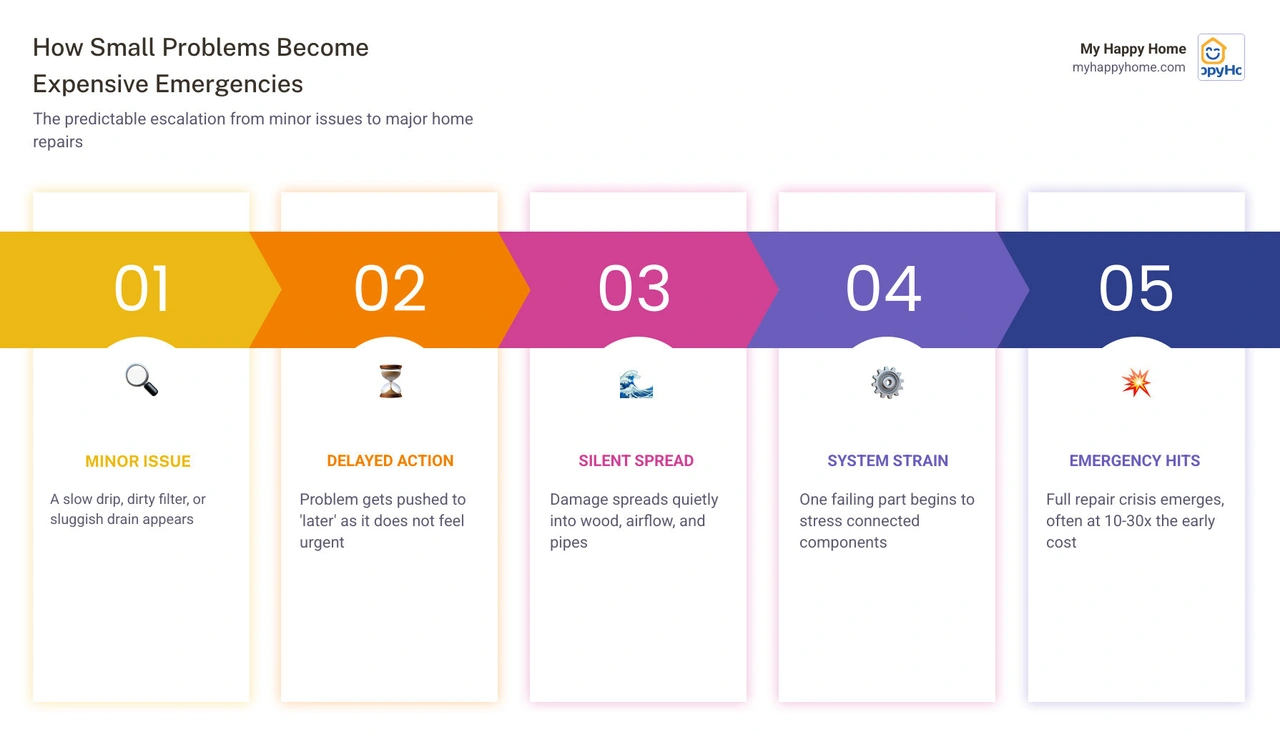
Here is a quick breakdown of how it works:
- A minor issue appears — a slow drip, a dirty filter, a small roof stain, or a slightly sluggish drain.
- It gets pushed to "later" — it does not feel urgent, so it waits.
- Damage spreads silently — water seeps into wood, filters restrict airflow, sediment builds in pipes.
- A connected system is affected — one failing part stresses the next.
- The emergency hits — usually at the worst time, and at a fraction of the cost it would have taken to fix early.
Research consistently shows that for every dollar skipped on proactive maintenance, homeowners can expect to pay roughly four dollars in reactive repairs. In many cases, the cost multiplier is far higher. A minor plumbing issue left unaddressed can go from a small fix to thousands of dollars in water damage and mold remediation. A skipped HVAC tune-up can turn a simple filter change into a full system replacement. The math is not complicated — but acting on it before something breaks is where most homeowners struggle.
The reason is understandable. Life is busy. Small problems rarely demand attention. They do not make noise, they do not stop you from going about your day, and they are easy to justify putting off. As one industry insight puts it: "It's not urgent. I'll fix it later." That phrase, repeated enough times across enough home systems, is how a manageable maintenance list becomes a financial emergency.
This guide is here to change that pattern.
I'm Matthew Palmieri, founder of My Happy Home, and with a background spanning HVAC, plumbing, smart home technology, and contractor operations, I have spent my career studying exactly how small problems become expensive emergencies without maintenance — and building systems to help homeowners get ahead of them. If you are ready to move from reactive stress to proactive peace of mind, this guide will show you how.
The Cost Multiplier: How Small Problems Become Expensive Emergencies Without Maintenance
When we delay home upkeep, we are not actually saving money. Instead, we are taking out a high-interest loan against our future selves. In the home service industry, this is known as compounding deferred maintenance.
The financial impact of delaying repairs follows a predictable, compounding curve. When a small mechanical or structural problem is ignored, the eventual repair bill does not just increase linearly—it multiplies. Industry data shows that early repairs typically require a fraction of the financial investment of delayed fixes. For instance, a minor, unaddressed issue frequently carries a 10-to-30 times cost multiplier once it escalates into a full-scale emergency.
This escalation is driven by how interconnected our homes are. A single failing component rarely suffers in isolation. Instead, it places additional physical stress on adjacent parts, triggering what we call the "emergency fund death spiral." This cycle begins when one neglected issue causes a sudden, expensive system failure. This unexpected emergency drains your home repair reserves, forcing you to defer maintenance on other critical systems to balance your budget. Before long, those newly deferred systems fail as well, creating a continuous loop of costly, reactive crises.
By shifting from a reactive mindset to a proactive one, you break this cycle entirely. Our guide on How Regular Maintenance Prevents Costly Home Repairs outlines how consistent, small interventions protect your budget.
To help visualize this trade-off, consider how preventive care stacks up against reactive crisis management:
- Maintenance Approach: Preventive Maintenance; Financial Predictability: High; scheduled, predictable, and budget-friendly; Lifespan of Home Systems: Maximized; systems run efficiently for their full engineered life; Secondary Damage Risk: Extremely low; issues are caught before they spread; Stress & Disruption: Low; scheduled at your convenience
- Maintenance Approach: Reactive Repairs; Financial Predictability: Extremely low; unexpected, premium emergency rates; Lifespan of Home Systems: Greatly reduced; constant strain causes early system failure; Secondary Damage Risk: High; leads to water damage, structural rot, or electrical hazards; Stress & Disruption: High; occurs during extreme weather or busy workdays
The Anatomy of Escalation in Home Systems
To prevent emergencies, we must first understand how they develop. Every major system in your home has a natural engineered lifespan. Under ideal conditions, a standard residential HVAC system should perform reliably for 15 to 20 years, a water heater for 10 to 15 years, and internal plumbing and electrical systems even longer. However, these lifespans are entirely dependent on routine care.
Without regular attention, normal wear and tear accelerates. Moving parts lose lubrication, electrical connections loosen under constant thermal expansion, and mineral deposits restrict fluid flow.

Catching these issues before they cause a breakdown requires a combination of regular observation and pattern recognition. Small problems always leave early warning signs, but because they do not cause immediate operational failure, they are easy to ignore. The key is to establish a baseline of what "normal" looks like for your home. By understanding the baseline performance of your systems, you can easily spot subtle changes before they turn into expensive emergencies.
Plumbing Neglect: How Small Problems Become Expensive Emergencies Without Maintenance in Pipes and Drains
Plumbing systems are highly vulnerable to the compounding effects of neglect. Because the vast majority of your home's pipes are hidden behind drywall, under subfloors, or in crawl spaces, a minor issue can cause massive damage before it is ever physically seen.
Consider a slow, hidden pinhole leak in a supply line. Initially, this leak might only show itself as a slight, unexplained movement on your water meter or a faint musty odor. If ignored, the constant moisture will warp subflooring, rot structural wood framing, and ruin drywall. Even worse, mold can begin to grow within 24 to 48 hours in damp, dark conditions, turning a simple pipe repair into a massive environmental remediation project.
Similarly, slow-draining sinks or tubs are often dismissed as minor inconveniences. However, a partial blockage acts as a trap for grease, hair, and soap scum, gradually hardening into a solid obstruction. Over time, the increased pressure behind the clog can cause pipe joints to fail or lead to a catastrophic sewer line backup.
In O'Fallon, MO, our distinct seasonal shifts make plumbing systems even more vulnerable. Severe Midwest winter freezes can quickly turn a weakened, unmaintained pipe or an undrained outdoor spigot into a burst pipe emergency.
Regular professional attention is key to keeping these systems healthy. Keeping your drains clear and free-flowing through proactive services, as discussed in our resource on Drain Cleaning Benefits and When to Call a Pro, is a vital step. To protect your home's entire system, we recommend exploring a comprehensive Plumbing Protection Plan, an targeted Drain Protection Plan, or a dedicated Water Heater Protection Plan to ensure your vital plumbing infrastructure is always monitored and maintained.
HVAC Strain: How Small Problems Become Expensive Emergencies Without Maintenance in Heating and Cooling
Your heating and cooling systems are the mechanical workhorses of your home. In O'Fallon, MO, where hot, humid summers demand constant air conditioning and freezing winters require reliable heating, these systems operate under high physical stress.
The most common point of failure in any HVAC system is also the simplest to prevent: a dirty air filter. When an air filter becomes clogged with dust, pet dander, and debris, it restricts airflow through the system. To compensate for this resistance, the blower motor must work significantly harder and run longer to keep your home comfortable.
This constant strain sets off a chain reaction:
- Overheating Blower Motors: The increased electrical draw and heat cause the blower motor to burn out prematurely.
- Frozen Evaporator Coils: Restricted airflow prevents warm air from passing over the cooling coils, causing them to freeze over and block all cooling.
- Compressor Failure: Operating with frozen coils or restricted airflow can cause liquid refrigerant to flood back into the compressor, destroying the heart of your air conditioning system.
What begins as a basic filter replacement can easily escalate into a major compressor failure during the hottest week of July.
This is why regular tune-ups are so critical. Our AC Tune-Up Guide: What to Expect highlights how professional cleanings, electrical checks, and airflow adjustments keep your system running smoothly. Beyond preventing emergency breakdowns, keeping your system optimized directly impacts your monthly operating expenses. You can learn more about how these simple services pay for themselves in our article on How a Tune-Up Improves Efficiency and Lowers Bills.
To secure year-round comfort and system longevity, consider enrolling in an Air Conditioning Protection Plan and a Heating Protection Plan.
Electrical and Appliance Wear: The Silent Risks of Delayed Care
While plumbing leaks and HVAC failures are highly visible, electrical and appliance wear present silent, high-stakes risks to your household.
In your home's electrical system, loose wiring connections, outdated outlets, and overloaded circuits are major safety hazards. Because electrical systems expand and contract slightly as current flows through them, connections can naturally loosen over time. A loose wire creates electrical resistance, which generates localized heat. If left uninspected, this heat can melt wire insulation and eventually spark an electrical fire.
Household appliances also require routine attention to prevent hazardous failures. For example, clothes dryers accumulate highly flammable lint inside their internal cabinets and exhaust vents over time. Restricted airflow from lint buildup forces the dryer to run hotter, significantly increasing the risk of a dryer fire.
By prioritizing proactive electrical inspections and appliance care, you protect both your property and your family. Implementing an Electrical Protection Plan ensures that certified professionals regularly inspect your electrical panel, outlets, and connections to catch these hidden hazards early.
Hidden and Indirect Consequences of Deferred Upkeep
Beyond the direct repair bills, delaying routine maintenance carries several hidden, indirect consequences that many homeowners do not expect.
One of the most significant risks involves your homeowners insurance coverage. Many homeowners assume that any sudden damage to their property will be covered by their policy. However, standard homeowners insurance policies explicitly exclude damage resulting from neglect, wear and tear, or deferred maintenance. If a slow, neglected pipe leak eventually causes a ceiling collapse, your insurance provider may deny the claim entirely, leaving you solely responsible for the restoration.
Similarly, skipping scheduled professional maintenance can completely void your manufacturer warranties. Most HVAC and appliance manufacturers require documented annual service by a licensed professional to keep their warranties valid. Without this proof, if a major component fails prematurely, the manufacturer is not obligated to cover the replacement parts.
Deferred maintenance also directly impacts your home's financial value:
- Reduced Resale Value: Home inspectors are highly trained to spot signs of neglect. A report filled with minor deferred issues—such as cracked caulking, slow drains, or an unserviced HVAC system—signals to potential buyers that the home has been neglected, often leading to aggressive price negotiations or canceled deals.
- Tenant Turnover: For landlords, deferred maintenance is a leading cause of tenant dissatisfaction. If essential systems like heating, cooling, or plumbing fail due to lack of care, tenants are far more likely to vacate, costing landlords significant turnover and vacancy expenses.
- Safety and Liability: Neglected properties present physical safety hazards, from electrical fire risks to structural failures, exposing owners to personal liability.
Establishing a Proactive Home Maintenance Schedule
Moving from a reactive cycle to a proactive routine does not have to be overwhelming. The key is to establish a consistent, manageable schedule of seasonal tune-ups and routine inspections.
By performing regular walkthroughs and noting the baseline conditions of your home, you will easily spot when a system begins to deviate from normal operation. Checking under sinks for moisture, inspecting your HVAC filters monthly, and keeping an eye on your home's exterior are simple habits that prevent minor issues from escalating.
To make homeownership truly stress-free, My Happy Home offers comprehensive memberships designed to handle this ongoing care for you. Our Home Protection Plan provides an all-in-one subscription that covers your HVAC, plumbing, electrical, and major household appliances under a single, predictable monthly plan. Instead of managing multiple contractors and worrying about when a system might fail, our members enjoy 24/7 support and access to vetted, licensed professionals who keep their homes running safely and efficiently.
Frequently Asked Questions About Home Maintenance Escalation
Does homeowners insurance cover damage caused by deferred maintenance?
No. Standard homeowners insurance policies are designed to cover sudden, accidental damage—such as storm damage or a sudden pipe burst. They explicitly exclude damage that accumulates over time due to a lack of maintenance, wear and tear, or neglect. If an insurer determines that a major issue was caused by a long-term, unaddressed problem, they will likely deny the claim.
What are the most common early warning signs of a plumbing leak?
The earliest signs of a plumbing leak include:
- Faint, musty odors in cabinets, crawl spaces, or basements.
- Unexplained movement on your water meter when no water is actively running in the home.
- A sudden, unexplained increase in your water bill.
- Soft spots, discoloration, or bubbling paint on walls, ceilings, or baseboards.
- Fluctuations in water pressure or slow-draining fixtures.
How often should home HVAC systems be professionally serviced?
We highly recommend having your HVAC systems professionally serviced twice a year: once in the spring for your air conditioning system, and once in the autumn for your heating system. These seasonal tune-ups ensure your systems are clean, safe, and fully optimized before the extreme temperatures of summer and winter arrive.
Conclusion
Your home is likely your largest financial investment. Protecting it does not require constant worry or sudden, budget-breaking emergency repairs. By understanding how small problems become expensive emergencies without maintenance, you can take control of your home's health and financial future.
At My Happy Home, we are redefining what home care looks like. Our modern memberships provide comprehensive, worry-free coverage for your HVAC, plumbing, electrical, and appliance systems under one simple plan. Say goodbye to the stress of unexpected breakdowns and the high costs of emergency repairs.
Ready to simplify your homeownership and protect your budget? Explore our comprehensive range of services and find the perfect protection plan for your home today.