Stop burning cash and start maintaining your home

Why Understanding How Regular Maintenance Prevents Costly Home Repairs Could Save You Thousands
How regular maintenance prevents costly home repairs comes down to one simple idea: small, consistent actions stop small problems from becoming expensive disasters.
Here is a quick breakdown of how it works:
- Maintenance Action: Changing HVAC filters regularly; Problem It Prevents: System overheating and early failure; Potential Repair Cost Avoided: Thousands in system replacement
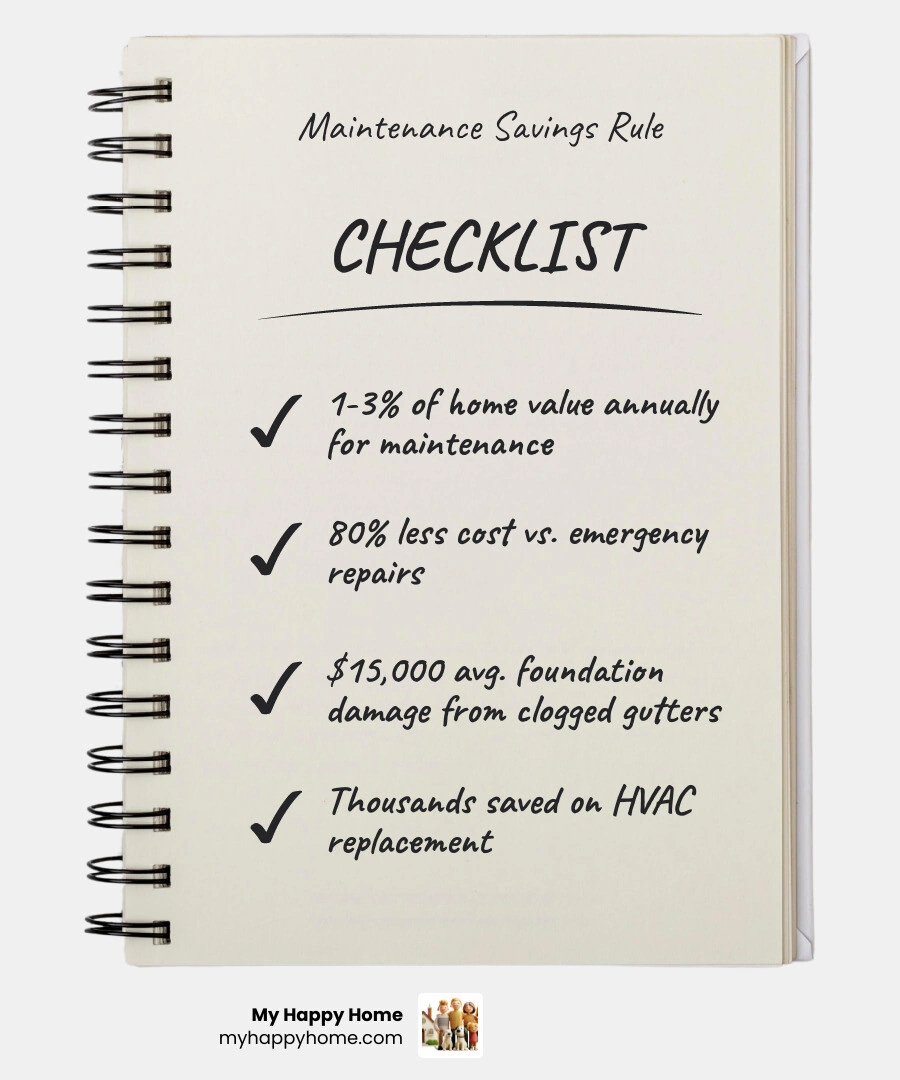
- Maintenance Action: Cleaning gutters twice a year; Problem It Prevents: Foundation water damage; Potential Repair Cost Avoided: Avg. $15,000 in foundation repair
- Maintenance Action: Inspecting roof annually; Problem It Prevents: Attic water intrusion and rot; Potential Repair Cost Avoided: Major structural repair or full replacement
- Maintenance Action: Flushing water heater yearly; Problem It Prevents: Sediment buildup and tank failure; Potential Repair Cost Avoided: Full unit replacement
- Maintenance Action: Sealing windows and doors; Problem It Prevents: Moisture intrusion and energy loss; Potential Repair Cost Avoided: Mold remediation and higher utility bills
- Maintenance Action: Testing smoke and CO detectors monthly; Problem It Prevents: Undetected safety hazards; Potential Repair Cost Avoided: Potentially irreplaceable: life and property
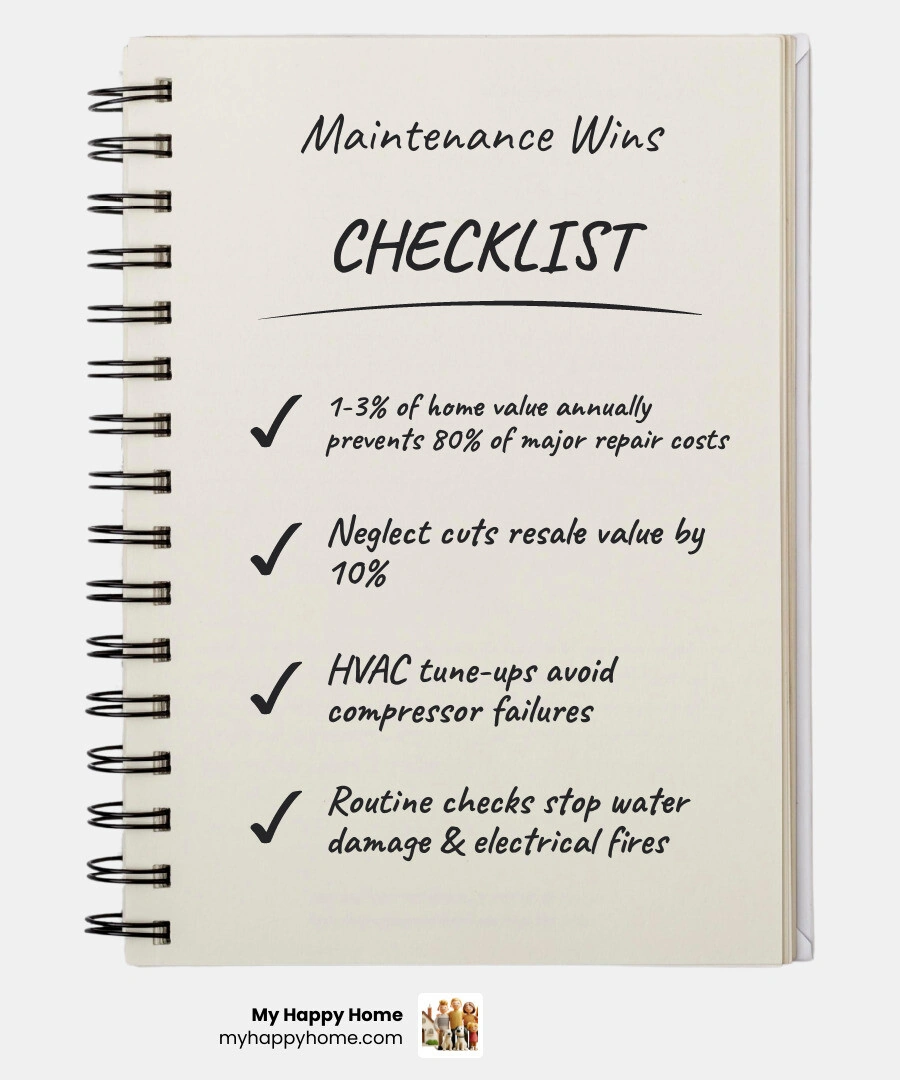
The core rule experts agree on: set aside 1-3% of your home's market value each year for maintenance. Homes that skip this end up paying far more in reactive repairs — studies show preventative maintenance typically costs around 80% less than fixing something after it breaks.
Right now, in May 2026, homeowners are feeling the pressure of rising repair costs and tighter household budgets. Yet two-thirds of homeowners who faced a major repair issue admit the problem could have been prevented with simple, proactive upkeep. That is not bad luck — that is a pattern. And it is one that busy families pay for in stress, disruption, and dollars that could have stayed in their pockets.
The good news is that protecting your home does not require a complete overhaul of your routine. It requires a plan — and a little consistency.
I'm Matthew Palmieri, founder of MyHappyHome™, and with a background spanning HVAC systems, appliance repair, plumbing, and home protection plans, I have spent my career helping homeowners understand exactly how regular maintenance prevents costly home repairs before those repairs derail their lives. In the sections ahead, I will walk you through the systems that matter most, the schedules that actually work, and how to make proactive home care feel manageable — not overwhelming.
The Financial Strategy of Proactive Home Upkeep
In O'Fallon, MO, we understand that a home is more than just a place to sleep; it is likely your largest financial asset. Treating it like one requires a shift from reactive "emergency" mode to a proactive financial strategy. When we wait for something to break, we aren't just paying for the part; we are paying for the emergency dispatch, the secondary damage (like mold from a leak), and the loss of time.
Research consistently shows that preventative maintenance costs approximately 80% less than reactive repairs. To put that in perspective, spending a small amount on a seasonal check-up can save you from a bill that is five times larger down the road. This is why housing experts recommend the "1-3% rule": setting aside 1-3 percent of your home's market value annually to cover routine upkeep.
By adopting this mindset, we avoid the "hidden financial drain." Neglecting routine upkeep can actually reduce your home's total value by up to 10%. On the flip side, How a Tune-Up Improves Efficiency and Lowers Bills demonstrates that keeping your systems running at peak performance pays immediate dividends in your monthly utility costs.
How Regular Maintenance Prevents Costly Home Repairs in Critical Systems
To truly master how regular maintenance prevents costly home repairs, we have to look at the home as an interconnected system. If the "shield" (your roof and siding) fails, the "skeleton" (your structure) is at risk. If the "veins" (your plumbing) leak, the "foundation" (the cornerstone) can shift.
Early detection is our best friend. Most catastrophic home failures don't happen overnight; they are the result of "quiet failures"—small drips or tiny cracks that go unnoticed for years. Our Services are designed to catch these issues while they are still small enough to manage.
How regular maintenance prevents costly home repairs in HVAC systems
Your HVAC system is the lungs of your home. In O'Fallon, our systems work hard through humid summers and freezing winters. The most basic task—airflow optimization—starts with your filters. Changing your HVAC filter every 30 to 90 days is the single most effective way to prevent the system from short-cycling or overheating.
A clogged filter makes your unit "breathe through a wool blanket," forcing the motor to work harder and eventually burn out. Our AC Maintenance Tune-Up Guide highlights that regular professional checks are vital for preventing frozen coils. When airflow is restricted, the temperature of the coils can drop below freezing, leading to ice buildup and potential compressor failure.
If you are wondering what happens during a professional visit, our AC Tune-Up Guide: What to Expect breaks down the inspection of electrical connections and refrigerant levels. Similarly, a Furnace Maintenance Tune-Up ensures your heating system is safe from cracked heat exchangers, which could otherwise allow combustion gases to enter your living space.
How regular maintenance prevents costly home repairs in plumbing and electrical
Plumbing issues account for 48% of all home maintenance tasks, and for good reason. Water damage is incredibly destructive, with the average insurance claim often exceeding $12,000. Through Plumbing Maintenance & Inspection, we can identify slow leaks behind cabinets or under floors before they rot the subfloor.
One often-overlooked task is sediment flushing for your water heater. Over time, minerals settle at the bottom of the tank, reducing efficiency and eventually rusting the bottom out. Flushing the tank annually can add years to its life, delaying the need for a full Water Heater Installation & Replacement. Additionally, regular Drain Cleaning Repair prevents the high-pressure backups that can damage older pipes.
On the electrical side, an Electrical Maintenance Inspection is about safety as much as savings. Loose wires or overloaded circuits are leading causes of residential fires. Catching a "quiet failure" in your breaker panel today prevents a catastrophic loss tomorrow.
Maximizing Home Value and Energy Efficiency Through Routine Care
Beyond preventing disasters, maintenance is a tool for wealth building. A well-maintained home retains its value and appeals more to buyers. In fact, professional inspections often reveal issues that can lead to buyers negotiating thousands of dollars off a sale price. By keeping detailed records of your maintenance, you build "buyer confidence" that your home is a sound investment.
Energy efficiency is another area where maintenance pays you back. For instance, understanding Heat Pump Efficiency in Different Climates helps you optimize your settings for the Missouri weather. There are numerous Heat Pump Benefits for Homeowners, but they only materialize if the coils are clean and the seals are tight. Furthermore, many manufacturer warranties require proof of annual servicing to remain valid. Skipping a tune-up could inadvertently void your protection on an expensive component.
Establishing a Seasonal Maintenance Schedule for Peace of Mind
Managing a home is easier when you break it down by the calendar. Here is a priority list to keep your O'Fallon home in top shape:
- Spring: Inspect the roof for winter damage (use binoculars from the ground!), check siding, and clear any debris from the AC condenser.
- Summer: Pressure wash walkways to prevent organic buildup and trim trees/shrubs at least one foot away from the foundation and six inches from the AC unit.
- Fall: Schedule your Furnace Maintenance Tune-Up or Heat Pump Maintenance Tune-Up. Clean gutters to prevent ice dams.
- Winter: Insulate exposed pipes in crawl spaces and check window weatherstripping to keep the heat in.
- Monthly: Test your smoke and carbon monoxide detectors. Check your HVAC filter.
- Seasonally: Perform an AC Maintenance Tune-Up before the first heatwave hits.
When to Trust Professional Technicians for System Longevity
While many tasks are great for the DIY-inclined, some systems require specialized diagnostic tools and safety protocols. For example, our Electrical Repair Service uses thermal imaging and precision meters to find heat buildup that the human eye can't see.
Professional technicians are trained to identify "quiet failures"—those subtle signs like a slightly discolored wire or a tiny refrigerant leak—that signal a major breakdown is imminent. Whether it is an AC Repair Service, a Plumbing Repair Service, or a Furnace Repair Service, having a vetted pro look at your systems ensures they meet local codes and operate at maximum safety.
Frequently Asked Questions About Home Maintenance
How much should I budget for annual home maintenance in 2026?
The standard recommendation remains 1% to 3% of your home's market value. If your home is valued at $400,000, aiming for $4,000 to $12,000 a year ensures you can cover both small monthly tasks and larger "big ticket" items like a future roof or HVAC replacement without taking on debt.
What are the most common repairs that could have been prevented?
Water damage from clogged gutters and failed water heaters are at the top of the list. HVAC compressor failures due to dirty filters and electrical fires caused by outdated or loose wiring are also frequently cited by experts as preventable through routine inspection.
How does neglecting maintenance affect my home's resale value?
Neglect can slash your home's value by 10%. Buyers in May 2026 are savvy; they look for signs of "deferred maintenance." If they see peeling paint or a dirty furnace, they assume there are bigger, invisible problems, and they will lower their offer accordingly.
Conclusion
Predictable homeownership is not a myth; it is the result of a good plan. By understanding how regular maintenance prevents costly home repairs, you move from the stress of "what might break next" to the peace of mind that comes with proactive care.
At MyHappyHome™, we believe that maintaining your home should be as simple as a monthly subscription. Our membership plans are designed to remove the guesswork and the high costs of emergency service. We provide comprehensive coverage for your HVAC, plumbing, electrical, and major appliances, all managed by licensed, vetted professionals.
By joining our community, you get more than just a repair service; you get the "MyHappyHome™ Promise"—a commitment to worry-free ownership and a home that works with you, not against you.
Explore our comprehensive home protection services and see how easy it is to stop burning cash and start protecting your biggest investment today.