

Duct Cleaning vs. Better Filtration: Tackling Fall Ragweed Allergies Indoors

Waking Up Congested: The September Ragweed Reality
As the days grow shorter, navigating the debate of Duct Cleaning vs. Better Filtration: Tackling Fall Ragweed Allergies Indoors becomes a top priority for congested homeowners. The September ragweed peak in Missouri brings aggressive pollen counts that easily infiltrate homes, transforming your safe haven into an allergy trap. You wake up with a scratchy throat, watering eyes, and relentless congestion, leading to a frustrating realization: your own heating and cooling system might be actively circulating outdoor allergens inside.
For professional guidance on managing your indoor air quality, our comprehensive HVAC services provide the solutions you need to breathe easier this season.
During the early fall transition, Missouri weather fluctuates wildly. You might open your windows to enjoy a crisp morning breeze, only to seal the house back up and run the air conditioning by mid-afternoon. Every time those windows open, or every time a family member walks through the front door, millions of microscopic pollen grains enter your living space. Once inside, these irritants are pulled into your ductwork and distributed into every room of the house.
This cycle forces a critical decision point for allergy sufferers: Should you pay a professional to clean your ductwork, or should you invest in better continuous filtration? While both services play a role in overall indoor air quality, they serve fundamentally different purposes. Understanding how these two approaches work is the only way to stop waking up congested and finally take control of your home's air.
The Hidden Toll of Indoor Allergens
Indoor allergies often feel worse than outdoor allergies because the irritants are trapped in a confined space. Outside, wind and rain naturally disperse pollen. Inside, your home acts as a sealed container. If your HVAC system lacks the capability to capture fine particles, it simply acts as a distribution network, blowing the same allergens into your bedroom while you sleep. Addressing this requires looking closely at how contaminants enter and travel through your home.
How Ragweed Infiltrates Your Ductwork
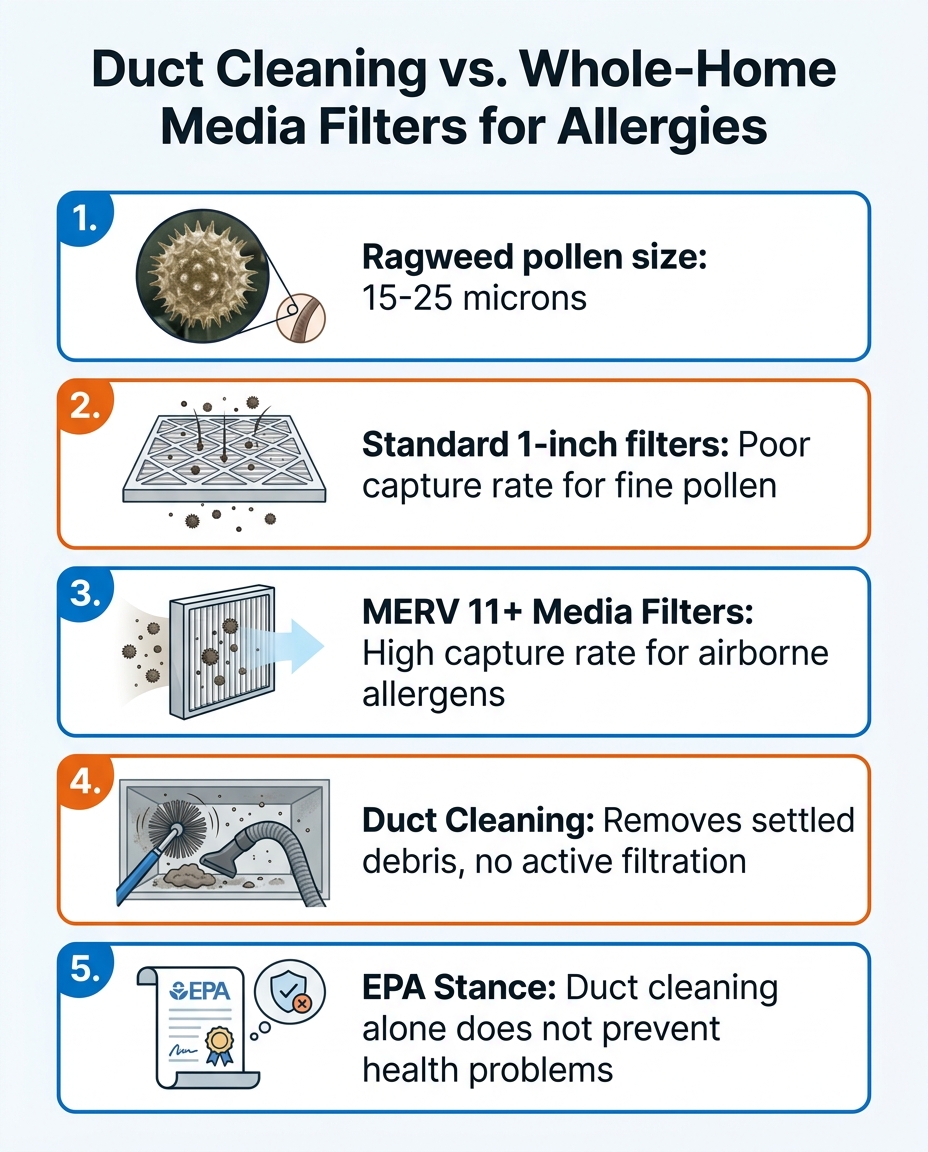
The Problem: You keep your doors closed and your house clean, yet allergy symptoms persist. The reality is that pollen is microscopic and incredibly pervasive. Ragweed pollen grains are typically 15 to 25 microns in size. To put that in perspective, a single grain of table salt is about 100 microns. These tiny particles easily drift on the wind, blanketing the region during the early fall.
The Cause: In our years of inspecting ductwork across O'Fallon MO, our team at My Happy Home consistently sees how these 15-25 micron particles find their way inside through natural drafts, poorly sealed windows, opening and closing exterior doors, and even on your clothes and pets. Once the pollen is airborne inside your house, the physics of your HVAC system take over. Your heating and cooling system relies on return vents to pull indoor air back to the central unit for conditioning. These return vents act like gentle vacuums, drawing in air along with all the suspended dust, pet dander, and ragweed pollen floating in your rooms.
If those return ducts have minor leaks—which is a pattern we see often in many residential systems—they can also pull unfiltered air directly from dusty attics or crawlspaces. The air travels through the return ductwork, passes through your system's filter, and is then pushed back out through the supply vents into your living areas.
The Solution: If the pollen is not actively trapped as it passes through the system, it will simply recirculate. This is why scheduling an HVAC maintenance and tune-up is highly recommended before the heavy heating season begins. One of our technicians can inspect your return ducts for leaks and evaluate your system's airflow, helping you understand exactly how outdoor allergens are bypassing your current defenses.
The Illusion of Protection: Why Standard 1-Inch Filters Fail
During our early fall maintenance visits, we often find that most homeowners assume the filter inside their furnace or air handler is there to purify the air they breathe. In reality, basic 1-inch fiberglass filters are designed strictly to protect the HVAC equipment itself. These cheap, see-through filters are often referred to in the industry as "rock catchers." They excel at stopping large debris like pet hair, heavy dust bunnies, and carpet fibers from coating the blower motor and evaporator coil.
However, they are completely ineffective against fine allergens. Because ragweed pollen grains measure just 15-25 microns, they slip right through the loose weave of a standard fiberglass filter. Relying on these basic filters during high-pollen seasons leads to rapid indoor air quality degradation. The pollen passes through the equipment and is blown directly back into your bedroom, living room, and kitchen.
Signs Your Standard Filter is Failing You:
• Visible dust buildup: You find yourself dusting hard surfaces every few days.
• Sunlight debris: You can see particles floating heavily in the air when sunlight streams through a window.
• Morning congestion: Family members wake up with stuffy noses and scratchy throats despite keeping windows closed.
• Dirty vent covers: Dark, dusty streaks appear on the ceiling or wall around your supply registers.
Some homeowners try to solve this by purchasing dense, high-MERV 1-inch filters from the hardware store. While these filters trap more particles, they also severely restrict airflow. Forcing your system to pull air through a dense 1-inch space acts like breathing through a thick wool blanket, causing the blower motor to overwork and potentially freeze the air conditioner coil. We recommend the correct path forward is upgrading your HVAC filter to a system designed for high filtration without the dangerous airflow restriction: a Whole-home media filter (MERV 11+).
Duct Cleaning: A System Reset, Not an Ongoing Cure
When allergy symptoms spike, many homeowners immediately assume their ducts are filled with pollen and need to be scrubbed clean. Professional duct cleaning involves using negative air machines and agitation tools to dislodge and extract settled dust, pet dander, construction debris, and past accumulation from inside the sheet metal or flex ductwork.
Myth vs. Reality
The Myth: Having your air ducts cleaned will permanently cure your family's fall allergies and stop pollen from circulating in the home.
The Reality: Duct cleaning is a physical removal of past buildup, acting as a valuable system reset. However, it provides zero active defense going forward. The Environmental Protection Agency (EPA) explicitly states that duct cleaning alone has not been shown to prevent health problems. If you clean your ducts but continue using a cheap 1-inch fiberglass filter, the very next time you open your door during the September ragweed peak in Missouri, new pollen will enter the home, bypass the filter, and begin contaminating those freshly cleaned ducts all over again.
Think of duct cleaning like washing your car. It removes the dirt that has already accumulated, making the car look pristine. But if you immediately drive that clean car down a muddy gravel road, it gets dirty again instantly. Without upgrading your filtration system—which acts as the ongoing shield—clean ducts will quickly become compromised during peak pollen seasons. Duct cleaning is highly beneficial for neglected systems, homes that have just undergone major renovations, or moving into a previously occupied house, but it is insufficient as an active, daily defense against seasonal allergies.
Whole-Home Media Filtration: Your Continuous Defense
To actually stop ragweed pollen from recirculating, you need a mechanism that actively traps fine particles every time the blower fan runs. This is where a Whole-home media filter (MERV 11+) excels. Unlike standard 1-inch filters, a media filter is housed in a dedicated cabinet installed directly into your ductwork, usually right next to the furnace or air handler.
Media filters are typically 4 to 5 inches thick and feature a deeply pleated design. This accordion-like structure provides massive surface area. The increased surface area means the filter material can be woven tightly enough to catch microscopic pollen grains without choking off the system's necessary airflow.
How a Media Filter Protects Your Home:
1. High-Efficiency Capture: A MERV 11 or higher rating effectively captures 15-25 micron particles, trapping ragweed, mold spores, and fine dust before they reach the blower motor.
2. Continuous Scrubbing: Every time your heating or cooling system cycles on, the air in your home is pulled through the media filter, actively scrubbing the environment multiple times a day.
3. Longer Lifespan: Because of the deep pleats and large surface area, media filters only need to be replaced every 6 to 12 months, compared to the monthly swaps required for 1-inch filters.
4. Equipment Protection: By keeping the internal coils and blower motor spotlessly clean, a media filter extends the lifespan of your HVAC system and maintains peak energy efficiency.
Adding a media cabinet requires minor sheet metal modifications, which is why our installation experts often integrate it during a new HVAC installation or as a standalone indoor air quality upgrade performed by a professional.
Head-to-Head Comparison: Duct Cleaning vs. Media Filters
To make the best decision for your home's air quality, it helps to see exactly how these two solutions stack up against each other. For typical O'Fallon MO homes struggling with seasonal allergies, understanding the long-term return on investment is key.
• Primary Function — Professional Duct Cleaning: Removes settled dust, debris, and past accumulation from inside ductwork. — Whole-Home Media Filter (MERV 11+): Actively captures airborne particles, pollen, and dander as air circulates.
• Service Frequency — Professional Duct Cleaning: Recommended every 3 to 5 years, or after major home renovations. — Whole-Home Media Filter (MERV 11+): Continuous daily protection; filter cartridge swapped every 6-12 months.
• Allergy Impact — Professional Duct Cleaning: Low ongoing impact. Does not filter new pollen entering the home. — Whole-Home Media Filter (MERV 11+): High active reduction. Continuously traps 15-25 micron seasonal allergens.
• Airflow Restriction — Professional Duct Cleaning: Improves airflow by removing heavy blockages in neglected systems. — Whole-Home Media Filter (MERV 11+): Maintains excellent airflow due to large, pleated surface area.
• Long-Term ROI — Professional Duct Cleaning: Provides a clean slate, but offers no ongoing defense against new contaminants. — Whole-Home Media Filter (MERV 11+): Delivers daily allergy relief and keeps HVAC equipment clean year-round.
While duct cleaning clears away the sins of the past, the media filter stands guard over the future. For families dealing with aggressive fall allergies, prioritizing continuous filtration provides significantly better day-to-day relief.

Why Honest HVAC Advisors Recommend Filtration First
The HVAC industry is filled with companies that aggressively push duct cleaning the moment a homeowner mentions allergies. While duct cleaning is a perfectly valid and helpful service for dirty systems, we frequently see it oversold as a miracle cure for seasonal congestion. Over our years of tackling indoor air quality in O'Fallon, our team at My Happy Home has remained committed to high-ROI solutions. We advise homeowners to secure their active filtration defense first, rather than pushing immediate, unnecessary duct cleaning upsells.
If you clean your ducts but leave a cheap fiberglass filter in place, you are treating the symptom (dusty vents) while ignoring the root cause (a lack of active particle capture). We recommend installing a Whole-home media filter (MERV 11+) because it addresses the root cause directly. It stops the pollen from recirculating, protects your equipment, and provides tangible relief you can feel every time you take a breath in your living room.
Once your filtration defense is in place, keeping it running at peak efficiency requires routine care. Enrolling in an HVAC Protection Plan ensures that your system receives the seasonal tune-ups it needs. A technician will regularly check your blower motor, verify your system's static pressure, and ensure your media filter is swapped out on the correct schedule. By tackling the problem with honest guidance and continuous active defense, you can finally reclaim your home from fall allergies.
Frequently Asked Questions
Does duct cleaning help with ragweed allergies?
Duct cleaning provides a clean slate by removing settled dust and debris, but it does not actively filter the air. If pollen continues to enter your home, clean ducts will not stop it from circulating. To truly combat ragweed allergies, you must pair a clean system with a high-efficiency media filter that traps new allergens as they arrive.
Is a media filter better than duct cleaning for indoor air quality?
Yes, for ongoing daily air quality, a media filter is significantly more effective. While duct cleaning is a one-time removal of past buildup, a media filter provides continuous, active defense against airborne particles every time the HVAC system runs. It captures the microscopic irritants that trigger symptoms day after day.
What is the best HVAC filter for fall allergies?
A whole-home media filter with a MERV 11 to MERV 13 rating is the ideal choice for targeting fall allergies. These thicker, pleated filters have the density required to trap 15-25 micron ragweed pollen without restricting the airflow your blower motor needs to function properly. Standard 1-inch fiberglass filters are insufficient for allergy relief.
Do air purifiers work better than duct cleaning?
Air purifiers and duct cleaning serve completely different functions. Duct cleaning removes static debris trapped in your home's hidden pipes, while air purifiers (especially whole-home systems) actively scrub the air of floating contaminants. For immediate and ongoing allergy relief, active purification and filtration will yield far better results than duct cleaning alone.
How often should I change a MERV 11 media filter during allergy season?
Most 4-inch or 5-inch media filters are designed to last between 6 and 12 months under normal conditions. However, during heavy allergy seasons or in homes with multiple pets, it is wise to check the filter at the 6-month mark. If the pleated surface is heavily coated in gray dust and debris, replacing it early ensures optimal airflow and particle capture.
Can a standard HVAC system accommodate a whole-home media filter?
Most standard forced-air HVAC systems can be retrofitted to accommodate a media filter, but it requires professional modification. An HVAC technician must cut into the existing return ductwork to install the wider media cabinet securely. This ensures an airtight seal so that all return air is forced through the filter rather than bypassing it.
Take Control of Your Indoor Air Quality
You don't have to surrender your comfort to the fall pollen surge. By understanding the difference between a one-time system reset and continuous active filtration, you can make the right investment for your family's health. Schedule a consultation to discuss upgrading your filtration today, and secure the ongoing defense you need to finally breathe easily indoors.

Get happy home tips delivered to your inbox.
Join the growing family of homeowners who have said goodbye to stress and hello to simple, worry-free living. With MyHappyHome, you're not just getting a service plan, you're getting a partner dedicated to your happiness.