
The ultimate climate test for heat pump efficiency
Why Heat Pump Efficiency in Different Climates Is the Question Every Homeowner Should Ask First
Heat pump efficiency in different climates varies more than most homeowners realize — and choosing the wrong system for your region can mean higher energy bills, less comfort, and a heating unit that struggles when you need it most.
Here's a quick snapshot of how heat pumps perform across U.S. climate conditions:
- Climate Type: Hot / Mild; Typical Outdoor Temp Range: 35°F and above; Approximate COP: 3.0 – 4.5; Heat Pump Coverage: 90–100% of heating and cooling needs
- Climate Type: Moderate; Typical Outdoor Temp Range: 15°F – 35°F; Approximate COP: 2.5 – 3.5; Heat Pump Coverage: 85–95% of heating needs
- Climate Type: Moderate-Cold; Typical Outdoor Temp Range: 5°F – 15°F; Approximate COP: 2.0 – 3.0; Heat Pump Coverage: 70–85% of heating needs
- Climate Type: Cold; Typical Outdoor Temp Range: 0°F – 5°F; Approximate COP: 1.5 – 2.5; Heat Pump Coverage: 50–70% capacity at 0°F
- Climate Type: Extreme Cold; Typical Outdoor Temp Range: Below 0°F; Approximate COP: 1.3 – 2.0; Heat Pump Coverage: Backup heating often recommended
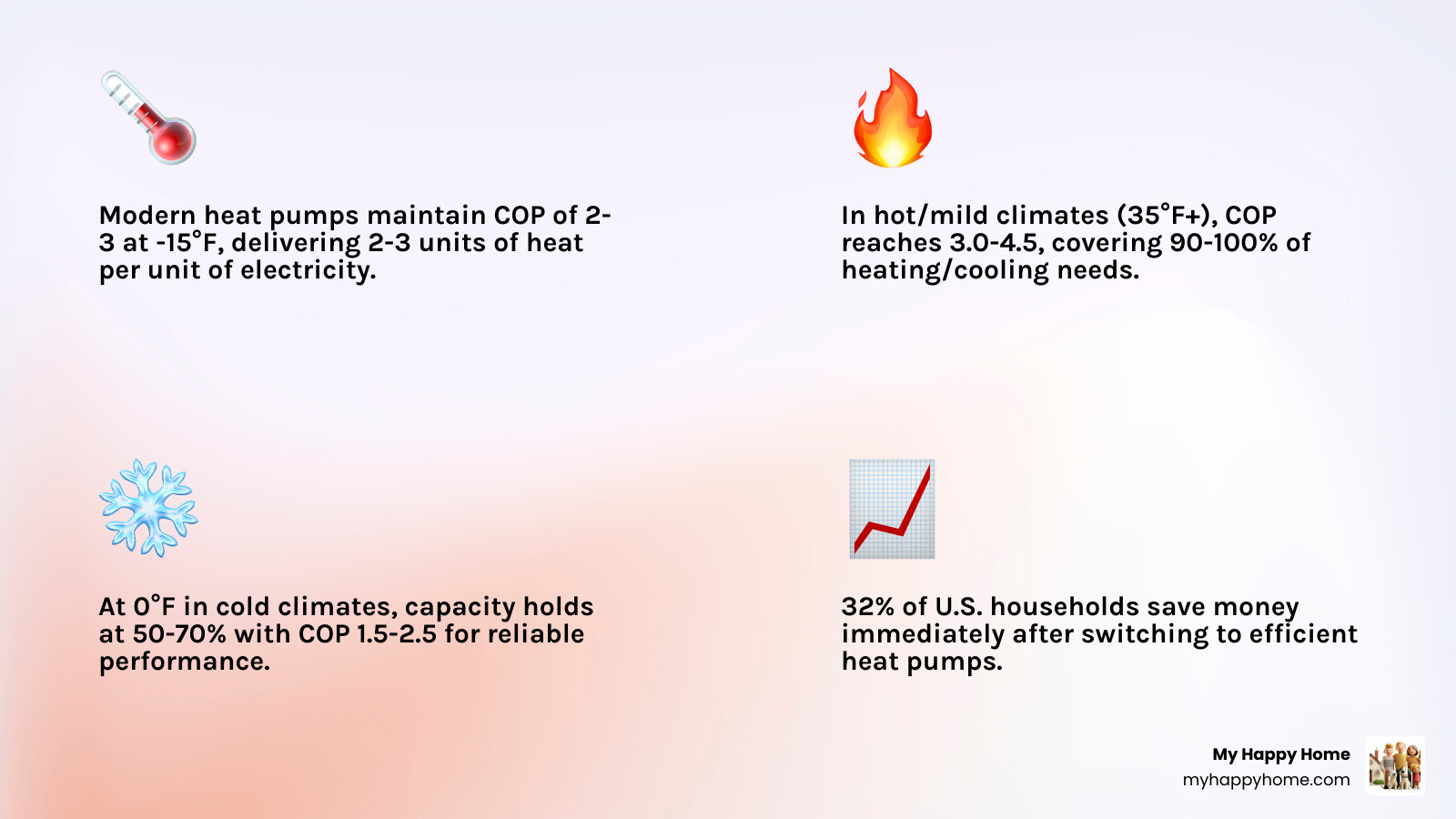
The short answer: modern heat pumps work in nearly every U.S. climate — including cold ones. Research confirms that today's cold-climate models can maintain a Coefficient of Performance (COP) between 2 and 3 even at temperatures as low as -15°F. That means they still deliver 2 to 3 units of heat for every single unit of electricity consumed, even in a Minnesota winter.
But efficiency doesn't tell the whole story on its own. Where you live, how your home is built, and which system you choose all shape real-world performance in ways that lab ratings don't fully capture. A heat pump that's perfect for Atlanta may be underpowered in Vermont — and a cold-climate unit built for -25°F is simply overkill in Houston.
One homeowner in Massachusetts, for example, reported saving roughly $150 per month during the coldest months after switching from an oil boiler to a heat pump — a real-world result that lines up with broader research showing that 32% of U.S. households save money after making the switch.
This guide breaks down exactly what drives heat pump efficiency across different climates, so you can make a confident, informed decision for your home.
Decoding the Metrics: SEER, HSPF, and COP
When we talk about heat pump efficiency in different climates, we have to speak the language of HVAC ratings. By April 2026, the industry has fully transitioned to more rigorous testing standards known as SEER2 and HSPF2. These aren't just alphabet soup; they are the benchmarks that tell us how much "bang for your buck" you’re getting from your electricity.
SEER and SEER2: The Cooling Kings
The Seasonal Energy Efficiency Ratio (SEER) measures cooling efficiency over a typical summer. Think of it like the MPG for your car, but for air conditioning. In hotter climates like Houston or Phoenix, a high SEER2 rating (typically 15 to 25+) is vital. The higher the number, the less energy the unit uses to keep you cool when the pavement is melting outside.
HSPF and HSPF2: The Heating Heroes
The Heating Seasonal Performance Factor (HSPF) is the heating equivalent of SEER. It measures the total heat output over a season divided by the electricity consumed. For those of us in moderate or cold climates, this is the number that matters most. Modern high-efficiency units typically range between 8 and 13 HSPF.
COP: The Real-Time Efficiency Snapshot
The Coefficient of Performance (COP) is a simpler, more direct ratio. If a unit has a COP of 3.0, it is producing three units of heat for every one unit of electricity it uses. While electric resistance heaters (like space heaters) have a COP of 1.0, heat pumps are "magic" because they move heat rather than creating it, often achieving COPs of 3.0 or 4.0 in mild weather.
Lab Ratings vs. Real-World Performance
It is important to remember that lab ratings are often optimistic. Research shows that real-world Seasonal Coefficient of Performance (SCOP) can deviate significantly from the sticker on the box. Factors like how often the unit enters a defrost cycle or whether the ductwork is leaky can reduce efficiency. That is why professional HVAC Services are essential to ensure the system is tuned for your specific environment.
- Climate Zone: Hot (e.g., Zone 5); Recommended SEER2: 16+; Recommended HSPF2: 7.5+; Primary Focus: Cooling Efficiency
- Climate Zone: Moderate (e.g., Zone 3); Recommended SEER2: 15+; Recommended HSPF2: 8.5+; Primary Focus: Balanced Performance
- Climate Zone: Cold (e.g., Zone 1); Recommended SEER2: 14+; Recommended HSPF2: 10+; Primary Focus: Heating Capacity
Heat Pump Efficiency in Different Climates: A Regional Breakdown
Geography is destiny when it comes to HVAC. In April 2026, we know that a "one size fits all" approach leads to shivering winters or sweat-soaked summers. The heat pump efficiency in different climates is dictated by the "design temperature" — the typical extreme low or high for your specific city.
In moderate climates, such as O'Fallon, MO, heat pumps are incredibly effective. These regions experience a mix of seasons where the heat pump can handle 85% to 95% of the annual heating load without breaking a sweat. However, as we move into different zones, the strategy changes.
Humidity also plays a massive role. In damp regions, the outdoor unit may frost over more quickly, triggering "defrost cycles" that temporarily use more energy. Conversely, in dry climates, the cooling side of the heat pump must be robust enough to handle high sensible heat.
If you're in a coastal or rainy area, you might find that a Heat Pump Repair Service Seattle WA is focused on moisture management and coil protection, whereas a tech in the Midwest might be more concerned with sub-zero start-up reliability. Regardless of where you are, the "building envelope" — your insulation and windows — acts as the first line of defense for efficiency.

Maximizing Heat Pump Efficiency in Different Climates for Cold Regions
There is a persistent myth that heat pumps stop working when the snow starts falling. In reality, modern cold-climate air-source heat pumps (ccASHPs) are engineered to thrive in the frost.
Research indicates that these advanced units can heat as effectively at 5°F as they do at 47°F. Even at -15°F, many models maintain a COP of 2.0 to 3.0. For homeowners looking at a Heat Pump Installation Replacement New York NY, the key is to look for the Energy Star Cold Climate certification. These units are specifically tested to provide significant heating capacity even when the outdoor air feels like an icebox.
To maximize efficiency in the cold:
- Choose the Right Size: Sizing for the heating load, rather than just the cooling load, ensures the unit doesn't rely too heavily on backup "heat strips."
- Defrost Sensors: Modern units use smart sensors to only run defrost cycles when necessary, saving electricity.
- Elevation: Mounting the outdoor unit on a stand keeps it above snow accumulation, ensuring proper airflow.
Maintaining Heat Pump Efficiency in Different Climates During Hot Summers
In hot-dominant regions, the heat pump’s job is to act as a high-performance air conditioner. Efficiency here is all about "latent heat removal" — or dehumidification. High-efficiency heat pumps are often better at this than standard central AC units because they can run at lower speeds for longer periods, pulling more moisture out of the air without over-cooling the room.
For those requiring a Heat Pump Maintenance Tune-Up Houston TX, the focus is often on the SEER2 rating. A unit with a SEER2 of 16 or higher can significantly reduce summer cooling costs. Variable-speed compressors are the MVP here; they allow the system to "cruise" at a low energy level rather than constantly cycling on and off like an old-fashioned system.
Advanced Technology: How Modern Units Defy the Cold
The secret sauce behind the improved heat pump efficiency in different climates lies in the hardware. We’ve come a long way from the single-speed "clunkers" of the past.
Variable-Speed Inverter Compressors
Older heat pumps were like a light switch: either 100% on or 100% off. Modern inverters are like a car’s accelerator. They can ramp up or down to match the exact heating or cooling demand of the home. This prevents the energy-wasting "jolt" of frequent starts and stops.
Vapor Injection and Two-Stage Compression
In extremely cold weather, the refrigerant can struggle to carry enough heat. Vapor injection technology boosts the heating capacity in sub-freezing temperatures without a major loss in efficiency. This allows a Heat Pump Repair Service Denver CO to offer solutions that work even when the Rockies are covered in deep powder.
The Refrigerant Revolution
As of April 2026, the industry has shifted toward next-generation refrigerants like R-454B and R-32. These fluids are not only better for the environment (lower global warming potential), but they are also more efficient at transferring heat, especially in extreme temperature swings.
Maximizing Performance: Installation and Maintenance
You could buy the most efficient heat pump in the world, but if it’s installed poorly, it will perform like a budget model.
Sizing and Airflow
We always use "Manual J" calculations to determine the exact heating and cooling needs of a home. An oversized unit will "short-cycle," wearing out parts and failing to dehumidify. An undersized unit will run constantly and fail to keep you warm in January. Furthermore, leaky ducts can reduce your system's efficiency by noticeably. Sealing and insulating those ducts is often the most cost-effective way to boost performance.
The Power of Maintenance
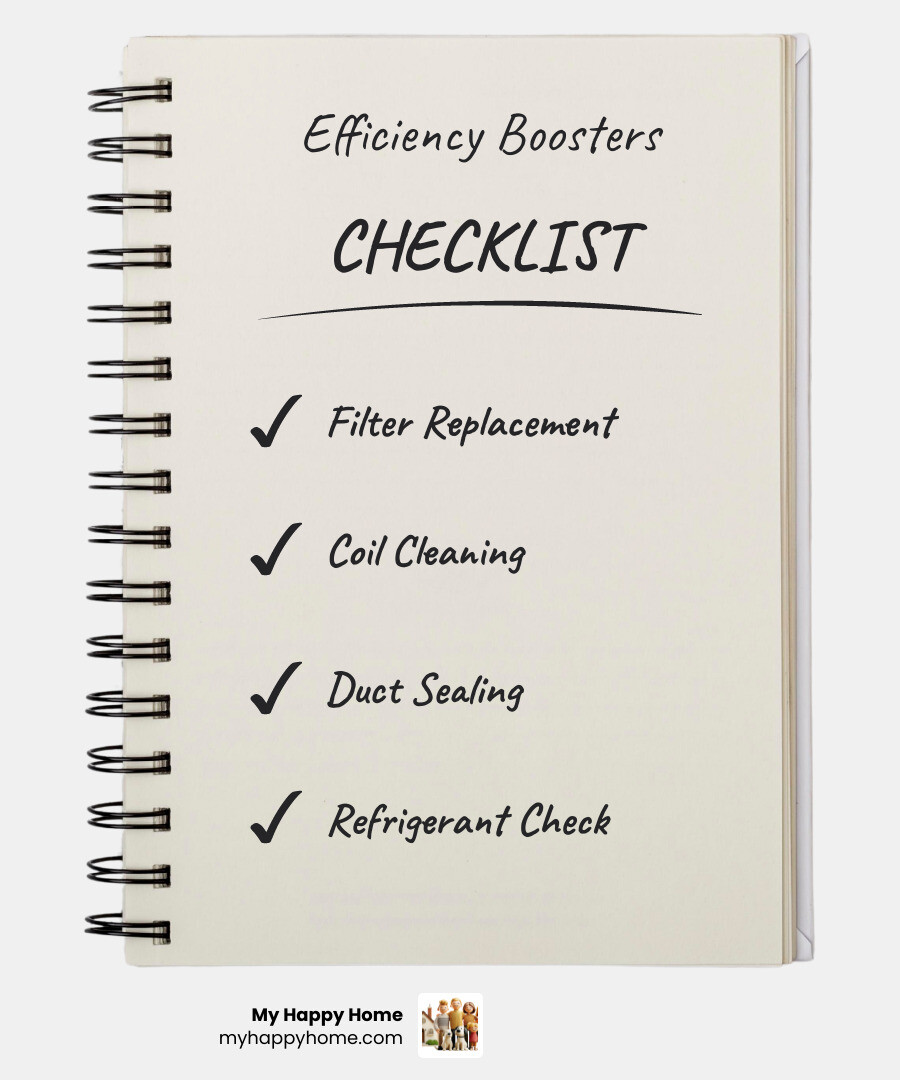
Regular care is the only way to sustain those high efficiency ratings. A Heat Pump Maintenance Tune-Up should include:
- Filter Replacement: A clogged filter forces the fan to work harder, spiking your bill.
- Coil Cleaning: Dirt on the outdoor coils acts as an insulator, preventing the system from absorbing or releasing heat.
- Refrigerant Check: Even a tiny leak can cause a double-digit drop in efficiency.
Thermostat Strategies
Unlike furnaces, heat pumps are "steady eddies." They work most efficiently when they maintain a constant temperature. "Setback" strategies (turning the heat way down at night) can actually backfire with a heat pump, as the unit might engage expensive backup electric heat to quickly recover the temperature in the morning.
Frequently Asked Questions
Can heat pumps really work in extreme cold?Yes. Modern cold-climate models are designed to maintain high efficiency even at -15°F. While their capacity drops as the temperature falls, they still provide 2 to 3 units of heat for every unit of electricity consumed, which is far more efficient than traditional electric baseboard heaters.
Will switching to a heat pump save money on energy bills?In most cases, yes. Studies show that 32% of U.S. households save money immediately upon switching. That number jumps to 90% when homeowners use federal subsidies to replace older, inefficient systems like oil boilers or propane furnaces.
When is a backup heating system necessary?If you live in a region where temperatures frequently drop below -20°F, a hybrid or "dual-fuel" system is often the smartest choice. This pairs the heat pump with a gas furnace that only kicks in during those rare, extreme cold snaps to ensure your home stays perfectly cozy.
Conclusion: Peace of Mind in Every Season
Understanding heat pump efficiency in different climates is the first step toward a more comfortable, sustainable home. Whether you are dealing with the humid summers of the South or the biting winters of the North, there is a heat pump technology designed for your backyard.
By selecting a climate-certified model and ensuring a professional Heat Pump Installation Replacement, you can enjoy lower energy bills and a smaller carbon footprint.
At My Happy Home, we believe homeownership shouldn't be stressful. Our membership plans provide comprehensive coverage for your HVAC, plumbing, and electrical systems, ensuring that if your heat pump ever needs a tune-up or a repair, expert help is just a click away. We’re here to make sure your home stays "happy" no matter what the weather does outside. Explore our protection plans today and say goodbye to surprise repair bills!