
How a heat pump works without breaking a sweat
What Every Homeowner Should Know About How a Heat Pump Works
How does a heat pump work is one of the most common questions homeowners ask before upgrading their home comfort system — and for good reason. The short answer:
A heat pump moves heat from one place to another instead of generating it. In summer, it pulls heat out of your home and releases it outside. In winter, it does the opposite — extracting heat energy from outdoor air and moving it inside to warm your home.
Here is a quick breakdown:
- A refrigerant circulates through the system, absorbing and releasing heat as it changes between liquid and gas states.
- In cooling mode, the refrigerant absorbs heat from indoor air and carries it outside.
- In heating mode, a reversing valve flips the cycle — the refrigerant pulls heat from outside air and delivers it indoors.
- A compressor powers the whole cycle, using electricity to keep the refrigerant moving.
- The result is a system that can deliver 3 to 5 units of heating or cooling for every 1 unit of electricity consumed.
That last point is why heat pumps have become the heating and cooling system of the moment. They do not burn fuel to create warmth. They simply move existing heat — and that makes them 3 to 5 times more energy-efficient than traditional electric heaters or fossil fuel systems.
For a busy family, that means one system handling year-round comfort, lower energy bills, and fewer headaches. Whether you are thinking about making the switch or just trying to understand what is already installed in your home, this guide walks you through exactly how it all works.
The Science of Heat Transfer: How Does a Heat Pump Work?
To understand how does a heat pump work, we have to look at the second law of thermodynamics. In nature, heat naturally flows from a high-temperature area to a lower-temperature area. A heat pump uses a small amount of mechanical energy to reverse this natural flow, effectively "pumping" heat uphill against the gradient.
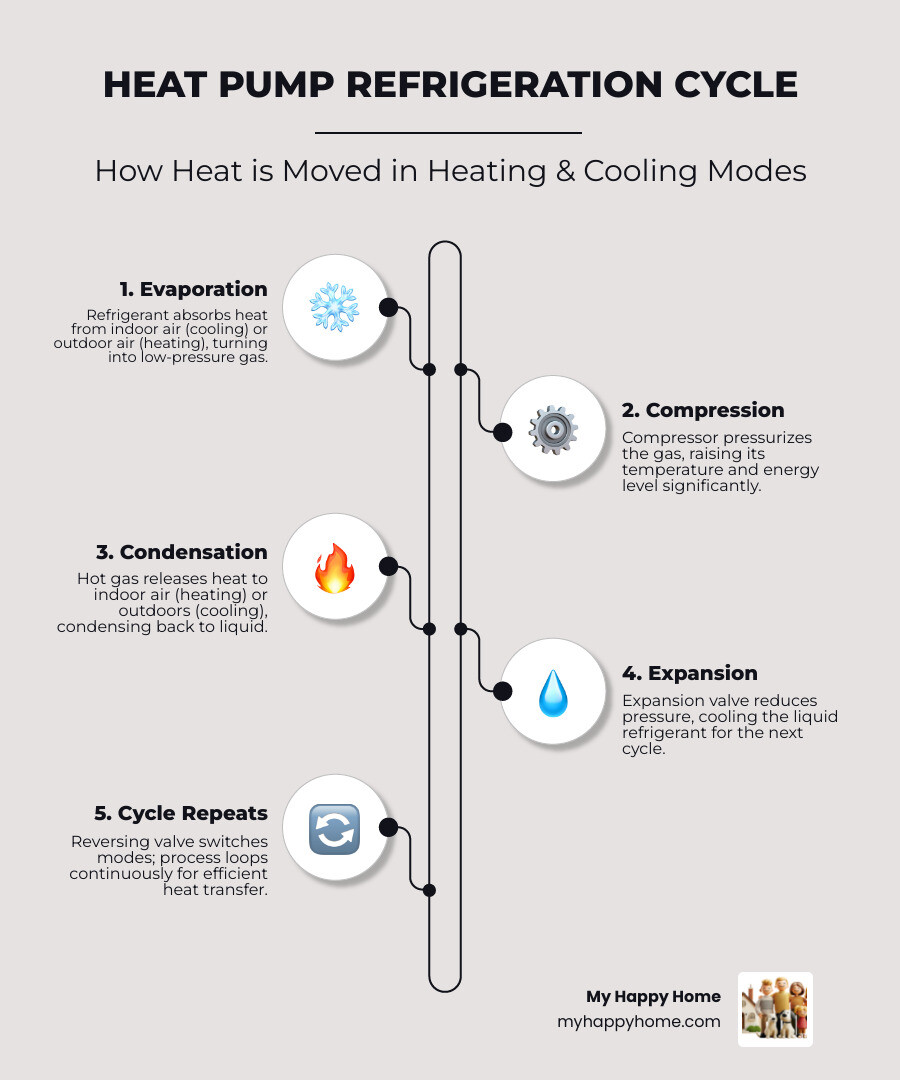
The secret ingredient in this process is the refrigerant. This special fluid has an incredibly low boiling point, allowing it to evaporate into a gas even in freezing temperatures. As the refrigerant cycles through the system, it undergoes phase changes—shifting from liquid to gas and back again. When it evaporates, it absorbs a massive amount of "latent heat" from its surroundings. When it condenses back into a liquid, it releases that stored heat.
This vapor-compression cycle allows the unit to use the outdoor environment as either a heat source (in winter) or a heat sink (in summer). Because the system is moving existing thermal energy rather than creating it through combustion, it is remarkably efficient. If you ever run into trouble with this complex process, our Heat Pump Repair Service Chicago IL experts are always ready to help. You can also explore more info about HVAC services to see how these systems integrate into your home.
How does a heat pump work in cooling mode?
When the Missouri humidity kicks in during July, your heat pump acts exactly like a high-end air conditioner. The process begins at the indoor evaporator coil. The cold, low-pressure liquid refrigerant enters the coil, where it encounters the warm air from your living room.
As the indoor fan blows air across the coils, the refrigerant performs its magic:
- Evaporation: The refrigerant absorbs the heat from your indoor air, causing the liquid to boil into a gas.
- Heat Absorption: By soaking up this thermal energy, the air blowing back into your ducts becomes crisp and cool.
- Transport: The now-warm gaseous refrigerant travels through the copper lines to the outdoor unit to dump the heat it just collected.
It is a seamless way to maintain a comfortable indoor climate. If your system isn't blowing cold air as it should, you might need a Heat Pump Repair Service Philadelphia PA to check your refrigerant levels or coil integrity.
How does a heat pump work in heating mode?
This is where the heat pump truly shines and differentiates itself from a standard AC unit. In the winter, a component called the reversing valve switches the direction of the refrigerant flow. Now, the outdoor coil acts as the evaporator, and the indoor coil acts as the condenser.
Even when it feels "cold" outside, there is still a significant amount of heat energy in the air (anything above absolute zero contains heat!).
- The low-pressure refrigerant absorbs heat from the freezing outdoor air and evaporates.
- The compressor then squeezes that gas, which causes its temperature to spike—often reaching over 100°F.
- This hot gas travels to your indoor unit, where it undergoes condensation, releasing all that concentrated heat into your home.
For those living in chillier regions, having a reliable Heat Pump Repair Service Boston MA ensures that your reversing valve and compressor are always ready for the first frost.
Key Components of a Modern System

A heat pump is a precision machine, and several key parts must work in perfect harmony to keep your home cozy. Here are the essential components:
- The Compressor: Often called the "heart" of the system, it uses electricity to pressurize the refrigerant and move it through the cycle.
- The Reversing Valve: The "brain" that allows the system to switch between heating and cooling modes.
- Expansion Valve: This acts as a gateway, regulating the flow of refrigerant and dropping its pressure so it can begin the evaporation process again.
- Outdoor Unit: Contains a coil and a large fan that either absorbs heat from or rejects heat to the outside air.
- Indoor Air Handler: Contains the indoor coil and a blower fan that distributes conditioned air through your ductwork.
- Refrigerant Lines: The copper "veins" that connect the indoor and outdoor units.
Keeping these parts in top shape is the best way to avoid a mid-season breakdown. Regular Heat Pump Maintenance/Tune-Up can catch small issues with the expansion valve or compressor before they turn into major repairs.
Efficiency Ratings and Cold Climate Performance
When shopping for a system or checking your current one, you will see terms like SEER2 and HSPF2. These are the metrics we use to measure how well the unit performs.
- SEER2 (Seasonal Energy Efficiency Ratio): Measures cooling efficiency.
- HSPF2 (Heating Seasonal Performance Factor): Measures heating efficiency over a season.
- COP (Coefficient of Performance): A direct ratio of energy out versus energy in. For example, a COP of 4.0 means the system provides 4 units of heat for every 1 unit of electricity it uses.
In the past, people worried that heat pumps couldn't handle "real" winters. However, by April 2026, technology has advanced significantly. Modern cold climate heat pumps can operate effectively down to -22°F (-30°C). Some models even maintain a COP of 3.8 at freezing temperatures, which is nearly four times more efficient than a space heater!
If you live in a place with fluctuating temperatures, like Missouri, having an HVAC Protection Plan ensures your high-performance system stays calibrated for extreme weather. Residents in colder areas can also rely on Heat Pump Repair Service Denver CO for specialized cold-weather calibrations.
Choosing Between Air-Source and Ground-Source Systems
Not all heat pumps pull energy from the air. While air-source heat pumps are the most common for residential use because they are easier to install, ground-source (geothermal) systems are the efficiency champions.
- Feature: Energy Source; Air-Source Heat Pump: Ambient Outdoor Air; Ground-Source (Geothermal): Constant Ground Temperature
- Feature: Typical COP; Air-Source Heat Pump: 3.0 – 5.0; Ground-Source (Geothermal): 3.0 – 6.0
- Feature: Installation; Air-Source Heat Pump: Simple, Outdoor Unit; Ground-Source (Geothermal): Complex, Underground Loops
- Feature: Lifespan; Air-Source Heat Pump: 15 – 20 Years; Ground-Source (Geothermal): 25 – 50 Years (Loops)
Ground-source systems use geothermal loops buried below the frost line, where the temperature stays between 50°F and 60°F year-round. This makes it much easier for the system to find heat in the winter.
For many homeowners in areas like Texas, a dual fuel system—which combines an air-source heat pump with a gas furnace for the few truly frigid days of the year—is a popular choice. If you are considering an upgrade, our team handles Heat Pump Installation/Replacement Houston TX to help you find the perfect fit.
Frequently Asked Questions About Heat Pump Mechanics
We hear a lot of myths about heat pumps. Let’s clear up the mechanics behind the most common questions.
Do heat pumps use a lot of electricity?
Actually, they use significantly less than most alternatives. While the annual consumption typically falls between 6,176 to 10,244 kWh, this electricity isn't being used to create heat—it’s just powering the fans and the compressor. Compared to electric resistive heating (like a baseboard heater or a toaster), a heat pump uses about 60% to 70% less energy. Our HVAC Protection plans can help ensure your unit stays at peak efficiency so those kWh numbers stay as low as possible.
Can a heat pump cool a house in 100-degree weather?
Yes! A heat pump is essentially an air conditioner with a "reverse" switch. High-efficiency models are designed for heat rejection even in extreme heat. As long as the refrigerant can be compressed to a temperature higher than the outside air, it can dump the heat. In scorching climates, homeowners often rely on Heat Pump Repair Service Phoenix AZ to ensure their outdoor coils are clean, which is vital for high-ambient performance.
At what temperature does a heat pump become ineffective?
While older models struggled below 25°F, modern cold-climate models are a different breed. They use variable-speed compressors to adjust their output. When the outdoor unit begins to frost over, the system enters a brief defrost cycle to melt the ice. Only in the most extreme conditions—think -30°C—might you need a "supplemental heat" source like electric heat strips. For those in damp, chilly climates, a Heat Pump Repair Service Seattle WA can ensure your defrost sensors are working correctly.
Conclusion
Understanding how does a heat pump work takes the mystery out of home comfort. These systems are the future of HVAC because they are smarter, cleaner, and much easier on your utility bill. By moving heat instead of burning fuel, they provide a sustainable way to keep your family comfortable in O'Fallon, MO, and beyond.
At My Happy Home, we believe homeownership shouldn't be stressful. Our membership plans are designed to remove the "what if" from your life. Whether it is your HVAC system, plumbing, or electrical work, we provide comprehensive coverage under one simple monthly plan. With our vetted technicians and 24/7 support, you can say goodbye to surprise repair bills for good.
Ready to protect your home’s most vital systems? Explore membership plans today and experience the peace of mind that comes with a My Happy Home membership.