
How to spot a hidden water leak early in 5 steps

The Silent Damage You Can't Afford to Miss: How to Spot a Hidden Water Leak Early
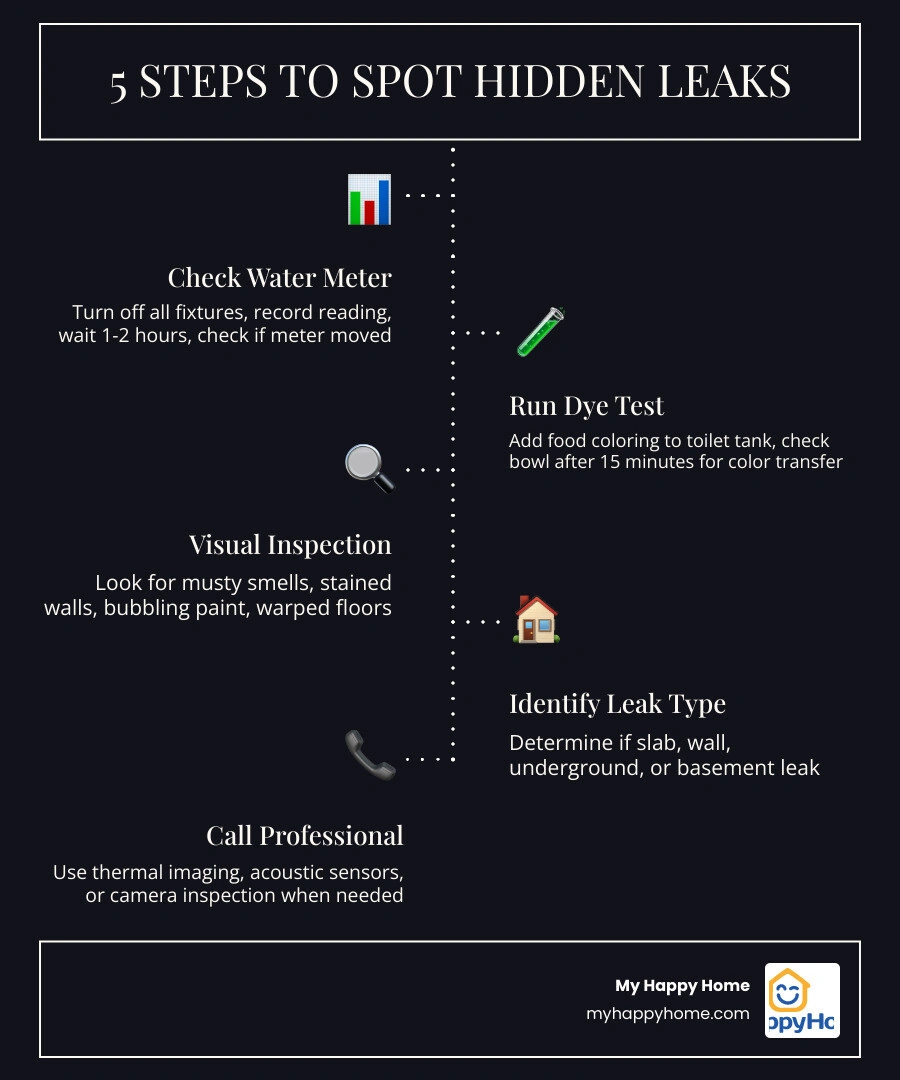
Knowing how to spot a hidden water leak early can save you from thousands of dollars in repairs, mold damage, and structural problems that build up quietly over weeks or months. Here is a quick overview of the five steps covered in this guide:
- Check your water meter - Turn off all fixtures, record the meter reading, wait 1-2 hours, and check if it moved.
- Run a dye test - Add food coloring to your toilet tank and check the bowl after 15 minutes for color transfer.
- Do a visual and sensory inspection - Look for musty smells, stained walls, bubbling paint, and warped floors.
- Identify the leak type - Determine whether you are dealing with a slab, wall, underground, or basement leak.
- Call a professional when needed - Use advanced detection tools like thermal imaging or acoustic sensors for leaks you cannot locate yourself.
Most hidden leaks do not start with a burst pipe or a flooded room. They begin as small drips tucked behind walls, under floors, or beneath your home's foundation. By the time you notice a water stain or a spike in your water bill, the damage has often been building for months. According to the EPA, the average household wastes roughly 10,000 gallons of water per year from fixable leaks alone. And with mold able to begin growing within just 24 to 48 hours of moisture exposure, catching a leak early is not just about saving water — it is about protecting your home and your family's health.
I'm Matthew Palmieri, founder of My Happy Home, and with a background in plumbing, HVAC, and home protection services, I have seen how how to spot a hidden water leak early can be the difference between a minor repair and a major renovation. In the steps below, I will walk you through a clear, systematic process any homeowner can follow.
Why You Need to Know How to Spot a Hidden Water Leak Early
Water is incredibly patient. It does not announce its presence with an alarm or a flashing light; instead, it slowly seeps through hairline cracks, worn seals, and aging joints. For homeowners in O'Fallon, MO, our distinct seasonal shifts—ranging from freezing winter temperatures to humid summer months—can put immense stress on residential plumbing systems. Over time, these temperature fluctuations cause pipes to expand and contract, which can lead to tiny, hidden structural failures.
When a leak goes unnoticed, the consequences extend far beyond a high water utility bill. The structural integrity of your home is directly at risk. Water is a universal solvent, meaning it will gradually break down key building materials like drywall, plaster, and wooden support beams. Even worse, the damp, dark environments created by hidden leaks are the perfect breeding ground for mold spores. Within 24 to 48 hours of moisture exposure, mold can colonize and release airborne particles that trigger allergies, asthma, and other respiratory issues, significantly lowering your indoor air quality.
Understanding how to identify these issues before they escalate is crucial. By catching a leak in its infancy, you protect your home's foundation, preserve your indoor air quality, and contribute to vital water conservation efforts. To learn more about the subtle warning signs your pipes might be giving you, check out our guide on Signs of Hidden Plumbing Problems in Your Home.
The 5-Step Guide to Early Leak Detection
We believe that home maintenance should be straightforward and stress-free. You do not need a truck full of specialized tools to start investigating your plumbing. By following a systematic, step-by-step approach, you can narrow down the location of a suspected leak using items you already have around your house.
Let's explore our practical 5-step guide to mastering early leak detection.
Step 1: How to Spot a Hidden Water Leak Early Using Your Water Meter
Your water meter is the single most reliable diagnostic tool at your disposal. It acts as the "brain" of your home's plumbing system, measuring every drop of water that enters your property. By running a simple baseline test, you can confirm whether you have an active leak without opening a single wall.

To perform this test, follow these steps:
- Turn off all water fixtures: Ensure that no appliances or fixtures are using water. This means turning off all faucets, showers, washing machines, dishwashers, and even outdoor irrigation systems. Let everyone in the household know not to flush toilets or tap into the water supply for the next couple of hours.
- Locate your water meter: In O'Fallon, MO, water meters are typically located in the basement, utility closet, or in an outdoor pit near the boundary of your property.
- Take a baseline reading: Look at the meter dial. Note the numbers carefully, paying special attention to the low-volume sweep hand or the digital flow rate indicator. Many modern meters have a small, triangular "leak indicator" wheel that spins even when a tiny amount of water is passing through.
- Wait and re-check: Leave the water off and wait between one and two hours.
- Analyze the results: Check the meter again. If the numbers have changed or the leak indicator dial is slowly spinning, you have an active leak.
The Pro Isolation Trick:If your meter moved, you can easily isolate whether the leak is inside your home or outside in your main service line. Locate your home's main interior shutoff valve (usually where the water line enters the house) and turn it off. Check the water meter again. If the meter stops moving, the leak is inside your home. If the meter continues to register water usage even with the main interior valve closed, the leak is located underground in the service line between the meter and your house.
Step 2: How to Spot a Hidden Water Leak Early with DIY Dye and Visual Tests
Once your water meter confirms there is an active leak, the next step is to check the most common—and often silent—culprits inside the house.
The Toilet Dye Test
Toilets are responsible for the vast majority of silent indoor water leaks. In fact, statistics show that around 1 in 10 properties have a constantly running toilet, which can waste hundreds of liters of water every single day. Because modern toilets often overflow directly into the bowl rather than through an external pipe, these leaks are incredibly easy to miss.
To perform a dye test:
- Remove the lid from your toilet tank.
- Drop a few drops of dark food coloring or a non-toxic dye tablet into the tank water until the color is deep and vibrant.
- Do not flush the toilet.
- Wait 15 to 20 minutes, then look into the toilet bowl.
- If the colored water has seeped from the tank into the bowl without flushing, your flapper valve is worn out or misaligned, allowing water to constantly drain. Replacing a flapper is a simple, low-cost fix that prevents massive water waste.
Inspecting Faucets and Appliance Hoses
Next, perform a visual sweep of all visible plumbing fixtures. Walk through your kitchen, bathrooms, and laundry rooms to check:
- Faucets and showerheads: Look for slow, persistent drips. Even one drip per second can waste thousands of gallons of water over the course of a year.
- Under-sink supply lines: Open your vanity cabinets and kitchen sink cupboards. Run your hands along the flexible metal or plastic supply lines and shutoff valves to feel for moisture or corrosion.
- Appliance connections: Pull out your dishwasher and washing machine if possible, or inspect the hoses connecting them to the wall. Rubber hoses can crack and fail as they age; we highly recommend upgrading to braided stainless steel hoses, which should be replaced every 5 to 8 years to prevent catastrophic failures.
Step 3: Conduct a Thorough Visual and Sensory Inspection
If your fixtures and toilets check out fine, the leak is likely concealed behind your walls, ceilings, or floors. This is where your senses of sight and smell come into play. Water naturally follows gravity, framing, and finish surfaces, meaning a stain on your ceiling or a damp spot on your floor might actually originate several feet away from where you see it.
Keep an eye out for these visual and sensory warning signs:
- Musty Odors: A persistent, earthy, or damp smell that does not go away after cleaning is a classic sign of hidden moisture. This odor is caused by mold and mildew thriving in dark, unventilated spaces behind drywall or under flooring.
- Wall Discoloration and Bubbling Paint: When water leaks behind drywall, the material acts like a sponge, absorbing the moisture. This causes yellow, brown, or dark stains to bleed through. You might also notice paint bubbling, cracking, or peeling away from the surface as moisture breaks down the adhesive bond.
- Warped or Spongy Flooring: If you have hardwood or laminate flooring, look for cupping, crowning, or warping. For carpeted areas, step around slowly to feel for soft, spongy, or unusually cold patches.
If you notice musty smells or moisture issues originating near your drains or sewer lines, it could indicate a backup or a cracked drainage pipe. To ensure your home's wastewater system is flowing freely and safely, learn more about our professional Drain Cleaning Repair services.
Step 4: Differentiate Between Slab, Wall, and Underground Leaks
Not all hidden leaks are created equal. Depending on where your pipes are routed, a leak can manifest in very different ways. Understanding these differences helps you describe the problem accurately when you call for professional assistance.
Slab Leaks
A slab leak occurs when the water lines running beneath your home's concrete foundation crack or burst. Because these pipes are encased in concrete, slab leaks are notoriously difficult to detect. Look for warm spots on your tile or linoleum floors (which indicate a hot-water line leak), the sound of running water when all fixtures are off, or sudden cracks appearing in your concrete slab or drywall.
Wall Leaks
Wall leaks occur in the supply or drain lines running through your home's wall cavities. They typically present as localized damp spots, peeling wallpaper, or water stains on ceilings. If you suspect a wall leak, a pinless moisture meter can help you map the boundaries of the wet area without damaging your drywall.
Underground Leaks
Underground leaks occur in the main water service line buried in your yard. The most common sign is a single strip or patch of grass that is significantly greener, taller, or softer than the rest of your lawn. You might also notice sinkholes or wet, muddy patches in your yard even during dry weather. If you suspect the issue is related to your main sewer line rather than the fresh water supply, our team is equipped to handle advanced diagnostics and repairs through our Sewer Line Repair Service.
Step 5: Know When to Call a Professional for Advanced Detection
While DIY steps are fantastic for confirming that a leak exists, locating the exact point of failure behind solid drywall or under a concrete slab requires specialized equipment. Attempting to find a leak by guessing and cutting holes in your walls often turns a small repair into a major, costly home renovation.
If your water meter test confirms a leak but you cannot find the source, or if you suspect a slab or underground leak, it is time to call in the experts.
Professional plumbers use non-invasive, advanced technologies to locate leaks with pinpoint accuracy:
- Thermal Imaging: Infrared cameras detect minute temperature differences on wall and floor surfaces. Because wet drywall or concrete holds heat differently than dry materials, thermal imaging allows technicians to "see" the exact path of the moisture without cutting into your walls.
- Acoustic Sensors: Pressurized water escaping from a pipe makes distinct sounds, such as hissing, splashing, or thumping. Professionals use highly sensitive ground microphones and acoustic listening sticks to trace these sounds directly to the source of the leak, even through concrete slabs.
- Video Camera Inspections: High-definition, waterproof cameras attached to flexible fiber-optic cables can be guided directly into your sewer and drain lines. This provides a real-time, internal view of your pipes, revealing cracks, root intrusions, or collapsed joints.
When you need precise, non-invasive diagnostics to protect your home's plumbing, our team is ready to help with our comprehensive Plumbing Repair Service.
Immediate Steps to Take After Spotting a Hidden Leak
Discovering a hidden water leak can feel overwhelming, but taking immediate, controlled action can dramatically limit the scope of the damage. If you suspect or locate an active leak, follow these crucial steps:
- Shut off the water supply: If water is actively pooling or dripping, locate your home's main water shutoff valve and turn it clockwise to cut off the water supply to the entire house. Make sure everyone in your home knows where this valve is located before an emergency happens.
- Protect electrical systems: If the water leak is near electrical outlets, light fixtures, or your main breaker panel, do not touch any wet surfaces. Turn off the electricity to the affected zone at your breaker box immediately to prevent shock hazards.
- Document everything: Before you begin cleaning up, take clear photos and videos of the active leak, the damaged building materials, and any ruined personal property. This documentation is vital if you need to file an insurance claim.
- Start the drying process: If it is safe to do so, blot up standing water with towels and set up fans and dehumidifiers to circulate the air. The faster you dry the area, the lower the risk of structural rot and mold growth.
- Check your appliances: Sometimes, hidden leaks are tied to your home's major systems, such as a leaking water heater tank or failed connection valves. If you suspect your hot water system is the culprit, our specialists can quickly diagnose and resolve the issue through our professional Water Heater Repair Service.
Frequently Asked Questions
How quickly can mold grow from a hidden water leak?
Mold spores can begin to colonize and grow within 24 to 48 hours of moisture exposure. Because mold thrives on cellulose-rich materials like drywall, wood, and carpet padding, a slow, hidden leak provides the perfect environment for rapid growth. Promptly drying out wet areas and resolving the leak is essential to maintaining healthy indoor air quality.
Can a hidden water leak damage my home's foundation?
Yes, absolutely. In O'Fallon, MO, our regional soils contain expansive clay. Clay soil swells significantly when it absorbs water and shrinks when it dries. A hidden leak beneath your concrete slab or near your foundation walls can saturate the surrounding soil, causing it to heave and shift. This uneven pressure can crack concrete slabs, damage foundation walls, and compromise your home's entire structural integrity.
What is the most common sign of a leak behind a wall?
The most common sign is a musty, earthy odor combined with visible changes in your wall's texture, such as bubbling paint, peeling wallpaper, or soft, sagging drywall. You may also notice yellow or light-brown water stains expanding outward on your walls or ceilings.
Conclusion
Taking a proactive approach to your plumbing system is one of the best ways to enjoy worry-free homeownership. By understanding how to spot a hidden water leak early, you can catch minor issues before they turn into major, stressful emergencies.
At My Happy Home, we believe in helping you protect your home from unexpected repair hassles. Our subscription-based home protection plans are designed to give you ultimate peace of mind, covering your essential plumbing, HVAC, electrical, and appliance systems under one affordable, predictable monthly membership. Rather than waiting for a pipe to burst or a system to fail, let us help you keep your home running smoothly year-round.
Protect your home and prevent costly water damage before it starts. Schedule your comprehensive Plumbing Maintenance Inspection with My Happy Home today, and say goodbye to surprise repair bills!