
How long should your water heater last?

How Long Does a Water Heater Last? (Quick Answer by Type)
How long does a water heater last depends on the type you have. Here is a quick breakdown before we dive deeper:
- Water Heater Type: Gas storage tank; Typical Lifespan: 8–12 years
- Water Heater Type: Electric storage tank; Typical Lifespan: 10–15 years
- Water Heater Type: Tankless (gas or electric); Typical Lifespan: 15–20+ years
- Water Heater Type: Heat pump / hybrid; Typical Lifespan: 10–15 years
- Water Heater Type: Solar; Typical Lifespan: 20+ years
If your unit is approaching or past these ranges — especially if it is showing warning signs — it is worth starting to plan ahead now.
Most homeowners never think about their water heater until a cold shower catches them off guard. It sits quietly in a utility closet or basement, heating water day after day, year after year. And then one day, it doesn't.
The problem is that when a water heater fails without warning, it rarely fails conveniently. You are left scrambling for an emergency replacement, potentially dealing with water damage, and paying more than you would have with a planned swap. Knowing where your unit stands — and what shortens or extends its life — puts you back in control.
The good news is that water heater lifespan is not just a fixed number. Water quality, how well the unit is maintained, how it was installed, and how much demand you put on it all play a real role. A well-maintained unit can outlast a neglected one by years.
I'm Matthew Palmieri, founder of My Happy Home, and with a background spanning HVAC, plumbing, and home protection services, understanding how long does a water heater last — and what homeowners can do to get the most out of theirs — is something I have worked with directly across thousands of homes. In the sections ahead, we will walk through everything you need to know to make a smart, confident decision about your water heater.
How Long Does a Water Heater Last by Type?
When evaluating the lifespan of your system, the technology it uses is the single biggest starting point. Different designs experience different levels of wear and tear. If you are experiencing frequent issues with an aging system, it might be time to look into Water Heater Installation & Replacement to ensure your household has a steady, reliable supply of hot water.
Understanding How Long Does a Water Heater Last with a Storage Tank
Traditional storage tank water heaters remain the most common systems found in O'Fallon, MO homes. These units work by keeping a large volume of water—typically 40 to 50 gallons—heated constantly so it is ready whenever you turn on a faucet.
Because they hold water indefinitely, storage tanks are subject to continuous corrosion and thermal stress. The constant heating and cooling cycles cause the metal tank to expand and contract, which eventually fatigues the steel. To combat corrosion, tank-style heaters are equipped with a sacrificial anode rod. This rod attracts corrosive elements in the water, rusting away so the tank shell doesn't have to. However, once the anode rod is fully depleted, the water begins attacking the steel tank itself, leading to rust, pinhole leaks, and eventual failure.
Furthermore, standby loss—the energy lost as heat escapes through the tank walls—forces the system to cycle on and off even when no one is home, adding steady wear and tear over its 8-to-12-year lifespan.
How Long Does a Water Heater Last if You Choose a Tankless System?
Tankless water heaters, often called on-demand systems, operate on a completely different principle. Instead of storing hot water, they use high-powered gas burners or electric elements to heat water instantly as it flows through a compact heat exchanger.
Because there is no storage tank holding water 24/7, the risk of tank corrosion is entirely eliminated. This fundamental design difference allows tankless systems to last significantly longer, often reaching 15 to 20+ years with proper care.
However, tankless systems are not completely maintenance-free. They are highly sensitive to mineral buildup within the narrow passages of the heat exchanger. In areas with hard water, scale can accumulate quickly, acting as an insulating barrier that forces the system to work harder and overheat. Regular descaling is essential to protect the heat exchanger and achieve the maximum potential lifespan of these advanced units.
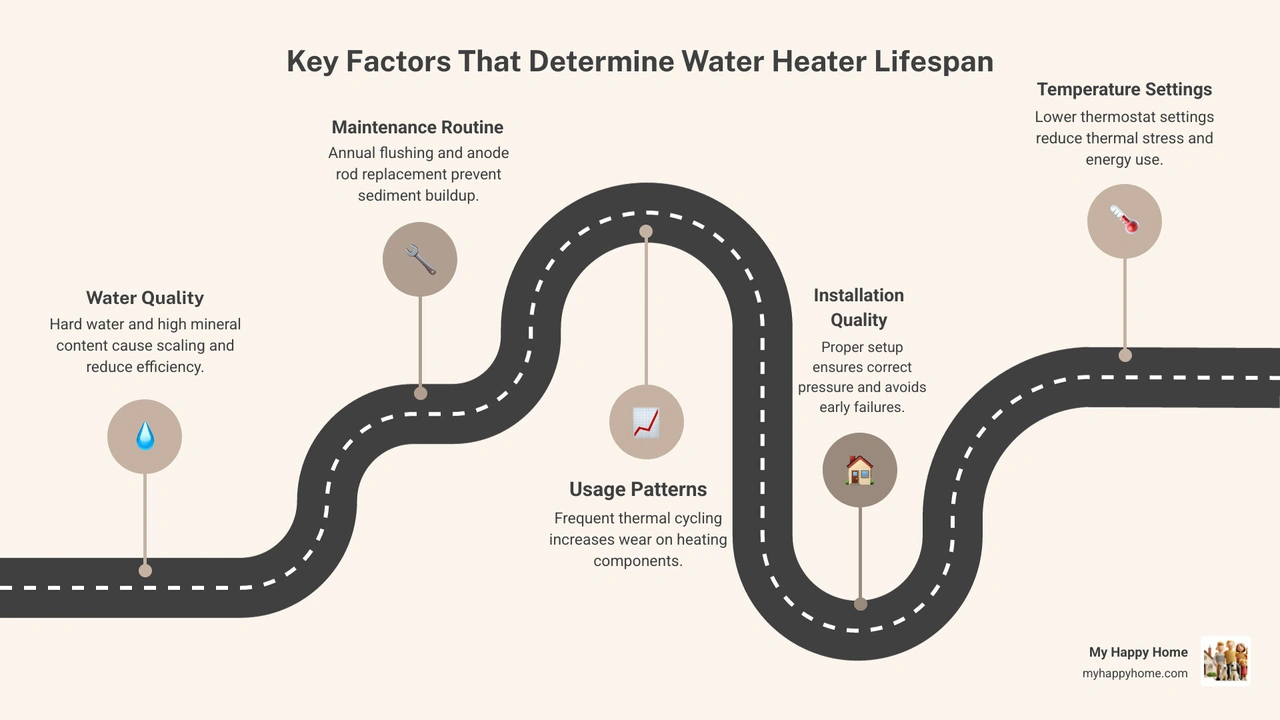
Key Factors That Determine Water Heater Longevity
While the manufacturer's estimate gives you a baseline, real-world lifespans vary based on several environmental and operational factors. Understanding these can help you protect your investment. If you want to keep your plumbing system in top shape, working with Professional Plumbing Services for regular inspections is the most effective approach.

The Impact of Hard Water and High Pressure
Water quality and system pressure are two silent killers of residential water heaters. In O'Fallon, MO, municipal and well water sources often contain dissolved minerals like calcium and magnesium. When heated, these minerals precipitate out of the water, forming a hard crust known as calcium carbonate or scale.
In tank-style heaters, this scale settles to the bottom, forming a thick layer of sediment that insulates the water from the burner or heating elements. As a result, the bottom of the tank overheats, weakening the steel and accelerating tank failure.
Excessive water pressure also places immense structural strain on your plumbing. If your home's water pressure exceeds 80 PSI, the constant high force can cause the tank to expand beyond its limits, stressing the welded joints and leading to premature leaks. Thermal expansion—the increase in water volume that occurs as water is heated—compounds this issue if your system lacks a properly functioning expansion tank. Installing a water softener to remove minerals and a pressure-reducing valve to keep your home's water pressure between 40 and 60 PSI can add years to your water heater's life.
Thermostat Settings and Usage Demands
The temperature setting on your water heater directly influences its rate of wear and tear. Many manufacturers ship water heaters with the thermostat set to 140°F, but most residential plumbing experts recommend turning it down to 120°F.
A higher temperature setting accelerates mineral precipitation and scaling. It also increases standby heating cycles, meaning the unit fires up more frequently to maintain that high temperature, leading to rapid thermal cycling and faster component degradation.
Heavy usage demands also shorten a system's lifespan. A large household that runs back-to-back showers, laundry, and dishwashers subjects the water heater to constant cold-water flushes. This rapid introduction of cold water causes rapid temperature drops and intense thermal expansion cycles, wearing out the heating elements or burners much faster than in a home with lower demand.
Warning Signs Your Water Heater Is Failing
A failing water heater rarely goes quietly. It will usually drop hints that its time is coming to an end. Recognizing these signs early can save you from a messy, stressful emergency. If you notice any of these red flags, it is wise to schedule a Water Heater Repair Service immediately.
- Rusty or Discolored Water: If your hot water runs red, yellow, or rusty, but your cold water runs clear, the inside of your tank or its sacrificial anode rod is likely corroding.
- Metallic Taste or Odor: A distinct metallic taste or a rotten-egg smell from your hot water taps points to heavy sediment buildup, bacterial growth, or internal tank decay.
- Strange Noises: Popping, banging, or rumbling sounds coming from the utility closet are a classic sign of heavy sediment buildup. The noise is caused by steam bubbles escaping from beneath the hardened layer of scale at the bottom of the tank.
- Active Leaks: Any pooling water around the base of your tank is an immediate warning. While a leaking valve might be repairable, a leak coming from the actual body of the tank cannot be fixed and requires immediate replacement.
- Temperature Fluctuations: If your water goes from hot to icy cold without warning, your heating elements, thermostat, or gas burners are likely failing.
Decoding Serial Numbers to Find Unit Age
If you aren't sure how old your water heater is, you can easily find out by looking at the data plate on the side of the tank. The manufacture date is almost always encoded within the serial number.
For most major brands, the serial number uses a letter to represent the month and two digits to represent the year. For example, in a serial number starting with F20, the "F" represents the sixth letter of the alphabet (June), and "20" represents the year 2020.
Other manufacturers use a simple numerical format where the first four digits represent the year and week of manufacture (e.g., 1824 would mean the 24th week of 2018). If the label is faded or hard to read, you can use the manufacturer's official online age lookup tool or consult a professional to establish your system's "planning age" so you aren't caught off guard.
Repair vs. Replace: How to Make the Right Decision
When your water heater acts up, you face a common dilemma: do you patch it up or invest in a brand-new system? To make an objective, cost-effective choice, we recommend using two industry standard guidelines: the 50% rule and the one-third rule.
The 50% rule states that if the cost of repairing your current water heater exceeds 50% of the cost of a brand-new unit, replacement is almost always the smarter financial move.
The one-third rule is an age-based variation: if the unit is over 8 years old and the repair bill is more than one-third of the replacement cost, you are likely better off upgrading. Spending significant money to repair an older unit that is already nearing the end of its typical lifespan is often just delaying the inevitable.
When to Upgrade to High-Efficiency Systems
If you decide to replace your system, look beyond a simple like-for-like swap. Upgrading to a high-efficiency system can deliver significant long-term energy savings.
An ENERGY STAR certified heat pump water heater (also known as a hybrid water heater) is one of the most efficient options available today. Instead of creating heat directly, it pulls heat from the surrounding air and transfers it into the water. These hybrid systems can reduce water heating energy use by up to 70% compared to standard electric models.
While they require a slightly higher initial investment, the dramatic reduction in your monthly utility bills and their positive environmental impact make them an incredibly smart upgrade for homeowners looking to future-proof their properties.
Proven Maintenance Strategies to Extend Water Heater Life
The single most effective way to maximize your water heater's lifespan is to establish a consistent maintenance routine. By taking care of a few simple tasks annually, you can prevent corrosion, scale buildup, and premature component failure.
- Perform an Annual Flush: Drain and flush your water heater tank at least once a year to wash away accumulated sediment. This keeps the heating elements clear and prevents the tank bottom from overheating.
- Inspect and Replace the Anode Rod: Check the condition of your sacrificial anode rod every several years. If it is heavily corroded or down to its wire core, replace it immediately to keep your tank protected.
- Test the T&P Valve: The Temperature and Pressure Relief (T&P) valve is a critical safety feature that prevents your water heater from over-pressurizing. Lift the test lever annually to ensure water flows out and stops completely when you release the lever.
- Keep the Temperature at 120°F: Lowering your thermostat from 140°F to 120°F reduces standby heat loss, saves energy, and significantly slows down mineral scaling inside the unit.
- Install a Water Softener: If your home has hard water, a whole-house water softener is the ultimate defense, removing minerals before they can settle inside your water heater and plumbing fixtures.
Frequently Asked Questions About Water Heater Lifespan
Can a water heater last 20 years?
While traditional storage tank water heaters rarely make it to the 20-year mark due to constant water contact and tank corrosion, tankless and solar water heaters can easily last 20 years or more. To achieve this kind of longevity, these systems require exceptional, consistent maintenance, including regular descaling and water filtration.
Does a water softener extend water heater lifespan?
Yes, absolutely. By removing heavy minerals like calcium and magnesium from your incoming water supply, a water softener prevents scale from accumulating on heating elements and tank walls. This protects the tank from overheating, keeps heating efficiency high, and can add several years to your system's life.
What causes popping or rumbling noises in a water heater?
Popping and rumbling noises are caused by sediment accumulation at the bottom of the tank. As water becomes trapped beneath this layer of hardened mineral scale, it boils and turns to steam. The popping sound is the steam bubbles bursting through the sediment layer. Draining and flushing the tank can resolve this issue if caught early.
Enjoy Ultimate Peace of Mind with My Happy Home
Dealing with a failing water heater is stressful, but it doesn't have to be. At My Happy Home, we believe in taking the surprise out of home repairs. Our subscription-based protection plans provide comprehensive, budget-friendly coverage for your home's most essential systems, including HVAC, plumbing, electrical, and major appliances.
With a Water Heater Protection Plan, you get access to 24/7 support and our network of vetted, licensed service professionals. If your water heater begins to act up, you won't have to worry about finding an honest plumber or facing a massive, unexpected repair bill. We manage everything from diagnostic scheduling to service completion, ensuring your home remains warm and comfortable all year round.
If your system is showing its age and you are ready to explore your options, contact us today to learn more about our Water Heater Installation & Replacement services and find the perfect membership plan to protect your home. Say goodbye to surprise repair bills and hello to predictable, worry-free homeownership!