
The complete guide to deciding on AC repair or replacement
How to Decide Between AC Repair and Replacement: Start With the Big Picture
Knowing how to decide between AC repair and replacement can save you from either overpaying for a dying system or replacing one that still has years of life left. It's one of the most stressful calls a homeowner has to make — especially when the heat is on and your family is uncomfortable.
Here's a quick-reference guide to help you make the right call:
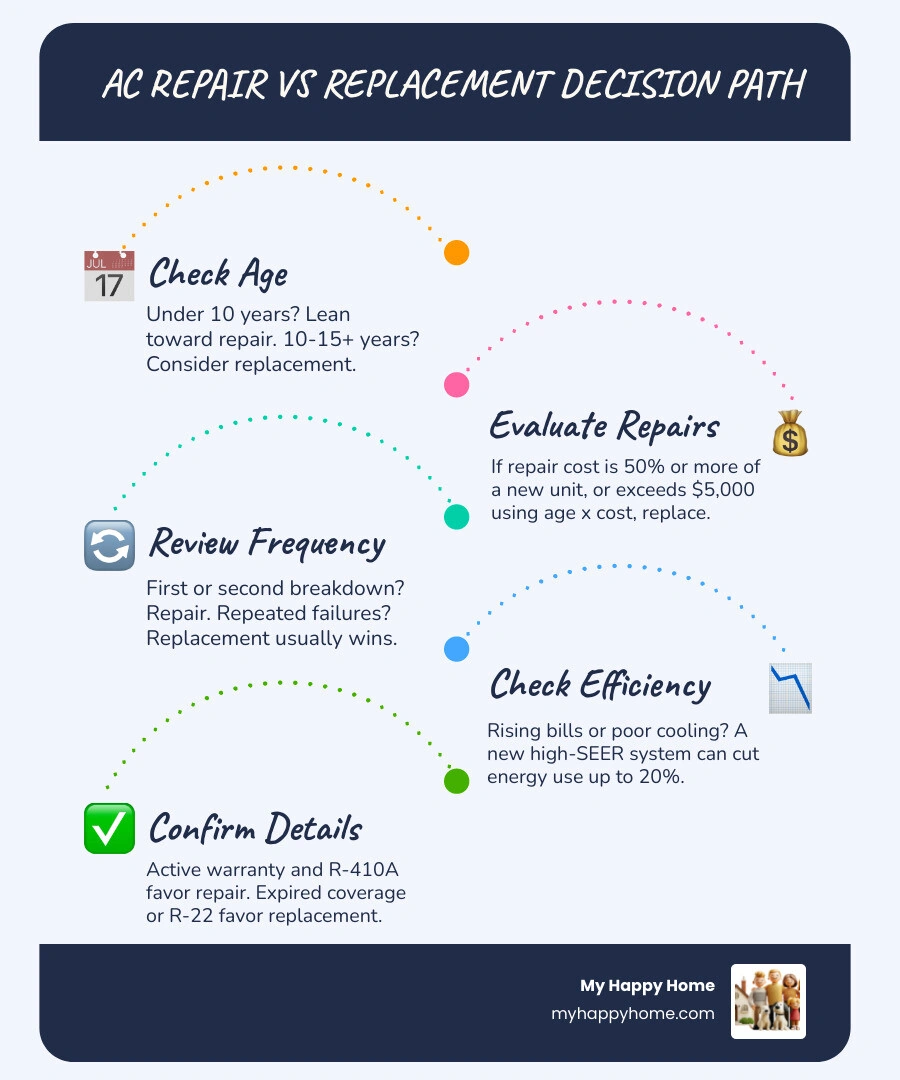
- Factor: Unit Age; Lean Toward Repair: Under 10 years old; Lean Toward Replacement: 10-15+ years old
- Factor: Repair Cost; Lean Toward Repair: Less than 50% of new unit cost; Lean Toward Replacement: 50% or more of new unit cost
- Factor: Age x Repair Cost; Lean Toward Repair: Result is under $5,000; Lean Toward Replacement: Result exceeds $5,000
- Factor: Breakdown Frequency; Lean Toward Repair: First or second issue; Lean Toward Replacement: Repeated failures
- Factor: Energy Bills; Lean Toward Repair: Stable year over year; Lean Toward Replacement: Rising without explanation
- Factor: Refrigerant Type; Lean Toward Repair: R-410A (current standard); Lean Toward Replacement: R-22 (phased out, expensive)
- Factor: Warranty; Lean Toward Repair: Still active; Lean Toward Replacement: Expired
- Factor: Cooling Performance; Lean Toward Repair: Consistent and even; Lean Toward Replacement: Uneven, weak, or humid
Most residential AC systems are built to last between 10 and 15 years. Once a unit starts crossing that threshold — especially with rising energy bills, frequent breakdowns, or an outdated refrigerant like R-22 — the math often shifts in favor of replacement. But age alone isn't the whole story. A well-maintained 12-year-old system with one minor issue is a very different situation from a neglected 8-year-old unit that's already had three service calls this summer.
This guide will walk you through each factor clearly, so you can make a confident decision — not a rushed one.
I'm Matthew Palmieri, founder of My Happy Home, and with a background spanning HVAC repair, replacement, and home protection plans, I've helped countless homeowners work through exactly this kind of decision. My experience in contractor operations and home services gives me a practical, homeowner-first perspective on how to decide between AC repair and replacement that goes beyond a simple yes or no. Let's walk through everything you need to know.
The Fast Answer: When Repair Usually Makes Sense
Repair is usually the smart move when your AC:
- Is under 10 years old
- Has a minor or isolated issue
- Has not needed repeated service
- Still cools the home evenly
- Is covered by an active warranty
In other words, if the system is relatively young and this is more of a hiccup than a pattern, repair often makes sense. A failed capacitor, thermostat issue, drainage problem, or electrical component can often be resolved without turning the whole situation into a replacement project.
The Fast Answer: When Replacement Is Usually the Better Move
Replacement is usually the better move when your AC:
- Is 10 to 15 years old or older
- Has frequent breakdowns
- Uses R-22 refrigerant
- Struggles with efficiency and comfort
- Leaves some rooms warm and others sticky
- Has safety concerns
If you are pouring money, time, and patience into a system that keeps disappointing you, that is usually a sign the unit is not having a bad day. It is having the end of its life.
Check the Age, Condition, and Repair Pattern of Your System

Age matters because AC systems are mechanical equipment. They wear down. Motors, coils, capacitors, contactors, insulation, wiring, and seals all age over time. Most central AC systems last about 10 to 15 years with proper maintenance, and some may last longer under ideal conditions. But once a system reaches that range, repairs tend to become more frequent and efficiency usually drops.
Condition matters just as much as age. A 9-year-old unit that has been neglected may be in worse shape than a 13-year-old system that has had yearly service and clean airflow.
How to Decide Between AC Repair and Replacement Based on Unit Age
A simple age-based framework helps:
- Under 10 years old: Usually worth repairing, especially if the issue is minor and the system has been reliable.
- 10 to 15 years old: This is the gray area. We need to look closely at repair history, energy use, warranty status, and refrigerant type.
- Over 15 years old: Replacement often becomes the stronger long-term choice, especially if a major component has failed.
A helpful way to think about it is remaining useful life. If a repair might buy you many more years, it can be worthwhile. If it is only buying time for a unit that is already near the finish line, replacement may be the better investment.
Is This a One-Time Repair or a Pattern of Breakdowns?
One repair does not automatically mean you need a new system. But a pattern of repairs changes the equation fast.
Ask yourself:
- Have we needed service more than once in the last year?
- Is the same problem coming back?
- Are larger components starting to fail?
- Does the system seem to fail during the hottest part of summer every year?
Repeated breakdowns are a major sign that replacement may be the more practical path. At that point, you are not just paying for parts. You are paying in stress, missed time, and the joy of sweating indoors while pretending box fans are a lifestyle choice.
If your system is acting up repeatedly, our AC Repair Service team can help identify whether it is a fixable issue or a sign of broader system decline.
What Your Maintenance History Says About the Decision
Regular maintenance can stretch system life and improve efficiency. Annual tune-ups help catch issues like dirty coils, clogged drains, airflow restrictions, loose electrical connections, and worn components before they turn into breakdowns.
A neglected system may still be repairable, but we need to be realistic. If years of dirt, strain, and poor airflow have taken a toll, one repair may not restore dependable performance.
Our AC Maintenance Tune-Up service can help keep systems running longer and more efficiently.
Maintenance warning signs that matter:
- You cannot remember the last professional tune-up
- The filter is often dirty or overdue
- The outdoor coil is clogged with debris
- Airflow from vents is weaker than it used to be
- The system runs longer than normal to reach the thermostat setting
- You have had frozen coils or drain line issues before
Compare Short-Term Fixes With Long-Term Value
Sometimes the cheapest move today is not the least expensive move over the next few years. That is why we like using a few simple decision rules instead of relying on gut instinct alone.
- Factor: System age; Repair May Make Sense: Younger unit; Replacement May Make Sense: Older unit near end of lifespan
- Factor: Repair scope; Repair May Make Sense: Minor component or isolated issue; Replacement May Make Sense: Major component failure or multiple issues
- Factor: Reliability; Repair May Make Sense: Rare service calls; Replacement May Make Sense: Ongoing breakdown pattern
- Factor: Efficiency; Repair May Make Sense: Bills and performance are stable; Replacement May Make Sense: Bills rising, system working harder
- Factor: Comfort; Repair May Make Sense: Home cools evenly; Replacement May Make Sense: Hot spots, humidity, weak airflow
- Factor: Refrigerant; Repair May Make Sense: Current refrigerant; Replacement May Make Sense: Outdated refrigerant, harder to service
How to Decide Between AC Repair and Replacement Using the 50% Rule
The 50% rule is one of the easiest benchmarks to use. If a repair is going to cost 50% or more of what a replacement would cost, replacement is usually the smarter move.
Why? Because if you are already spending that much on an aging system, you are still left with older equipment after the repair is done. You have spent heavily, but you have not reset the clock.
This rule is most useful when:
- The system is older
- The repair involves a major component
- Efficiency has already declined
- The unit has a history of other issues
It is not a law of physics. It is a decision tool. A newer unit with a large repair may still be worth fixing. But for older equipment, the 50% rule is often a strong signal.
How the $5,000 Rule Helps Simplify the Choice
Another common guideline is the $5,000 rule:
- Multiply the age of the system by the repair cost
- If the result is over $5,000, replacement is generally favored
This is not perfect, but it helps put age and repair cost together in one quick test. A repair on a 5-year-old system is different from the same repair on a 14-year-old one. The older system simply has less runway left.
The main value of this rule is that it helps us avoid the sunk-cost trap. Just because you repaired the system last year does not mean you should keep repairing it forever.
Will a Newer System Lower Future Energy Use?
In many cases, yes. Older AC systems lose efficiency over time, and newer systems are designed to perform better with less energy. Replacing an older unit with a properly installed ENERGY STAR-certified system can reduce heating and cooling costs by up to 20%, according to the research provided.
High-efficiency systems can also offer:
- Better humidity control
- More even temperatures
- Quieter operation
- Improved airflow management
- Compatibility with smart thermostats and modern controls
If your current system is older and inefficient, AC Installation Replacement may provide better long-term value than repeated repairs.
Evaluate Performance, Comfort, and Refrigerant Issues
Sometimes the decision has less to do with a single broken part and more to do with how the system actually feels in daily life. If your AC runs constantly, struggles to keep up, or leaves the house damp and uneven, the system may be telling you it is worn out even if it technically still runs.
Rising Energy Bills Can Signal Declining Efficiency
If your energy bills are going up without a major change in how you use the system, declining AC efficiency may be the reason. Older equipment often has to run longer and work harder to deliver the same cooling.
That can happen because of:
- Dirty or damaged coils
- Refrigerant issues
- Aging motors or compressors
- Airflow restrictions
- General wear and tear
A tune-up can sometimes restore lost performance, which is why maintenance matters. If you are not sure whether efficiency loss is due to neglect or aging equipment, start with a professional assessment and regular service. Our guide on How Often Should You Schedule an AC Tune-Up is a good next read.
Poor Cooling and Humidity Control Often Mean Bigger System Problems
A healthy AC should cool consistently and help remove indoor humidity. If some rooms are always hot, the house feels clammy, or the system short cycles, there may be a larger issue than a simple repair can solve.
Common warning signs include:
- Uneven cooling from room to room
- Warm air coming from vents
- Sticky indoor air
- Weak airflow
- Ice forming on the unit
- Constant cycling without reaching the set temperature
Some of these problems can be repair-related. Others point to a system that is poorly matched to the home, losing efficiency, or reaching the end of its service life.
For related troubleshooting, see:
- Why Is My AC Blowing Warm Air Troubleshooting Steps
- Ice Forming on Your AC Unit Causes and What to Do
Why Refrigerant Type Matters More in 2026
In 2026, refrigerant type is a major repair-vs-replace factor. If your system uses R-22, that is a red flag. R-22 has been phased out in the U.S., which means it is no longer produced or imported. As a result, leak repairs and refrigerant-related service on R-22 systems can become difficult and expensive.
If an older unit using R-22 develops a refrigerant leak or needs a major sealed-system repair, replacement is often the more sensible path.
By contrast, systems using R-410A are generally easier to service in the current market. Either way, if refrigerant is part of the issue, we want a professional diagnosis before making a final decision.
Don’t Ignore Warranty Coverage, Safety, and Your Home Plans
The repair-or-replace question is not only about mechanical condition. Warranty coverage, home safety, and your future plans all matter too.
Is the System Still Under Warranty or Fully Out of Pocket?
Warranty coverage can shift the decision in favor of repair, especially for younger units. If key parts are still covered, a repair may be much easier to justify.
Check:
- Manufacturer parts warranty status
- Whether the warranty was properly registered
- Whether coverage has expired due to age
- What is excluded from coverage
If the warranty is gone and the unit is older, replacement often becomes more attractive because newer systems usually come with stronger warranty protection.
Safety Problems That Push the Decision Toward Replacement
Safety always comes first. While many AC problems are inconvenient rather than dangerous, some HVAC issues can create real hazards.
Watch for:
- Burnt wiring or scorched electrical components
- Repeated breaker trips
- Signs of overheating
- Fire-risk electrical faults
- For combined HVAC systems, a cracked heat exchanger in a furnace can create carbon monoxide danger
If there is any sign of a safety issue, shut the system down and call for service right away. Safety concerns can move the decision quickly toward replacement, especially when the equipment is older.
How Long You Plan to Stay in the Home Changes the Best Choice
Your timeline matters more than many homeowners realize.
If you plan to stay in the home for many years, replacement can make more sense because you are more likely to benefit from:
- Lower energy use
- Better comfort
- Fewer breakdowns
- New warranty coverage
- Improved peace of mind
If you expect to move soon, a repair may be reasonable if it safely restores function and the system is otherwise stable. On the other hand, a newer AC can also be a selling point and may improve resale appeal. There is no universal answer here. The best choice depends on whether you are optimizing for short-term practicality or long-term value.
Frequently Asked Questions About How to Decide Between AC Repair and Replacement
Should you repair a unit that still cools but struggles on very hot days?
Maybe. AC systems have performance limits. In general, many systems can only cool the inside of a home to about 20 degrees below the outdoor temperature under demanding conditions. So if it is extremely hot outside, some performance drop is normal.
But if your system cannot keep the home comfortable, runs non-stop, or has become less reliable during peak summer than it used to be, that is worth evaluating. For an older unit, this can be a sign that replacement is getting close.
What if the issue is just the thermostat or power problem?
That is exactly why we should not jump straight to replacement. Sometimes the problem is surprisingly simple:
- Thermostat settings are off
- Batteries are dead
- A breaker has tripped
- The disconnect is off
- The air filter is severely clogged
Before assuming the worst, review:
Simple problems do not mean your system is doomed. They mean your AC might just be having a dramatic moment.
When should you call for a professional evaluation?
Call for a professional evaluation when:
- Your unit is over 10 years old and acting up
- You have had multiple repairs in a short period
- Energy bills are rising without explanation
- The system makes new or unusual noises
- Airflow has dropped off
- Cooling is uneven
- Humidity problems are getting worse
- You want a pre-season inspection before summer heat arrives
Helpful resources:
A good evaluation should look at age, condition, repair history, refrigerant type, efficiency, and safety. We want a full picture, not a guess.
Conclusion: Make the Choice That Protects Comfort, Safety, and Long-Term Value
When we think about how to decide between AC repair and replacement, the best answer usually comes from combining a few factors instead of focusing on just one. Age matters. Repair history matters. Refrigerant matters. Comfort matters. Safety definitely matters.
A quick checklist:
- Is the system under 10 years old or nearing the end of its lifespan?
- Is this a one-time repair or part of a pattern?
- Does it still cool evenly and control humidity?
- Are energy bills rising?
- Does it use R-22?
- Is the warranty still active?
- Do you plan to stay in the home long enough to benefit from replacement?
If you work through those questions honestly, the right direction usually becomes much clearer.
And if you want help sorting through it, we are here to make the process easier. Whether you need a diagnosis, ongoing maintenance, or guidance on the next step, My Happy Home can help you protect comfort, safety, and long-term value. Start with our AC Repair Service, explore AC Installation Replacement, or take a proactive step with an AC Maintenance Tune-Up.
If you are looking for a simpler way to stay ahead of AC problems and other unexpected home repairs, My Happy Home also offers a modern home repair coverage plan approach that helps homeowners stay protected with less stress and more peace of mind.