
Stop making your AC work harder than it has to
Why Dirty Air Filters Are Silently Destroying Your AC Performance
How dirty air filters destroy your AC performance is simpler to understand than most people think — and the damage happens faster than you'd expect.
Here's the short answer:
- Restricted airflow forces your AC to work harder to move the same amount of air
- Cooling efficiency drops as the system struggles to reach your thermostat setting
- Energy bills climb by as much as 15%, according to the U.S. Department of Energy
- Evaporator coils freeze when warm air can't flow across them properly
- The blower motor overheats from the constant extra strain
- Short cycling begins — the system turns on and off repeatedly, wearing out components fast
- Indoor air quality suffers as dust, dander, and allergens recirculate through your home
That chain reaction all starts with one neglected filter.
Your air conditioner relies on steady, unobstructed airflow the same way you rely on being able to breathe freely. The moment that airflow gets blocked — even partially — every component in the system feels it. And yet, research shows that 29% of Americans never replace their air filters at all.
Heating and cooling already account for nearly half of your home's total energy use. A dirty filter makes that number worse for no good reason. In May 2026, with peak cooling season arriving fast, this is exactly the kind of simple maintenance that keeps a busy household comfortable — and keeps repair bills from catching you off guard.
How Dirty Air Filters Destroy Your AC Performance
Think of your HVAC system as a marathon runner. To perform at its best, it needs to breathe deeply and consistently. When you leave a dirty filter in place, it’s like asking that runner to complete a race while breathing through a thick wool blanket. The system doesn't just stop; it struggles, gasps for air, and eventually, the internal parts start to fail.
The primary way how dirty air filters destroy your AC performance is through airflow restriction. When the filter media is packed with dust, pet hair, and skin cells, the blower fan has to exert significantly more force to pull air through the blockage. This creates a massive amount of system strain that ripples through every mechanical part.
To ensure your system isn't fighting a losing battle, regular AC Maintenance Tune-Up is essential. Without it, you are essentially paying more for less comfort.
How Dirty Air Filters Destroy Your AC Performance and Efficiency
When we talk about cooling capacity, we are talking about your AC’s ability to remove heat from your home. A clogged filter acts as a barrier, preventing the system from pulling in enough warm air to be cooled. This leads to a noticeable drop in efficiency.
According to the U.S. Department of Energy, a dirty filter can cause a 15% spike in energy consumption. Because the HVAC system has to run for much longer cycles to reach the desired temperature on your thermostat, it consumes more electricity than it was ever designed to use.
- Filter Condition: Clean / New; Energy Usage Increase: 0% (Baseline); Cooling Effectiveness: 100%
- Filter Condition: Lightly Soiled; Energy Usage Increase: 5% - 7%; Cooling Effectiveness: 90%
- Filter Condition: Heavily Clogged; Energy Usage Increase: 15% +; Cooling Effectiveness: 60% - 70%
The Impact on Monthly Utility Bills
In O'Fallon, MO, where summer humidity can make the air feel like a warm, wet towel, your AC is already working overtime. Heating and cooling devour almost 50% of the energy used in the average American home. When you add a 15% efficiency penalty due to a $20 filter, you are effectively throwing money out the window.
A dirty filter turns your Air Conditioning Protection Plan into a necessity rather than a luxury. By keeping that filter clean, you ensure that your monthly utility bills stay predictable rather than skyrocketing during the hottest months of May and June.
The Domino Effect: Mechanical Failures and System Damage
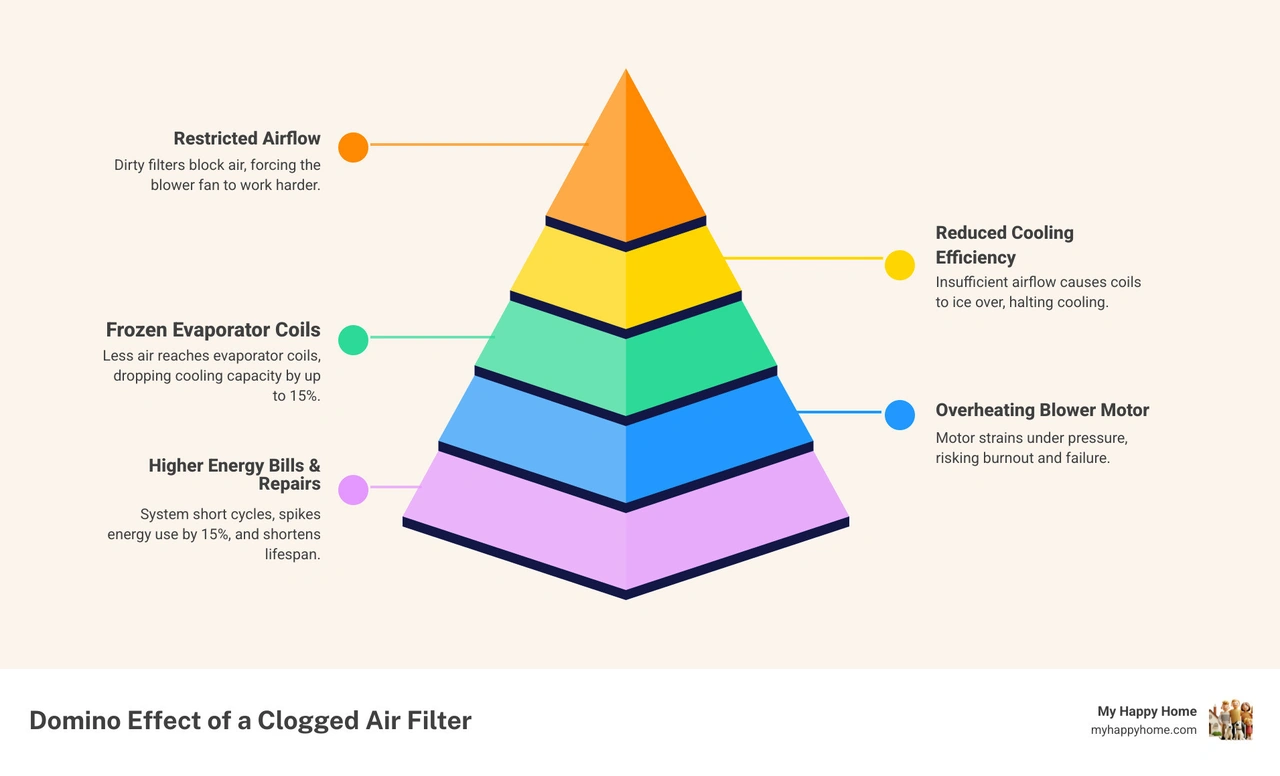
A dirty filter doesn't just make the air a little warmer; it can trigger a "domino effect" of mechanical failures. It starts with the filter, but it ends with the most expensive parts of your machine.
One of the most common results of restricted airflow is Ice Forming on Your AC Unit: Causes and What to Do. When air can't pass over the evaporator coils, those coils get too cold and freeze the condensation on them. This creates a block of ice that completely stops the cooling process. Furthermore, the extra electrical draw from a struggling motor is a common reason why an AC Circuit Breaker Keeps Tripping: What It Means.
Short Cycling and Overheating Risks
Short cycling is when your AC turns on and off every few minutes. This happens because the system is overheating or sensing that it can't move enough air to operate safely. This constant stopping and starting is brutal on your system's lifespan. It wears out the compressor and the blower motor—the two most expensive parts to fix.
If you find your AC Not Turning On: What to Check First should always be that air filter. An overheated motor may trigger a safety shut-off that prevents the system from starting until it cools down or the blockage is removed.
Why Restricted Airflow Leads to Frozen Evaporator Coils
The science is simple: your AC works by blowing warm indoor air over cold coils filled with refrigerant. The refrigerant absorbs the heat, leaving the air cool. If a dirty filter blocks that warm air, the refrigerant stays too cold. Moisture from the air (humidity) then hits those freezing coils and turns into ice.
Once the ice starts to form, it acts as an insulator, making the problem even worse. Eventually, you’ll need an AC Repair Service to safely thaw the unit and check for permanent damage to the compressor.
Recognizing the Warning Signs in Your Home
You don't always need to open the HVAC cabinet to know your filter is failing. Your home will tell you.
If you notice Why Is My AC Blowing Warm Air? Troubleshooting Steps, the first culprit is almost always the filter. You might also notice weak airflow—where the air coming out of the vents feels like a faint whisper rather than a steady breeze. Before you panic, check these AC Troubleshooting Tips Before Calling a Pro.
Visible Signs of How Dirty Air Filters Destroy Your AC Performance
- Discolored Media: A new filter is white or off-white. A dirty one will be gray, brown, or even black.
- Dust on Furniture: If you find yourself dusting your coffee table every two days, your filter is likely full and can no longer trap new particles.
- Musty Odors: Damp dust trapped in a filter can grow mold or bacteria, leading to a "dirty sock" smell whenever the AC kicks on.
- Thermostat Struggles: If your thermostat is set to 72 but the house won't get below 78, the system is likely "choked." Be sure to How to Check Your Thermostat Before Calling for AC Repair to ensure the settings are correct, but then look straight at the filter.
Indoor Air Quality and Respiratory Health
Your HVAC filter is the "lungs" of your home. It is designed to trap allergens, pet dander, and microscopic PM2.5 particles that can aggravate asthma or allergies. When the filter is clogged, these pollutants have nowhere to go but back into your living space.
For residents in O'Fallon, MO, where seasonal allergies can be intense, a clean filter is a medical necessity. Neglecting it doesn't just hurt the machine; it can lead to increased respiratory distress for everyone in the house. This is why a regular Furnace Maintenance Tune-Up (which includes the filter) is vital even when you aren't using the heat.
Choosing the Right Filter and Maintenance Schedule
Not all filters are created equal. Choosing the wrong one can be just as bad as leaving a dirty one in place.
Understanding MERV Ratings and System Strain
MERV stands for Minimum Efficiency Reporting Value. It’s a scale from 1 to 16 that tells you how good the filter is at catching small particles.
- MERV 1-4: Basic fiberglass filters. They stop "golf ball" sized dust but won't help with allergies.
- MERV 8-11: The "sweet spot" for most homes. These trap dander and pollen without putting too much strain on the motor.
- MERV 13-16: High-efficiency filters. These are great for air quality but can be so thick that they actually restrict airflow in older systems, mimicking a dirty filter.
Always check your manufacturer's specs or consult your HVAC Protection Plan details to see what rating your system can handle.
Recommended Replacement Intervals for May 2026
How often should you swap it out? It depends on your lifestyle. While the standard advice is every 90 days, that’s a "best-case scenario." You should check yours monthly if:
- You have pets (fur and dander clog filters fast).
- You live in a dusty area or near construction.
- Someone in the home has a respiratory condition.
- It is peak summer (May through September) and the AC runs 24/7.
For more on what to look for during these checks, see our AC Tune-Up Guide: What to Expect.
Step-by-Step Guide to Maintaining Your Air Filter
Replacing a filter is the single easiest DIY task in homeownership. Here is how to do it safely.
How to Safely Replace Your HVAC Filter
- Power Down: Turn off your AC at the thermostat. You don't want the system to kick on while the filter is out, as it will suck raw dust directly into the internal components.
- Locate the Filter: It’s usually in a slot next to the indoor air handler or behind a large return air grille in a wall or ceiling.
- Note the Direction: Look at the old filter before you pull it out. There will be an arrow on the frame. This arrow must point toward the furnace/AC unit (the direction the air is traveling).
- Check the Size: The dimensions (e.g., 20x20x1) are printed on the side. Make sure your new one matches exactly.
- Slide it In: Insert the new filter, ensuring the arrow is pointing the right way, and secure the cover.
If you are unsure of the location, check these AC Troubleshooting Tips Before Calling a Pro.
Cleaning Washable Filters Correctly
Some systems use permanent, washable filters. If you have one of these:
- Rinse: Use a garden hose or a showerhead to spray water through the filter in the opposite direction of the airflow.
- Dry Completely: This is the most important step. Never put a wet filter back into your AC. It will grow mold and can cause the system to freeze up. Let it air dry for at least several hours.
- Reinstall: Once bone-dry, slide it back into the HVAC cabinet.
Frequently Asked Questions About Dirty Air Filters
Can a dirty air filter cause my AC to blow warm air?
Yes. When the filter is clogged, the evaporator coil doesn't get enough air to absorb heat properly. This can cause the coil to freeze into a block of ice, which blocks all airflow. The air that does manage to squeeze through won't be cooled, resulting in warm air coming from your vents.
How much does a clogged filter increase my energy bill?
On average, a clogged filter increases energy consumption by about 15%. Since cooling accounts for a huge portion of your summer utility costs, this can add up to a significant amount of money wasted every month.
Will a dirty filter really break my air conditioner?
It absolutely can. The restricted airflow forces the blower motor to run hotter and harder. Over time, this leads to motor burnout or compressor failure. Replacing a compressor can be one of the most expensive repairs in the industry—often costing thousands—all because of a neglected $20 filter.
Conclusion
Understanding how dirty air filters destroy your AC performance is the first step toward a more comfortable, affordable home. It’s a small part with a massive responsibility. By spending five minutes once a month to check your filter, you protect your system from catastrophic failure, keep your energy bills low, and ensure your family breathes clean air.
At MyHappyHome™, we believe homeownership shouldn't be stressful. Our membership plans are designed to take the guesswork out of maintenance. Whether you need a seasonal AC Maintenance Tune-Up or protection against unexpected breakdowns, we are here to help you keep your home running smoothly. Don't let a dusty filter stand between you and a cool, happy home this summer.