
Are two-stage and variable-speed systems worth it for your home?
How to Decide if a Higher-End AC System Makes Sense
Are two-stage and variable-speed systems worth the extra cost? For most homeowners planning to stay put long-term, the answer is yes — but the right choice depends on your climate, your home's ductwork, and how much you value comfort beyond just temperature.
Here's a quick breakdown:
- System Type: Single-Stage; Best For: Short-term ownership, tight budgets, mild climates; Energy Savings vs. Single-Stage: Baseline; Comfort Level: Basic
- System Type: Two-Stage; Best For: Moderate climates, balanced budgets, duct limitations; Energy Savings vs. Single-Stage: 10-20%; Comfort Level: Good
- System Type: Variable-Speed; Best For: Hot/humid climates, long-term owners, comfort-first households; Energy Savings vs. Single-Stage: 25-40%; Comfort Level: Excellent
Most families notice the difference in how their home feels — not just what the thermostat reads. Single-stage systems blast on at full power and then shut off completely, creating temperature swings and leaving excess humidity behind. Two-stage and variable-speed systems run longer at lower speeds, which pulls more moisture out of the air and keeps temperatures far more consistent. That difference matters a lot when you're trying to keep a busy household comfortable day in and day out.
I'm Matthew Palmieri, founder of My Happy Home, and with a background spanning HVAC systems, contractor operations, and home protection plans, I've helped hundreds of homeowners work through exactly this question of whether two-stage and variable-speed systems are worth the extra cost for their specific situation. In this guide, I'll walk you through everything you need to make a confident, clear-headed decision.
What’s the Real Difference Between Single-Stage, Two-Stage, and Variable-Speed AC?
To understand whether upgraded HVAC technology is worth the investment, we first have to look at how these systems handle the air in your home. The core difference lies in the compressor—the "heart" of your outdoor air conditioning unit. The compressor determines how hard the system has to work to cool your living spaces.
Modern systems are evaluated using SEER2 (Seasonal Energy Efficiency Ratio) ratings, which measure seasonal cooling efficiency. The more control a compressor has over its operational capacity, the higher its SEER2 rating and the lower your monthly energy bills will be.

How Single-Stage Systems Cool Your Home
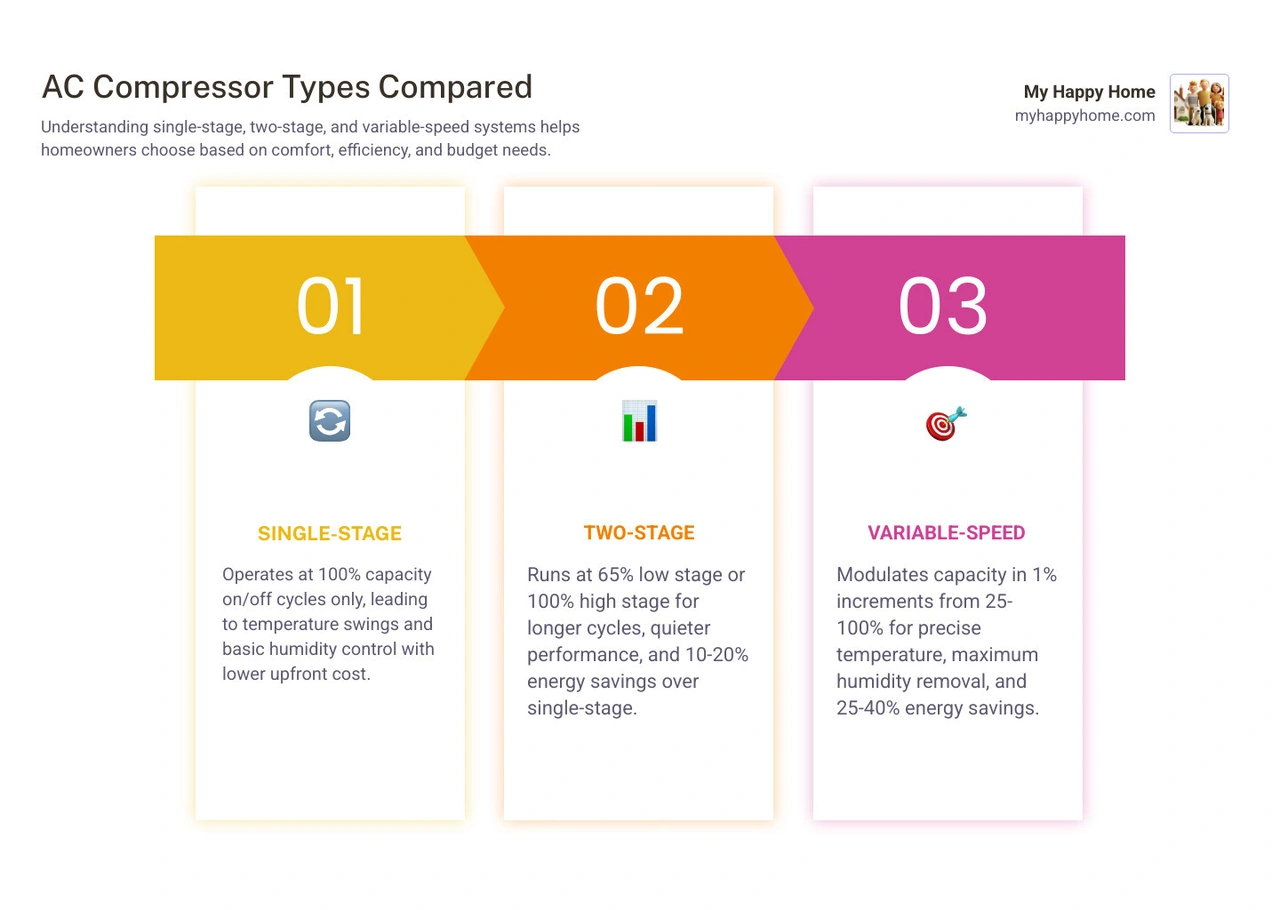
A single-stage system is the traditional standard for residential cooling. It operates on a simple binary principle: it is either 100% on or completely off. Think of it like a basic light switch.
When your indoor temperature rises above your thermostat's setpoint, the system kicks on at full capacity, blasting cold air into your home. Once the target temperature is reached, the system shuts down entirely. This constant on/off cycling creates noticeable temperature swings and places a high amount of start-up stress on the equipment. While single-stage units feature basic, highly reliable equipment with lower upfront installation costs, they are the least efficient option on the market.
How Two-Stage Systems Balance Performance and Simplicity
A two-stage system introduces a middle ground. Instead of a simple light switch, think of this system as having two distinct gears, much like a car.
- Low Stage: Runs at approximately 60% to 70% of the system's total capacity.
- High Stage: Operates at 100% capacity when outdoor temperatures spike.
A two-stage system spends about 80% of its operating time running in its low stage. Because it runs at a lower capacity, it can stay on for longer, gentler cycles. This reduces the frequent starting and stopping associated with single-stage units, resulting in quieter operation, more consistent temperatures, and improved energy efficiency.
How Variable-Speed Systems Fine-Tune Cooling
Variable-speed systems represent the pinnacle of modern HVAC engineering. Instead of fixed steps, these systems utilize advanced inverter technology to continuously modulate their output. Think of it as a dimmer switch or an automatic transmission that adjusts in real-time.
A variable-speed compressor can operate anywhere from 25% to 100% of its total capacity, adjusting in precise 1% increments based on real-time data from indoor and outdoor sensors. It calculates the exact amount of cooling required to maintain your thermostat setting and runs almost continuously at ultra-low, highly efficient speeds. This continuous modulation provides incredibly steady airflow, virtually eliminates temperature fluctuations, and delivers unmatched energy performance.
Are Two Stage and Variable Speed Systems Worth the Extra Cost for Comfort and Humidity?
When evaluating a new air conditioner, many homeowners focus solely on temperature. However, true indoor comfort is heavily dependent on relative humidity and air quality. If you have ever sat in your living room and felt like the air was heavy, sticky, or hard to breathe even though the thermostat read a cool 72 degrees, you have experienced the limits of standard single-stage cooling.
Are Two Stage and Variable Speed Systems Worth the Extra Cost in Humid Homes?
To cool your home, an air conditioner must perform two tasks: lower the air temperature (sensible cooling) and remove airborne moisture (latent cooling).
Single-stage systems cool homes very quickly, but their short runtimes do not give the indoor evaporator coil enough time to remove significant moisture. The system shuts down before the air is properly dehumidified, leaving behind cold, clammy air.
Because two-stage and variable-speed systems run longer, slower cycles, they excel at latent heat removal. As air continuously passes over the cold evaporator coil, moisture condenses and drains away. In fact, variable-speed systems can remove up to 400% more moisture than standard single-stage units. This allows them to easily maintain a comfortable 45% to 50% indoor humidity level, preventing that "sweat-chill" cycle and creating a healthier, more breathable indoor environment.
Are Two Stage and Variable Speed Systems Worth the Extra Cost for Noise and Temperature Stability?
Single-stage systems typically allow for temperature swings of 3 to 4 degrees before cycling back on, which can make different rooms feel warmer or cooler at any given moment. Variable-speed systems, by comparison, maintain your home's temperature within a fraction of a degree (often within 0.5 degrees of your setpoint).
Noise is another major comfort differentiator. Single-stage units create a loud crash when they kick on at 100% capacity, often operating at 70 to 75 decibels. Because variable-speed systems ramp up gradually and spend most of their time running at low capacities, they operate as quietly as 50 to 55 decibels—roughly the volume of a quiet conversation.
Energy Savings, Operating Costs, and Payback by Climate
The financial return on your investment in a high-efficiency system is directly tied to your local climate and how many hours your system runs each year.
- Climate Type: Hot / Arid; Typical Location Example: Phoenix, AZ; Two-Stage Energy Savings: 20-23%; Variable-Speed Energy Savings: 25-40%; Estimated Payback Period: 2 to 3 Years
- Climate Type: Moderate / Humid; Typical Location Example: O'Fallon, MO; Two-Stage Energy Savings: 20-23%; Variable-Speed Energy Savings: 25-40%; Estimated Payback Period: 4 to 6 Years
- Climate Type: Mild / Temperate; Typical Location Example: Pacific Northwest; Two-Stage Energy Savings: 10-15%; Variable-Speed Energy Savings: 15-25%; Estimated Payback Period: 8+ Years / Long-Term
Why Climate Changes the Value of a High-Efficiency System
In areas with extreme heat, air conditioners run almost constantly for several months. In these environments, the efficiency gains of a variable-speed system translate into substantial monthly utility savings, allowing homeowners to recoup their initial investment very quickly.
In moderate climates like O'Fallon, MO, we experience hot, humid summers but also extended shoulder seasons (spring and fall) where cooling demands are highly volatile. High-efficiency systems are incredibly effective here because they spend the bulk of the season operating at highly efficient part-load capacities, adapting seamlessly to changing weather patterns without wasting energy.
Where Two-Stage Offers the Best Value
For many homeowners in moderate climates, a two-stage system represents the practical "sweet spot." It requires a lower upfront premium than a variable-speed system but still delivers roughly 20% to 23% energy savings over a standard single-stage unit. If you want a significant upgrade in comfort and dehumidification without paying the premium for a fully modulating system, two-stage technology is an excellent, budget-friendly compromise.
Where Variable-Speed Delivers the Strongest Return
If you live in a region with heavy summer cooling demands, high local utility rates, or severe humidity, variable-speed systems deliver the strongest long-term return. Over a typical 15-year lifespan, a variable-speed system can reduce your energy consumption by 25% to 40% compared to a single-stage system, resulting in thousands of dollars in lifetime utility savings.
When Two-Stage May Be Smarter Than Variable-Speed
While variable-speed systems offer incredible performance, they are not the right choice for every property. There are specific scenarios where installing a two-stage system is actually the smarter, safer decision.
Homes With Ductwork or Airflow Limits
Variable-speed systems run for extended periods at low speeds, which keeps the indoor coil very cold. If your home has uninsulated or poorly insulated ductwork routed through an unconditioned attic or crawl space, this prolonged exposure to cold air can cause the exterior of the ducts to sweat. This condensation can eventually lead to water damage and mold growth.
Additionally, variable-speed systems require properly sized, low-restriction ductwork to maintain correct static pressure. If your home's duct design is restrictive or poorly balanced, a variable-speed blower motor may work overtime to push air, canceling out energy savings and putting unnecessary stress on the system. In these cases, a two-stage system is often a safer choice because its cycles are slightly shorter and less prone to causing duct condensation.
Budget-Conscious Upgrades That Still Improve Comfort
If you want to move away from the harsh temperature swings of a single-stage unit but need to keep your upfront investment manageable, a two-stage system is a fantastic compromise. It provides a significant portion of the comfort and dehumidification benefits of variable-speed technology with lower equipment complexity and a more accessible entry point.
Why Installation Quality Matters More Than the Label
No matter which technology you choose, the efficiency and lifespan of your new system depend entirely on the quality of the installation. A premium variable-speed system that is oversized, paired with incompatible indoor equipment, or installed with an incorrect refrigerant charge will perform worse and break down faster than a basic single-stage system installed correctly.
Before upgrading, it is crucial to have a professional perform a detailed load calculation to ensure your new system is perfectly matched to your home's unique footprint. To learn more about keeping your system running at peak performance, read our guide on How a Tune-Up Improves Efficiency and Lowers Bills.
Long-Term Ownership: Repairs, Maintenance, Lifespan, and What Else to Consider
Buying an air conditioner is not a one-time transaction; it is a 15-to-20-year ownership commitment. Understanding how these systems compare in long-term maintenance and reliability is key to evaluating their true value.
Which System Type Is Usually Simplest to Maintain?
Single-stage systems are highly valued for their simplicity. They use standard, widely available parts like basic contactors, capacitors, and single-speed motors. If a component fails, any qualified technician can easily source a replacement, and repairs are generally straightforward. To learn more about what goes into keeping these systems running smoothly, check out our AC Tune-Up Guide: What to Expect.
Two-stage and variable-speed systems rely on more complex components, such as electronic expansion valves, communicating thermostats, and inverter control boards. While these advanced parts enable incredible efficiency, they require specialized diagnostic tools and can be more expensive to replace if they fail outside of warranty.
Can Premium Systems Last Longer?
Despite their complexity, premium systems often enjoy a longer overall lifespan. The most damaging event for an air conditioner compressor is a "hard start"—the sudden surge of electricity and mechanical friction that occurs when a single-stage system turns on at 100% capacity.
Because two-stage and variable-speed systems start up gradually and run for longer, continuous cycles, they experience significantly fewer start-stop cycles. This dramatic reduction in daily wear and tear preserves the integrity of the compressor and motor bearings, often extending the system's operational lifespan by several years.
Don’t Overlook Maintenance Plans and Seasonal Service
Regardless of the system you choose, regular preventive maintenance is the single best way to protect your investment, lower your operating costs, and prevent unexpected breakdowns.
How often should you have your system serviced? We recommend scheduling professional maintenance at least once a year to keep your system running cleanly and efficiently. You can read more about this in our article How Often Should You Schedule an AC Tune-Up.
To take the hassle out of home maintenance, My Happy Home offers comprehensive membership plans that keep your essential home systems protected. With our subscription-based service, you can enjoy peace of mind knowing that routine care and unexpected repairs are handled by vetted, licensed professionals. Explore our Air Conditioning Protection Plan and our all-inclusive HVAC Protection Plan to keep your home comfortable year-round.
Final Verdict: Who Should Choose Single-Stage, Two-Stage, or Variable-Speed?
Making the final decision comes down to balancing your upfront budget, your long-term plans for your home, and your personal comfort priorities.
Best Fit for Short-Term Ownership or Tight Budgets
If you plan to move within the next few years, or if you are working with a strict upfront budget, a reliable single-stage system is often the most practical choice. It provides dependable cooling, is simple to service, and keeps your initial investment to a minimum.
Best Fit for Long-Term Homeowners Who Want Better Comfort
If you are planning to stay in your home for five years or longer, upgrading to a two-stage or variable-speed system is highly recommended.
- Choose a two-stage system if you want a reliable, highly effective boost in dehumidification and temperature consistency without the premium cost of fully modulating technology.
- Choose a variable-speed system if you want the absolute best in whisper-quiet operation, precise temperature control, maximum monthly energy savings, and superior indoor air quality.
Next Step if You’re Comparing Replacement Options
Replacing your air conditioner is a major home improvement decision. Our team at My Happy Home is here to help you navigate the process with ease, offering comprehensive protection plans that cover repairs and maintenance under one simple, predictable monthly membership.
Ready to explore your options? Check out our full suite of Services, learn more about our HVAC coverage, or schedule a professional consultation for your AC installation replacement today. We’re here to make homeownership simple, stress-free, and always comfortable!