
How to save money on AC with these 5 quick changes

Why Summer Cooling Costs Are Hitting Homeowners Hard in 2026
If you've been searching for summer AC energy saving tips for homeowners, you're not alone — and the timing couldn't be more important.
Here are five quick changes that can lower your cooling costs this summer:
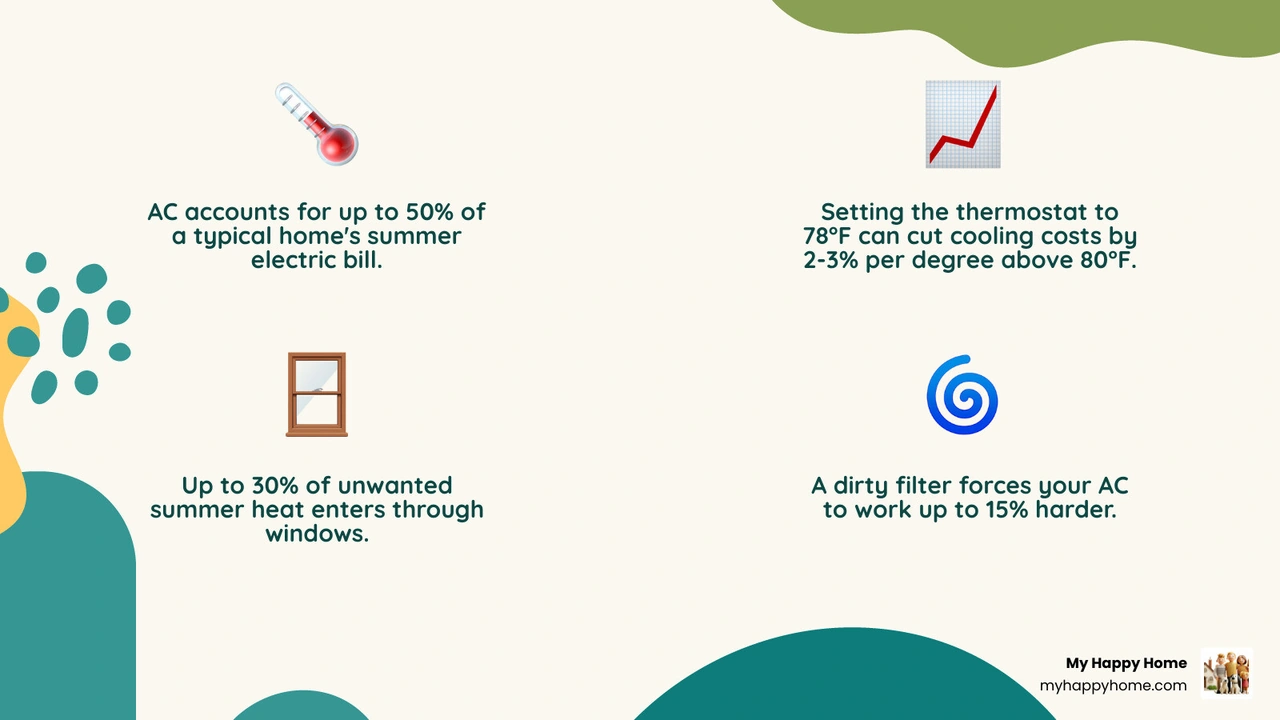
- Set your thermostat to 78°F (24°C) when you're home — each degree above 80°F saves an additional 2% to 3% on cooling costs.
- Run ceiling fans counterclockwise to create a wind chill effect, so you can raise the thermostat without feeling warmer.
- Seal air leaks around doors and windows with caulk or weatherstripping to stop cooled air from escaping.
- Close blinds or blackout curtains on south- and west-facing windows during peak sun hours — noticeably of unwanted heat enters through windows.
- Change your AC air filter regularly — a dirty filter forces your system to work up to 15% harder than it needs to.
Air conditioning already accounts for up to 50% of a home's total summer electric bill in a typical year. In May 2026, with electricity rates climbing and temperatures projected above average across much of the country, that number is hitting even harder for families trying to stay comfortable without breaking the budget. The good news? You don't need expensive upgrades to make a real difference. Small, consistent changes — many of them free or close to it — can cut your cooling costs by 20% to 30% while keeping your home cool and comfortable all season long.
I'm Matthew Palmieri, founder of My Happy Home, and with a background in HVAC, smart home technology, and home service operations, I've spent my career helping homeowners find practical, stress-free ways to manage their home systems — including actionable summer AC energy saving tips for homeowners just like the ones in this guide. Let's walk through five changes you can make right now to start saving.
Summer AC Energy Saving Tips for Homeowners: Master the Thermostat

Managing your thermostat is the single fastest way to take control of your summer utility bills. Many homeowners fall into the trap of treating their thermostat like a gas pedal—cranking it down to 65°F on a hot afternoon in the hopes that the house will cool down faster. In reality, your air conditioner runs at the exact same speed regardless of the target temperature. Setting it excessively low only ensures that the compressor runs longer, wasting energy and placing unnecessary strain on your system.
To balance comfort and cost, we recommend setting your thermostat to 78°F (24°C) when you are home and awake. If that feels a bit too warm initially, try raising the temperature by just one degree increments over a few days to let your body adjust. The savings add up quickly: for every degree you set your thermostat above 80°F, you can save approximately 2% to 3% on your cooling costs. Conversely, every degree you lower your thermostat below 78°F increases your energy consumption by roughly 3% to 5%.
The Power of Automation and Smart Thermostats
Manually adjusting your thermostat several times a day is easy to forget. That is where smart or programmable thermostats become invaluable. By programming automated temperature setbacks of 7°F to 10°F when you are away from home for eight hours or more—such as during the workday—you can save up to 10% a year on your overall cooling bills.
Modern smart thermostats take this efficiency a step further. They learn your family’s daily schedule, utilize geofencing to detect when the last person has left the house, and automatically transition into energy-saving modes. Many models also send helpful maintenance alerts when it is time to swap out your air filter or if your cooling system is failing to reach its target temperature. On average, a smart thermostat saves homeowners between $131 and $145 annually, easily paying for itself within the first year of use.
If you ever notice that your thermostat is displaying incorrect readings, cycling your AC on and off too rapidly, or failing to communicate with your cooling system, it is important to troubleshoot the control unit before scheduling an emergency repair. You can learn exactly how to diagnose these issues in our guide on How to Check Your Thermostat Before Calling for AC Repair.
Leverage Ceiling Fans and Smart Ventilation
When it comes to staying cool on a budget, ceiling fans are an air conditioner’s best friend. However, to maximize their benefits, you have to understand how they work. Ceiling fans do not actually cool the air in a room; instead, they cool the people occupying the room by creating a "wind chill" effect. As the breeze passes over your skin, it accelerates the evaporation of moisture, making you feel up to four degrees cooler than the actual ambient room temperature.
Because fans cool people and not spaces, leaving a ceiling fan running in an empty room is simply wasting electricity. Always remember the golden rule of fan efficiency: turn fans off when you leave the room.
The energy math behind this strategy is incredibly compelling. A typical high-efficiency central air conditioning unit consumes approximately 3,500 watts of power when in active use. In contrast, a standard ceiling fan uses only about 50 watts. By upgrading to ENERGY STAR certified ceiling fans, which use up to 60% less energy than standard models, you can cut that power consumption down to a mere 15 to 20 watts.
How Ceiling Fans Act as Summer AC Energy Saving Tips for Homeowners
To turn your ceiling fans into highly effective cooling tools, you must ensure they are rotating in the correct direction for the season. During the summer, your fan blades should rotate counterclockwise at a medium to high speed. This counterclockwise motion pushes a column of air directly downward, creating the refreshing breeze you need to stay comfortable.
By leveraging this downward breeze, you can comfortably set your thermostat to 80°F or 82°F while enjoying the physical comfort of a 76°F room. This simple behavioral shift allows you to reduce your reliance on your heavy-use AC compressor, cutting down on utility costs without sacrificing your personal comfort.
Managing Humidity and Airflow Without Lowering the Thermostat
High humidity is the ultimate enemy of summer comfort. When the air inside your home is saturated with moisture, your body cannot efficiently evaporate sweat, leaving you feeling sticky, hot, and tempted to lower the thermostat even further. Managing indoor humidity directly allows you to maintain a higher thermostat setting while feeling perfectly comfortable.
Your home's exhaust fans are crucial tools in this battle. Always run your bathroom exhaust fan during and for about 20 minutes after a shower to pull hot, humid air out of your living space. Similarly, utilize your kitchen exhaust hood while boiling water or cooking on the stovetop. Ensure these fans are vented directly to the outdoors and not simply blowing air into your attic, which can lead to moisture damage and mold growth.
Additionally, try to schedule moisture-producing household chores — such as running the dishwasher or washing laundry — during the cooler early morning or late evening hours. Shifting these activities keeps excess humidity and heat from building up in your home during the hottest parts of the afternoon when your air conditioner is already working its hardest.
Seal Air Leaks, Block Solar Heat, and Shift Appliance Use
No matter how efficiently your air conditioning system runs, you will still face high utility bills if your home is constantly losing cooled air to the outdoors. Think of your home as a thermal envelope: during the hot summer months, outdoor heat is constantly trying to penetrate this envelope, while your expensive, conditioned indoor air is trying to escape.
Low-Cost Insulation and Window Fixes as Summer AC Energy Saving Tips for Homeowners
Up to 30% of unwanted summer heat enters your home directly through your windows in the form of solar heat gain. South- and west-facing windows are particularly vulnerable to this intense afternoon sun. Installing simple, low-cost window treatments can dramatically reduce this thermal transfer. Blackout curtains, thermal drapes, and light-colored reflective window liners are highly effective at blocking out solar radiation. Keeping these window coverings completely closed during the hottest peak hours of the day (typically between 10:00 AM and 4:00 PM) acts as a protective shield for your indoor climate.
At the same time, look for air leaks around your home's exterior doors and windows. The U.S. Environmental Protection Agency (EPA) estimates that air leaks can waste between 25% and 40% of a home's cooling energy. Fortunately, the fix is simple and inexpensive:
- Caulk around window frames: Inspect the exterior and interior edges of your window frames and apply a fresh bead of high-quality silicone caulk to seal any visible gaps.
- Apply weatherstripping: Install adhesive foam or rubber weatherstripping along the tracks of drafty doors and windows to create a tight, seamless seal when they are closed.
- Seal electrical outlets: Install inexpensive foam draft sealers behind the outlet plates on exterior-facing walls to block hidden air pathways.
Beyond doors and windows, your home’s ductwork is another primary source of energy waste. In a typical residential property, about 20% of the conditioned air moving through the duct system is lost due to improper installation, loose connections, or deteriorating duct tape. Sealing and insulating your ducts — especially those running through unconditioned spaces like attics, crawl spaces, or unfinished basements — can improve your cooling system's overall efficiency by as much as 20%. For long-lasting results, always seal duct joints with professional-grade mastic sealant or foil tape rather than standard cloth duct tape, which degrades rapidly under high summer temperatures.
Smart Appliance Strategies to Prevent Heat Buildup
Your household appliances are hidden sources of indoor heat and energy consumption. Making a few conscious adjustments to how and when you use these machines can keep your home cooler and ease the burden on your AC:
- Switch to LED lighting: Traditional incandescent lightbulbs are incredibly inefficient, converting up to 90% of their energy into heat rather than light. By replacing them with LED bulbs, which use up to 90% less energy and last up to 25 times longer, you eliminate a significant source of indoor heat while lowering your lighting costs.
- Optimize laundry practices: Up to 85% of the energy consumed by a clothes washing machine goes entirely toward heating the water. By washing your laundry loads in cold water and running only full loads, you save energy and prevent hot water pipes from radiating heat through your walls.
- Run appliances during off-peak hours: Delay heat-generating chores like running the clothes dryer or dishwasher until after 8:00 PM when outdoor temperatures have dropped. Additionally, make sure to clean your dryer's lint trap after every single cycle to maintain optimal airflow and minimize drying times.
- Reconsider your summer menu: Avoid using your conventional oven during the hottest hours of the day. Instead, utilize your microwave, air fryer, toaster oven, or outdoor grill to keep cooking heat entirely outside your living space.
Prioritize Regular AC Maintenance and Tune-Ups
When the peak summer heat waves roll into O'Fallon, MO, you need to know your air conditioner is ready to handle the heavy workload. Shockingly, about 83% of all residential AC breakdowns occur during the very first major heat wave of the summer. This happens because systems that have sat idle all winter are suddenly forced to run continuously while clogged with dust, dirt, and debris.
Investing in regular, proactive maintenance is the ultimate insurance policy for your home comfort. A well-maintained air conditioning system runs up to 15% more efficiently, saves you between $180 and $300 annually in avoided energy waste, and can extend the overall lifespan of your expensive equipment by three to five years.
Simple DIY Maintenance Steps
While some tasks require professional expertise, there are several highly effective maintenance steps you can perform yourself:
- Change your air filter regularly: This is the absolute easiest and most important DIY maintenance task. A dirty, clogged air filter restricts airflow, forcing your AC blower motor to work significantly harder and consume up to 15% more electricity. Check your filter every 30 days during the peak summer cooling season. Replace disposable filters or clean reusable ones every 30 to 90 days. For the ideal balance of indoor air quality and system airflow, we recommend using filters with a MERV rating between 8 and 13.
- Clear debris around the outdoor unit: Your outdoor condenser unit needs room to breathe to release the heat it extracts from your home. Maintain at least a two-foot clear perimeter around the outdoor unit by trimming back grass, weeds, shrubs, and overhanging tree branches.
- Keep outdoor coils clean: Gently vacuum away accumulated leaves, dirt, and cottonwood fibers from the exterior fins of your condenser unit using a soft brush attachment.
For a complete step-by-step breakdown of how to care for your system and keep it running smoothly, check out our comprehensive AC Maintenance Tune-Up Guide.
The Value of Professional Inspections
While DIY steps are fantastic for day-to-day efficiency, they cannot replace the trained eye of a certified professional. A comprehensive professional tune-up involves inspecting critical electrical components, testing capacitors, verifying correct refrigerant charges, and cleaning the hard-to-reach internal evaporator coils.
To understand what goes on behind the scenes during a professional service visit, explore our detailed resource on AC Tune-Up Guide: What to Expect.
Regular professional care ensures that minor issues—like a failing capacitor or a tiny refrigerant leak—are caught and repaired before they turn into major, expensive system failures in the middle of a July heatwave. Learn more about how these professional checkups translate directly into monthly savings by reading How a Tune-Up Improves Efficiency and Lowers Bills.
To take the guesswork out of scheduling and keep your home running perfectly year-round, consider checking out our flexible How Often Should You Schedule an AC Tune-Up guide to find the perfect maintenance cadence for your home.
Conclusion
Managing a home doesn't have to be stressful or filled with unpredictable expenses. By implementing these quick, practical changes — from optimizing your thermostat settings and utilizing ceiling fans to sealing air leaks and keeping up with basic filter changes — you can enjoy a cooler, more comfortable home this summer while significantly lowering your monthly utility bills.
At My Happy Home, we believe in making homeownership simple, predictable, and worry-free. Our comprehensive home protection plans provide affordable, all-in-one repair and maintenance coverage for your HVAC, plumbing, electrical systems, and major household appliances under a single monthly plan. With 24/7 customer support and a dedicated network of vetted, licensed professionals, we handle everything from scheduling to service completion.
Say goodbye to surprise repair bills and enjoy true peace of mind this summer. Explore our AC Maintenance Tune-Up Guide today to see how easy it is to keep your home running at peak efficiency all season long.
What is the most efficient temperature for AC in summer?
The U.S. Department of Energy recommends setting your air conditioner to 78°F (24°C) when you are at home and active. This temperature provides a comfortable indoor climate while preventing excessive energy consumption.
To maximize your savings, program your thermostat to raise the temperature by 7°F to 10°F when you are away from home for eight hours or more. Returning the temperature to 78°F when you return ensures you aren't paying to cool an empty house. Avoid setting your thermostat to an ultra-low temperature when you first turn the AC on; it will not cool your home any faster and will only lead to unnecessary energy waste.
When is it time to replace an old AC unit?
If your air conditioning system is more than 12 years old, requires frequent repairs, or struggles to keep your home comfortable on hot days, it is likely time to consider a replacement. Older systems typically operate on outdated, less efficient technology and carry much lower SEER (Seasonal Energy Efficiency Ratio) ratings than modern units.
Upgrading to an ENERGY STAR certified central air conditioner can reduce your cooling energy use by up to 20% to 30%. Additionally, there are numerous local utility rebates and federal tax incentives available in 2026 to help offset the initial purchase cost of high-efficiency replacements, making an upgrade a wise long-term investment for your home.
How do dirty air filters affect summer AC energy saving tips for homeowners?
A dirty, clogged air filter is one of the most common causes of high energy bills and system breakdowns. When a filter is covered in dust, pet dander, and debris, it severely restricts the airflow entering your HVAC system. This forces your AC's blower motor to work significantly harder to pull in air, increasing its energy consumption by up to 15%.
This restricted airflow also prevents the system from effectively cooling your home, leading to longer run cycles and increased wear and tear on the compressor. In extreme cases, a severely clogged filter can cause the indoor evaporator coil to freeze over, completely shutting down your air conditioner. Checking your filter monthly and replacing it every 30 to 90 days is the simplest way to protect your equipment and keep your bills low.