
The ultimate guide to what is a SEER2 rating on an AC unit

What Is a SEER2 Rating on an AC Unit — and Why It Matters for Your Home
What is a SEER2 rating on an AC unit is a straightforward question with a practical answer: it is the federal efficiency standard that measures how much cooling your air conditioner delivers for every unit of electricity it consumes across an entire cooling season. The higher the number, the less electricity your system uses to keep your home comfortable.
Quick Answer:
- Term: SEER2; What It Means: Seasonal Energy Efficiency Ratio 2 — the updated AC efficiency metric
- Term: How it works; What It Means: Total cooling output (BTUs) divided by total electricity used (watt-hours) over the cooling season
- Term: When it took effect; What It Means: January 1, 2023 — required on all new AC units and heat pumps
- Term: Minimum rating (South/Texas); What It Means: 14.3 SEER2 for split systems under 45,000 BTU
- Term: Minimum rating (North); What It Means: 13.4 SEER2
- Term: Good rating range; What It Means: 16–20 SEER2 for most homeowners
- Term: Highest available; What It Means: Up to 32.2 SEER2 on some ductless mini-split systems
- Term: Key difference from old SEER; What It Means: SEER2 uses stricter testing conditions, making ratings about 4.7% lower for the same equipment
If you have noticed efficiency numbers on new AC quotes that look slightly lower than what you expected, you are not alone. Many homeowners are surprised to see a "14.3" where they once saw "15" — but that shift does not mean the equipment got worse. It means the testing finally got more honest.
Think of SEER2 like the miles-per-gallon rating on a car. The old SEER test was a bit like measuring fuel economy on a perfectly flat highway with zero wind. SEER2 tests under conditions that actually resemble the real world — including the resistance your ductwork creates when air flows through it. The result is a number you can actually trust.
This matters for your family because your AC system is one of the largest energy consumers in your home. Choosing the right SEER2 rating can mean real savings on your summer utility bills, better humidity control on sticky days, and a more comfortable home overall — without guessing.
I'm Matthew Palmieri, founder of My Happy Home, and with a career spanning HVAC systems, contractor operations, and home service delivery, I have spent years helping homeowners cut through the confusion around questions like what is a SEER2 rating on an AC unit so they can make decisions with confidence. In this guide, we will walk you through everything you need to know — from how SEER2 is calculated to what ratings qualify for tax credits in 2026.
What Is a SEER2 Rating on an AC Unit?
To understand what is a SEER2 rating on an AC unit, it helps to look at how we measure energy. SEER2 stands for Seasonal Energy Efficiency Ratio 2. It represents a major update mandated by the U.S. Department of Energy (DOE) that officially took effect on January 1, 2023.
Every air conditioner and heat pump is built to remove heat from your indoor air and transfer it outside. Doing this requires electrical power. The SEER2 rating is simply a ratio that compares how much cooling work the system does compared to how much electrical energy it draws to get the job done.
When you purchase a new cooling system, you will see this rating clearly displayed on the bright yellow EnergyGuide label. This rating gives you a standardized way to compare the efficiency of different models, helping you balance your upfront equipment investment against your long-term monthly energy bills.
Understanding What Is a SEER2 Rating on an AC Unit and How It Is Calculated
The math behind a SEER2 rating is relatively simple in concept, even if the testing behind it is highly technical.
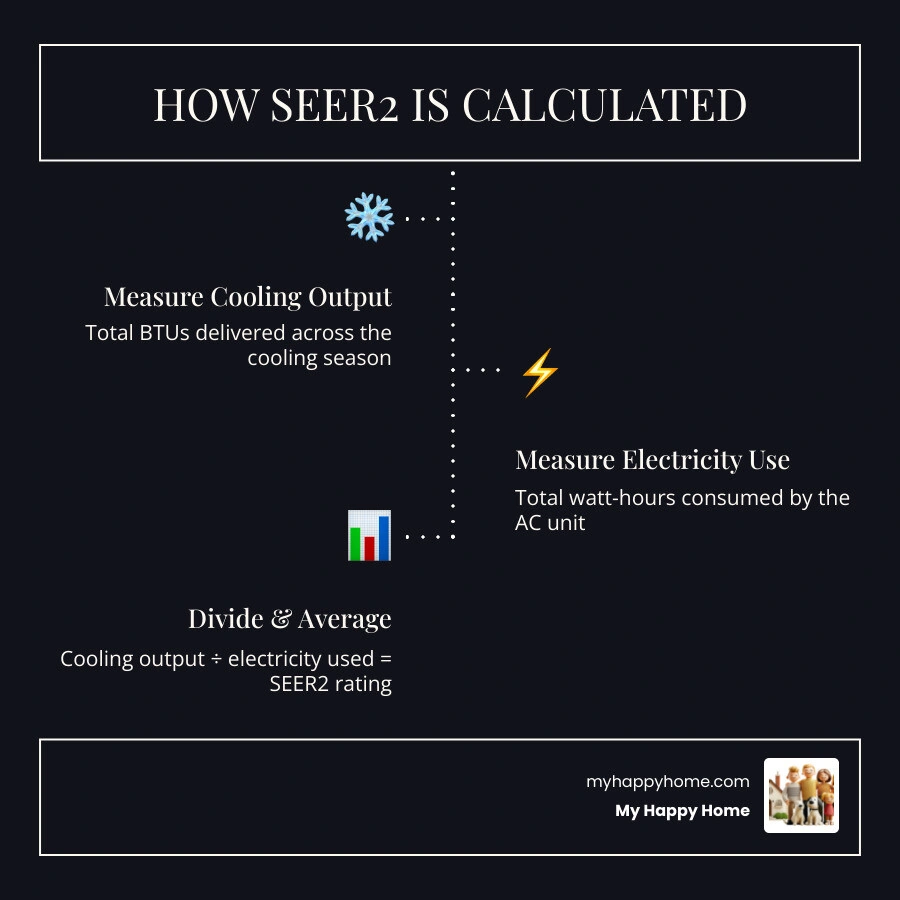
To calculate the rating, laboratory technicians measure the system's total cooling output over a simulated cooling season. This output is measured in British Thermal Units (BTUs)—the standard unit of heat energy. They then divide that total cooling output by the total electrical energy consumed by the system over that same period, measured in watt-hours (Wh).
$$\text{SEER2} = \frac{\text{Total Seasonal Cooling Output (BTUs)}}{\text{Total Electrical Energy Consumed (Watt-Hours)}}$$
What makes SEER2 unique compared to older metrics is that it does not assume a single, constant outdoor temperature. Instead, the calculation is weighted across a broad outdoor temperature range—from 65°F to 104°F—to accurately mimic how a system performs during real seasonal shifts, from mild spring days to peak summer heatwaves.
How to Find What Is a SEER2 Rating on an AC Unit in Your Home
If you are trying to locate the efficiency rating of the equipment currently keeping your home cool, you have a few reliable places to look:
- The EnergyGuide Label: If your system was installed recently, there may still be a bright yellow EnergyGuide sticker affixed to the side of your outdoor condenser unit. This sticker lists the certified SEER2 rating clearly.
- The Manufacturer’s Data Plate: Every outdoor condenser has a metal data plate containing its model number, serial number, and electrical specifications. Often, the SEER or SEER2 rating is printed directly on this plate.
- The Indoor Air Handler Sticker: Because a system's true efficiency depends on both the outdoor condenser and the indoor blower coil, checking the indoor unit (often located in your basement, attic, or utility closet) can yield a matching rating sticker.
- The AHRI Directory: If the physical labels have faded or peeled off, write down the model numbers of both your outdoor unit and indoor coil. You can enter these into the Air-Conditioning, Heating, and Refrigeration Institute (AHRI) directory online to find your system's certified efficiency rating.
If you are inspecting your system and notice other issues—like poor airflow, strange noises, or a system that refuses to turn on—be sure to review our AC Troubleshooting Tips Before Calling a Pro to run through the basics before seeking professional assistance.
SEER vs. SEER2: Why the Testing Standards Changed
The transition from traditional SEER to SEER2 was not just a minor bureaucratic update; it was a fundamental shift in how HVAC equipment is evaluated. The Department of Energy mandated this change because the old testing standards (known as the "M" testing standard) did not reflect how systems actually perform once they are installed in a real home.
Under the old SEER standards, testing was conducted under laboratory conditions with an external static pressure of just 0.1 inches of water column (in. w.g.). In a real residential setting, however, air has to push through tight ductwork, returns, and air filters, which creates far more resistance.
To bridge this gap, the DOE introduced the M1 testing standard for SEER2. This new protocol increases the required testing static pressure to 0.5 in. w.g.—a five-fold increase that closely simulates the actual static pressure found in a typical home's duct system. Because this testing condition is much tougher, SEER2 ratings are typically about 4.7% lower than the old SEER numbers for the exact same physical equipment.
- Testing Parameter: External Static Pressure; Old SEER Standard (M): 0.1 inches of water column; New SEER2 Standard (M1): 0.5 inches of water column
- Testing Parameter: Blower Motor Loading; Old SEER Standard (M): Low resistance (laboratory ideal); New SEER2 Standard (M1): High resistance (simulates real ductwork)
- Testing Parameter: Rating Conversion; Old SEER Standard (M): Baseline; New SEER2 Standard (M1): Typically ~4.7% lower than SEER
- Testing Parameter: Real-World Accuracy; Old SEER Standard (M): Overestimated real-world efficiency; New SEER2 Standard (M1): Highly accurate to installed performance
The Impact of Static Pressure on Real-World Performance
Static pressure is essentially the resistance or "friction" that your HVAC blower motor must overcome to push air through your home. Think of it like trying to breathe through a wide-open tube versus a narrow straw.
When an air conditioner is tested at a very low static pressure (like the old 0.1 in. w.g. standard), the blower motor does not have to work very hard. But when that same unit is installed in a real home with bends in the ductwork, closed registers, and dirty air filters, the static pressure spikes. Under the old system, a unit rated at 15 SEER might have actually operated closer to a 13 SEER in practice.
By testing at 0.5 in. w.g., the SEER2 standard forces manufacturers to design more robust blower motors (such as electronically commutated motors, or ECMs) that can maintain airflow and efficiency even when facing real-world ductwork resistance. If your current system is struggling to push cool air or is making your blower work overtime, check out our troubleshooting guide on Why Is My AC Blowing Warm Air? Troubleshooting Steps to understand how airflow restrictions impact your comfort.
Regional SEER2 Requirements and Compliance
Because the climate varies dramatically across the United States, the Department of Energy does not enforce a single, nationwide minimum efficiency standard for central air conditioners. Instead, the country is split into three distinct compliance regions: the Northern, Southeast, and Southwest regions.
Our primary service area in O'Fallon, MO sits within the Northern region. However, because the HVAC supply chain is national, and many homeowners relocate or own properties in multiple states, it is crucial to understand how regional standards differ—especially if you are comparing equipment across different areas.
Minimum Efficiency Standards for Texas and the South
In the hotter climates of the Southeast and Southwest (including states like Texas), the cooling season is longer and far more intense. Consequently, the DOE enforces stricter standards in these regions compared to the North.
- Southeast Region Minimums: For split-system central air conditioners under 45,000 BTU/h (3.75 tons), the minimum standard is 14.3 SEER2 (which is equivalent to 15.0 SEER under the old scale). For larger split systems of 45,000 BTU/h or more, the minimum is 13.8 SEER2.
- Northern Region Minimums (including O'Fallon, MO): Because our winters are cold and our cooling seasons are shorter, the minimum standard for split-system air conditioners is slightly lower at 13.4 SEER2 (equivalent to 14.0 SEER).
- Heat Pumps & Packaged Units: Heat pumps are subject to nationwide standards rather than regional ones. Split-system heat pumps must meet a minimum of 14.3 SEER2 across all regions, while single-packaged units (which house the heating and cooling components in one outdoor cabinet) must meet a minimum of 13.4 SEER2.
SEER2 vs. EER2: Peak Load vs. Seasonal Efficiency
While SEER2 measures efficiency across an entire cooling season with varying temperatures, EER2 (Energy Efficiency Ratio 2) measures steady-state efficiency at a single, fixed outdoor temperature of 95°F.
Think of SEER2 as your car's average city/highway combined fuel economy, while EER2 is its fuel economy when driving uphill at maximum capacity. EER2 is particularly important in the Southwest and parts of the South where temperatures routinely climb into the high 90s and triple digits. In these extreme climates, a system with a high EER2 rating ensures your utility bills do not skyrocket during the hottest afternoons of the year.
Upgrading to a system with both strong SEER2 and EER2 ratings provides benefits that go far beyond simple utility savings. To learn more about how modern, high-efficiency systems improve indoor air quality and overall home value, read our guide on New AC Benefits Beyond Comfort.
Maximizing Your AC Efficiency and Savings
Investing in a higher SEER2 rating can yield substantial financial and comfort returns over the lifespan of your system. To maximize these savings, it helps to understand the technology under the hood.
Standard, entry-level systems typically use single-stage compressors, which operate like a light switch—they are either 100% on or completely off. Mid-range systems use two-stage compressors that can run at a lower, energy-saving capacity (usually around 65%) on mild days and ramp up to full capacity when heat peaks.
The most efficient systems on the market utilize variable-speed compressors (often called inverter technology). These systems can adjust their operating capacity anywhere from 30% to 100% in tiny increments. By running continuously at lower speeds, they consume a fraction of the electricity of a single-stage system, eliminate temperature swings, and provide unmatched humidity control.
If you want to keep your existing system running at its absolute peak efficiency, scheduling regular service is essential. Explore our AC Maintenance Tune-Up service to see how we help homeowners protect their investment.
Key Benefits of High-Efficiency SEER2 Systems:
- Lower Utility Bills: Moving from a 14 SEER2 unit to a 20 SEER2 unit can result in an efficiency gain of approximately 43%, directly reducing your monthly cooling costs.
- Superior Dehumidification: Variable-speed systems run for longer, gentler cycles, allowing them to pull significantly more moisture out of your indoor air.
- Whisper-Quiet Operation: Because high-SEER2 units spend most of their time running at lower speeds, they generate far less noise both inside and outside your home.
- Reduced Environmental Impact: Higher efficiency means reduced demand on the electrical grid and lower carbon emissions.
The Role of Professional Installation and Maintenance
An air conditioner's SEER2 rating is a laboratory-certified potential, but your real-world efficiency depends entirely on the quality of the installation and ongoing maintenance. A poorly installed system can easily lose noticeably of its rated efficiency due to leaky ductwork, improper refrigerant charge, or incorrect system sizing.
Before installing any new system, a qualified professional must perform a Manual J load calculation to determine the precise cooling capacity your home requires. Oversized systems will "short-cycle" (turning on and off rapidly), which destroys their efficiency and leaves your home feeling humid. Undersized systems will run constantly without ever cooling your home to the thermostat setpoint.
Regular maintenance is also key to preserving your system's efficiency over time. Dirt on your coils and blower blades acts as an insulator, forcing your system to work harder and consume more electricity. To understand the timeline and benefits of regular care, read our articles on How Often Should You Schedule an AC Tune-Up and How a Tune-Up Improves Efficiency and Lowers Bills.
Tax Credits and Rebates for High-Efficiency Upgrades in 2026
To make high-efficiency upgrades more accessible, the federal government offers substantial financial incentives under the Inflation Reduction Act.
Through the 25C Energy Efficient Home Improvement Credit, homeowners can claim a federal tax credit covering up to 30% of the project cost for qualifying installations:
- Central Air Conditioners: Up to $600 for systems that meet ENERGY STAR certified efficiency tiers (typically requiring at least 16.0 SEER2 and 12.0 EER2 for split systems).
- Heat Pumps: Up to $2,000 for qualifying ducted or mini-split heat pumps that meet consortium standards (typically requiring 16.0 SEER2 or higher).
Additionally, many local utility companies offer direct rebates for upgrading to high-efficiency systems, which can be combined with federal tax credits to offset your initial investment. When you are ready to explore your options, our team is here to assist with expert AC Installation & Replacement services tailored to your home.
Frequently Asked Questions About SEER2 Ratings
What is considered a good SEER2 rating for a central air conditioner?
A "good" SEER2 rating depends on your local climate, usage patterns, and budget. In our region of O'Fallon, MO, we typically break ratings down into the following tiers:
- Entry-Level (13.4 to 14.3 SEER2): These systems meet federal minimum standards. They represent a reliable, budget-friendly option for homeowners who prioritize lower upfront costs or have lower annual cooling demands.
- Mid-Range (15.0 to 16.9 SEER2): This is often considered the "sweet spot" or best value tier. These systems provide a noticeable reduction in energy bills, qualify for many utility rebates, and frequently feature two-stage compressors for improved comfort.
- Premium (17.0 to 20.0+ SEER2): These ultra-efficient, variable-speed systems offer maximum energy savings, whisper-quiet operation, and elite humidity control. They are ideal for homeowners planning to stay in their homes long-term.
- Ductless Mini-Splits: For zoned comfort, ductless mini-split systems offer incredible efficiency, with some advanced single-zone models reaching SEER2 ratings as high as 32.2.
Can I mix an old SEER component with a new SEER2 unit?
No, we highly advise against mixing old SEER components with new SEER2 units. An air conditioning system is a matched system consisting of an outdoor condenser, an indoor evaporator coil, and a blower fan.
If you connect a modern, high-efficiency SEER2 outdoor unit to an older, dirty indoor coil, the system will not perform at its rated efficiency. More importantly, the mismatched components can cause improper refrigerant flow, leading to premature compressor failure, frozen coils, or total system breakdown. If you are experiencing issues with an older, mismatched system, our team can help diagnose the problem through our professional AC Repair Service.
Does a higher SEER2 rating mean a quieter air conditioner?
Generally, yes. While the SEER2 rating itself measures energy efficiency rather than noise, the advanced technology required to achieve high SEER2 ratings inherently reduces operational sound.
High-efficiency systems utilize variable-speed blowers and compressors that run at lower, gentler capacities for most of the day. Instead of the loud, sudden "clunk" and roar of a single-stage system turning on at 100% power, a variable-speed system ramps up quietly and runs so smoothly you may not even notice it is operating. Many premium units also include specialized sound-dampening blankets around the compressor to further reduce decibel levels.
Conclusion
Understanding what is a SEER2 rating on an AC unit empowers you to make smart, confident choices about your home's comfort and energy future. By shifting to real-world testing standards, the SEER2 metric gives you an honest look at how your equipment will perform when installed in your home.
At My Happy Home, we believe homeownership should be simple, predictable, and stress-free. That is why we offer comprehensive home protection plans that bundle repair coverage for your HVAC, plumbing, electrical, and major appliances into one affordable monthly subscription.
With vetted, licensed technicians, 24/7 customer support, and no surprise repair bills, we are here to ensure your systems run efficiently year-round. Say goodbye to unexpected breakdown costs and enjoy true peace of mind today.