
HVAC air purification options that actually help your home

Why the Air Inside Your Home May Be More Harmful Than You Think
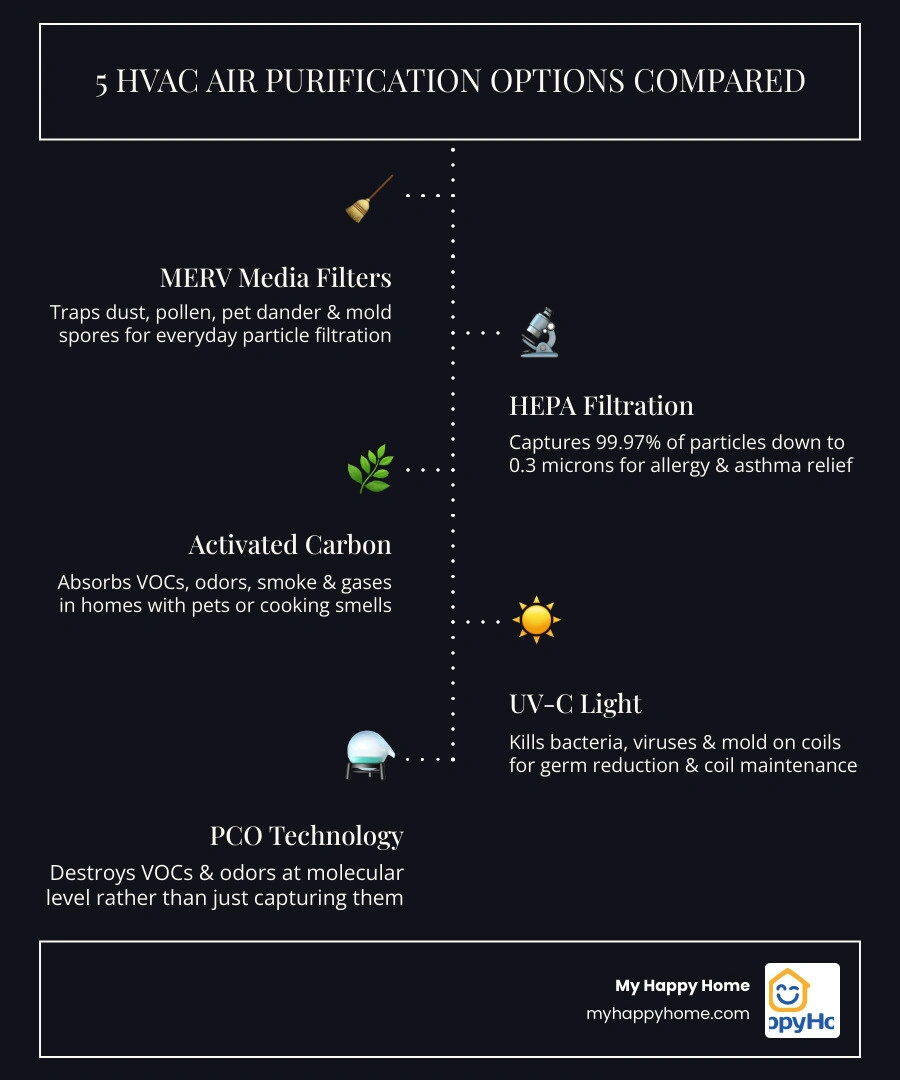
If you're exploring air purification options for your HVAC system, here's a quick breakdown of the most common choices:
- Technology: MERV Media Filters; What It Removes: Dust, pollen, pet dander, mold spores; Best For: Everyday particle filtration
- Technology: HEPA Filtration; What It Removes: Particles down to 0.3 microns (99.97%); Best For: Allergy and asthma sufferers
- Technology: Activated Carbon; What It Removes: VOCs, odors, smoke, gases; Best For: Homes with pets, cooking smells, or chemical sensitivities
- Technology: UV-C Light; What It Removes: Bacteria, viruses, mold on coils; Best For: Germ reduction and coil maintenance
- Technology: PCO (Photo-Catalytic Oxidation); What It Removes: VOCs, odors — destroys rather than captures; Best For: Chemical vapor and odor elimination
Most families assume the air inside their home is safe. After all, you can't see it. But according to the American Lung Association, indoor air can be anywhere from 2 to 5 times — and sometimes up to 100 times — more polluted than the air outside. And since most of us spend more than 90% of our time indoors, that matters a lot.
For parents, this hits close to home. Dust, pollen, pet dander, mold spores, and invisible chemical vapors cycle through your living spaces every time your heating or cooling system runs. For kids with allergies or asthma, or anyone who just wants to breathe easier, the quality of your indoor air is not a small thing.
The good news is that your HVAC system — the one already moving air through every room in your home — can be a powerful tool for cleaning that air. The right purification solution, installed in your ductwork, works quietly in the background so your family can breathe cleaner air without any extra effort.
I'm Matthew Palmieri, founder of My Happy Home and a longtime expert in HVAC systems and home service solutions, and I've spent my career helping homeowners make sense of exactly these kinds of decisions — including evaluating the best air purification options for your HVAC system for different home types, family needs, and budgets. In the sections ahead, we'll walk through every major option clearly and simply, so you can find what fits your home best.
Whole-House Systems vs. Portable Air Purifiers
When looking to improve your indoor air quality, you will generally face a choice between two main paths: installing a whole-house system directly into your central HVAC setup or placing multiple portable, standalone air purifiers in individual rooms. While both approaches can capture airborne pollutants, they operate on completely different scales and offer vastly different levels of convenience and coverage.

The Limits of Standalone Portable Units
Portable air purifiers are designed to clean the air in a single, confined space. They rely on small, localized fans to draw in nearby air, pass it through a filter, and blow it back out. If you place a portable unit in your bedroom, it may do an admirable job of cleaning the air in that specific room, provided the bedroom door remains closed.
However, portable units suffer from several distinct disadvantages:
- Limited Coverage: To clean the air throughout an entire home, you would need to purchase, plug in, and maintain a separate portable unit for almost every single room.
- Aesthetic and Physical Clutter: Portable purifiers take up valuable floor space, require open electrical outlets, and often feature cords that can be tripping hazards.
- Noisy Operation: Because portable units sit directly in your living spaces, you will constantly hear the hum of their internal fans, especially when run on higher, more effective speed settings.
- Uneven Air Distribution: Standalone units cannot actively pull air from the far corners of a room, let alone from other parts of the house, leaving pockets of stagnant, unpurified air.
The Power of Whole-House HVAC Integration
A whole-house air purifier integrates directly into your existing HVAC ductwork, typically installed in the return air duct just before the air reaches your furnace or air handler. This strategic positioning allows the system to clean all the air circulating through your home.
When your heating or cooling system's blower fan runs, it pulls air from every room through the return registers. This air passes through the integrated whole-house purifier, where contaminants are captured or destroyed, before the system redistributes the freshly cleaned air back through your supply vents.
This centralized approach offers unmatched advantages:
- Comprehensive Whole-Home Coverage: Instead of treating one room at a time, a whole-house system cleans the air in every single room connected to your ductwork simultaneously.
- Silent and Invisible Operation: The entire purification process takes place inside your basement, attic, or utility closet. There are no bulky boxes sitting in your living room and no noisy fans running next to your television.
- Continuous, Active Circulation: By setting your HVAC thermostat's fan to the "ON" or "CIRCULATE" position, you can keep air moving through the purifier continuously, ensuring constant cleaning even when your heating or cooling is not actively cycling.
- Protection for Your HVAC Investment: By capturing dust and debris before it reaches your heating and cooling equipment, a whole-house system keeps internal components like your blower motor and evaporator coil clean, helping to prevent costly breakdowns.
To understand more about how keeping your air clean can benefit your overall home environment, take a look at our detailed guide on How to Improve Indoor Air Quality at Home.
Comparing Filtration Technologies and Air Purification Options for Your HVAC System
Selecting the right purification technology requires understanding what types of pollutants you need to target. Indoor air pollutants generally fall into three categories: particulates (dust, pollen, pet dander), bioaerosols (viruses, bacteria, mold spores), and volatile organic compounds or odors (cooking smells, chemical vapors, pet odors). No single technology is perfect at removing all three, which is why many advanced systems combine multiple methods.
Our team at My Happy Home can help you evaluate your specific home needs through our comprehensive HVAC Services. Let's look at how these primary technologies compare:
- Technology Type: MERV Media Filters; Primary Target: Large to medium particles (dust, pollen, dander); How It Works: Pleated physical barrier traps particles as air passes through; Maintenance Required: Replace filter every 6 to 12 months
- Technology Type: True HEPA Systems; Primary Target: Ultra-fine particles (down to 0.3 microns); How It Works: Dense paper-like glass fiber media forces particles to stick to fibers; Maintenance Required: Replace HEPA core every 2 to 5 years; pre-filters every 3 to 6 months
- Technology Type: Activated Carbon; Primary Target: Gas-phase pollutants, chemical vapors, VOCs, odors; How It Works: Adsorption process where gas molecules bond chemically to carbon pores; Maintenance Required: Replace carbon blankets or canisters every 3 to 12 months
- Technology Type: UV-C Lamps; Primary Target: Biological contaminants (mold, bacteria, viruses); How It Works: Ultraviolet light disrupts microbial DNA, stopping reproduction; Maintenance Required: Replace UV bulbs every 12 to 24 months
- Technology Type: PCO (Photo-Catalytic Oxidation); Primary Target: Odors, VOCs, toxic chemical vapors; How It Works: UV light activates a catalyst to chemically break down gases into water and $CO_2$; Maintenance Required: Replace catalyst cartridge and UV lamp annually
Understanding MERV Ratings and Media Filters as Air Purification Options for Your HVAC System
The most common starting point for improving air quality is upgrading your standard furnace filter to a high-efficiency media filter. Media filters are thick, pleated physical barriers designed to capture airborne particles.
What Is a MERV Rating?
MERV stands for Minimum Efficiency Reporting Value. It is an industry-standard rating scale ranging from 1 to 16 that measures a filter's ability to capture particles of varying sizes. The higher the MERV rating, the smaller the holes in the filter, and the more effective it is at trapping fine particles.
- MERV 1 to 4: These are typically cheap, flat fiberglass filters. They are designed solely to protect your HVAC equipment from large dust bunnies and lint. They do almost nothing to improve indoor air quality or capture allergens.
- MERV 5 to 8: Standard pleated filters. They can capture larger particles like dust mites, mold spores, and some pet dander, but fine dust and pollen will still pass right through.
- MERV 9 to 12: High-efficiency residential filters. These are excellent for general household air purification. They effectively trap pollen, fine dust, pet dander, and auto emissions.
- MERV 13 to 16: Hospital-grade filtration. These dense filters capture bacteria, smoke, sneeze droplets, and microscopic virus-carrying particles. Modern premium filters in this range are designed to trap up to 95% of particles down to 0.3 microns without severely restricting your system's airflow.
The Balance Between Filtration and Airflow
It is tempting to simply buy the highest MERV filter available and slide it into your system. However, denser filters create more resistance to airflow, also known as static pressure. If your HVAC system was not designed to handle a highly restrictive filter, it can choke the system's airflow, forcing the blower motor to work harder, run hotter, and consume more energy. Over time, this can lead to frozen AC coils, cracked heat exchangers, and premature system failure.
To prevent these issues, high-quality whole-house media air cleaners utilize deep-pleated filters (typically 4 to 5 inches thick) rather than standard 1-inch filters. The deep pleats greatly increase the surface area of the filter media. This allows the filter to have incredibly small holes for high-efficiency particle capture while still allowing air to pass through easily, keeping static pressure low and protecting your equipment.
Regular checkups are essential to ensure your system can handle upgraded filtration safely. You can learn more about how proper maintenance protects your system's performance by visiting our page on AC Maintenance Tune-Up.
Advanced Technologies: HEPA, Carbon, UV, and PCO Air Purification Options for Your HVAC System
For homeowners in O'Fallon, MO, dealing with severe allergies, asthma, or stubborn indoor odors, standard media filters may not go far enough. That is where advanced, medical-grade whole-house technologies come into play.
True HEPA Filtration
True HEPA (High-Efficiency Particulate Air) filters represent the absolute gold standard in particle filtration, capturing 99.97% of particles as small as 0.3 microns. Because True HEPA filters are incredibly dense, they cannot be installed directly in the main airflow path of a standard residential HVAC system without completely choking the airflow.
Instead, whole-house HEPA systems are installed in a bypass configuration. A portion of the return air is continuously diverted through the HEPA unit, cleaned to a near-sterile level, and then fed back into the main air stream. This bypass design provides the ultimate level of particle filtration without putting any harmful static pressure strain on your heating and cooling equipment.
Activated Carbon Adsorption
While physical filters excel at trapping solid particles, they cannot stop gases, odors, or volatile organic compounds (VOCs). VOCs are chemical vapors emitted by common household items like paints, cleaning supplies, new carpets, and adhesives.
To tackle these gas-phase pollutants, systems utilize activated carbon. Carbon is treated with oxygen to open up millions of microscopic pores between the carbon atoms. Through a process called adsorption, chemical gas molecules physically and chemically bond to the massive surface area of the carbon, neutralising odors and trapping toxic vapors before they can recirculate.
Ultraviolet Germicidal Irradiation (UV-C)
Ultraviolet air purifiers do not filter particles; instead, they use short-wave ultraviolet light (UV-C) to target biological contaminants. When airborne mold spores, bacteria, and viruses pass through the intense UV-C light field, the radiation penetrates their cell walls and disrupts their DNA. This renders the pathogens inactive and unable to reproduce, effectively killing them.
UV-C systems are typically installed in one of two ways:
- Coil Irradiation: The UV lamp is mounted directly facing your indoor AC evaporator coil. Because the coil is cold and damp, it is a prime breeding ground for mold and algae. A continuous UV light keeps the coil clean, improving both air quality and HVAC heat transfer efficiency.
- Air Stream Disinfection: The UV system is placed in the return ductwork to sanitize the moving air as it passes by.
Photo-Catalytic Oxidation (PCO)
PCO is an advanced, aerospace-inspired technology that takes odor and pathogen control to the next level. A PCO system combines a UV-C light source with a catalyst panel, usually coated in titanium dioxide.
When the UV light shines on the catalyst, it creates a chemical reaction on the surface that produces highly reactive hydroxyl radicals. As air flows across this surface, these radicals instantly break down complex organic molecules, VOCs, and odors on contact, converting them into harmless carbon dioxide and water vapor. Because PCO destroys these contaminants rather than simply trapping them, the catalyst surface remains clean and effective over time.
To ensure your home remains safe and comfortable, it is vital to select advanced systems that carry zero-ozone certification (such as UL 2998), ensuring they improve your indoor air quality without introducing any harmful secondary pollutants.
Installation and Maintenance Requirements for Integrated Systems
To achieve optimal performance and protect your home's HVAC equipment, whole-house air purifiers require professional installation and a commitment to routine maintenance.
The Importance of Professional Installation
Integrating an advanced air purifier into your heating and cooling system is not a simple DIY project. It requires cutting directly into your sheet metal return ductwork, ensuring airtight seals, and calibrating the system's airflow.
A professional technician will carefully evaluate your system's static pressure to make sure the added filtration will not restrict airflow or cause your blower motor to overheat. Furthermore, systems involving electrical wiring, UV-C lamps, or bypass HEPA ducting require precise physical placement to prevent damage to your existing furnace or air conditioning coils.
Routine Maintenance for Lasting Performance
Just like your car, a whole-house air purifier cannot run indefinitely without attention. As filters load up with captured contaminants, they eventually become restricted, reducing their efficiency and putting stress on your HVAC system.
Here is what a typical maintenance schedule looks like for integrated systems:
- Standard Media Filters (MERV 11-16): Replace every 6 to 12 months, depending on household factors like pets, smoking, or nearby construction.
- True HEPA Bypass Systems: Replace the main HEPA filter core every 2 to 5 years. However, the carbon pre-filters designed to protect the HEPA core must be replaced every 3 to 6 months.
- Activated Carbon Filters: Replace carbon blankets or canisters every 3 to 6 months to ensure they continue to adsorb odors effectively.
- UV-C Lamps: While the bulb may continue to glow for several years, its germicidal effectiveness declines over time. UV lamps should be replaced every 12 to 24 months (typically annually) to maintain their ability to deactivate pathogens.
- PCO Cartridges: Replace the catalyst and lamp assembly annually to keep the chemical oxidation process running at peak efficiency.
Neglecting these simple maintenance tasks can lead to restricted airflow, reduced indoor air quality, and unnecessary wear and tear on your heating and cooling systems. You can read more about how keeping up with these tasks saves you money in the long run by reading How Regular Maintenance Prevents Costly Home Repairs.
Frequently Asked Questions About HVAC Air Purification
Do whole-house air purifiers produce harmful ozone?
This is a common and very important question. Ozone ($O_3$) is a highly reactive gas that can irritate the lungs, worsen asthma, and cause chest pain when inhaled. Historically, some electronic air cleaners and ionizers produced small amounts of ozone as a byproduct of their electrostatic charging process.
Today, reputable whole-house air purification systems are designed to be completely ozone-free. When shopping for an HVAC air purifier, look for systems that are certified to UL 2998. This strict safety standard guarantees that the device emits zero ozone (less than 5 parts per billion), making it entirely safe for continuous use in homes with children, pets, or individuals with respiratory conditions.
Can I add an advanced purifier to my existing heating and cooling system?
In almost all cases, yes! You do not need to purchase a brand-new heating and cooling system to enjoy the benefits of advanced air purification. Most whole-house media air cleaners, UV-C lights, PCO systems, and bypass HEPA units are designed to be retrofitted directly into your existing ductwork.
During a routine visit, a technician can inspect your duct layout, measure your system's static pressure, and recommend the best compatible options. Combining an air purification upgrade with a seasonal system checkup is a great way to optimize your comfort. To learn more about how these services keep your system running smoothly, check out our article on How a Tune-Up Improves Efficiency and Lowers Bills.
How do these systems help with specific allergens and pathogens?
Whole-house systems are incredibly effective because they treat the root causes of poor indoor air quality at a molecular and microscopic level:
- Pollen and Pet Dander: High-efficiency MERV 13 to 16 media filters and HEPA systems excel at trapping these relatively large physical particles, preventing them from settling on your furniture or irritating your sinuses.
- Mold Spores: Mold thrives in dark, damp spaces. UV-C lights installed near your AC evaporator coil destroy mold spores on the coil's surface, while media filters capture airborne spores circulating through the ducts.
- Viruses and Bacteria: Advanced systems combining MERV 16 filtration with UV-C or PCO technology can capture and deactivate up to 99% of airborne viruses and bacteria, significantly reducing the spread of seasonal illnesses within your home.
- Asthma Triggers: By continuously removing fine dust, smoke, and chemical VOCs from the air, these systems help create a stable, irritant-free indoor environment, which is vital for asthma sufferers.
Conclusion
Bathing your home in clean, pure air shouldn't be a daily struggle involving noisy portable units and dusty rooms. By integrating the right air purification options for your HVAC system, you can transform your existing heating and cooling setup into a powerful, silent, whole-home air cleaning machine. Whether you need the robust particle-trapping power of a hospital-grade media filter, the germ-killing capability of UV-C light, or the odor-destroying performance of photo-catalytic oxidation, there is a perfect solution for your family.
At My Happy Home, we believe in making homeownership stress-free. Through our comprehensive membership plans, we provide predictable, hassle-free repair and maintenance coverage for your HVAC, plumbing, electrical, and appliance systems under one affordable monthly plan. We serve homeowners in O'Fallon, MO, with licensed, vetted professionals who are committed to your comfort and peace of mind.
Ready to say goodbye to indoor air worries and unexpected repair bills? Explore our Services Overview to see how we protect your entire home, check out our dedicated HVAC Protection Plan to keep your heating and cooling systems in peak condition, or Get professional indoor air quality support today to find the perfect air purification setup for your family.