
Cooling without ductwork options compared

Why Homeowners Are Searching for Adding Cooling Without Ductwork Options Compared
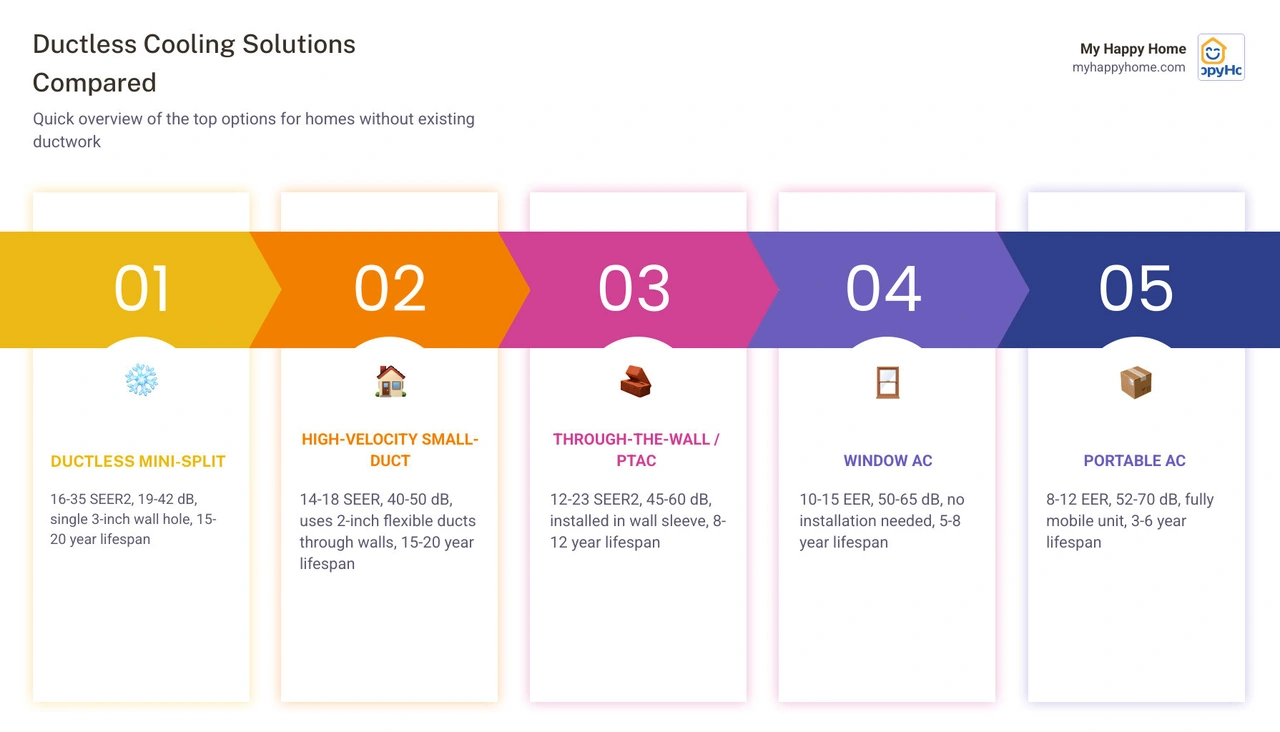
When it comes to adding cooling without ductwork options compared side by side, here is a quick look at how the main solutions stack up:
- System: Ductless Mini-Split; SEER/SEER2 Rating: 16-35 SEER2; Noise Level: 19-42 dB; Installation Disruption: Very low (3-inch wall hole); Lifespan: 15-20 years
- System: High-Velocity Small-Duct; SEER/SEER2 Rating: 14-18 SEER; Noise Level: 40-50 dB; Installation Disruption: Low (2-inch flexible ducts); Lifespan: 15-20 years
- System: Window AC; SEER/SEER2 Rating: 10-15 EER; Noise Level: 50-65 dB; Installation Disruption: None; Lifespan: 5-8 years
- System: Through-the-Wall / PTAC; SEER/SEER2 Rating: 12-23 SEER2; Noise Level: 45-60 dB; Installation Disruption: Low (wall sleeve); Lifespan: 8-12 years
- System: Portable AC; SEER/SEER2 Rating: 8-12 EER; Noise Level: 52-70 dB; Installation Disruption: None; Lifespan: 3-6 years
Millions of homes across the United States were built long before central air conditioning became standard. If yours is one of them, you already know the problem: summers are uncomfortable, and adding traditional ductwork means tearing into walls, ceilings, and budgets. In fact, installing new ductwork in an existing home can add up to $18,000 on top of the cost of the cooling system itself. And even when ductwork already exists, it can leak noticeably of cooled air before it ever reaches the room you are trying to cool.
The good news is that you have real options. From sleek ductless mini-splits to high-velocity systems that thread through existing wall cavities, today's duct-free cooling technology is more efficient, quieter, and more home-friendly than ever. Whether you are trying to keep a historic bungalow comfortable without touching original plaster walls, or simply want to stop overpaying to cool rooms you barely use, this guide will help you make a confident, informed decision.
I'm Matthew Palmieri, founder of My Happy Home, and my background spans HVAC systems, smart home technology, and home services operations — giving me a practical, homeowner-first perspective on adding cooling without ductwork options compared for every type of home. Let's walk through what actually works.
Adding Cooling Without Ductwork Options Compared
When you live in an area like O'Fallon, MO, the summer humidity and heat can make a reliable air conditioning system feel less like a luxury and more like an absolute necessity. If your home lacks traditional ductwork, you might feel like you are trapped between expensive remodeling projects or noisy, inefficient window boxes.
Fortunately, the HVAC industry has evolved significantly. Let's break down the five primary ways to introduce cooling to a home without vents, exploring how they function and where they work best.
1. Ductless Mini-Split Systems
Ductless mini-splits are widely considered the premier solution for homes without ducted systems. These setups consist of an outdoor condenser unit linked to one or more indoor air handlers via a small conduit housing the power cable, refrigerant lines, and condensate drain.
Because they do not require large, sweeping ducts, we only need to drill a small three-inch hole in your exterior wall to connect the units. This makes them incredibly flexible. You can place indoor units on walls, suspend them from ceilings, or even install floor-mounted consoles. Our team provides comprehensive HVAC Services to help you design a multi-zone layout that perfectly matches your home's unique footprint.
2. High-Velocity Small-Duct Systems
If you want the benefits of a central air conditioning system but simply do not have the space for bulky 12-inch metal ducts, a high-velocity system is an excellent alternative. These systems use a specialized outdoor condenser and an indoor blower unit that sends cooled air through flexible, insulated tubes that are only two inches in diameter.
These mini-ducts can be snaked through existing wall cavities, crawl spaces, and ceilings with almost zero disruption to your drywall or plaster. The air is delivered into your rooms through small, round outlets about the size of a tea saucer. High-velocity systems are highly effective at removing noticeably more moisture from the air than traditional central units, which is a massive benefit during those sticky Missouri summers.
3. Window Air Conditioners
Window units are the traditional "quick fix" for single-room cooling. They are self-contained systems that sit directly in a window frame, pulling in indoor air, cooling it over refrigerant coils, and exhausting the heat outside.
While they require no professional installation and can be purchased easily, they come with substantial drawbacks. They block your natural light, ruin your home’s curb appeal, represent a notable security risk, and operate with loud, vibrating compressors right next to where you sleep or watch television.
4. Through-the-Wall Units (PTACs)
Through-the-wall air conditioners function similarly to window units, but they are permanently installed into a sleeve cut directly through an exterior wall. You often see these in hotels (known as Packaged Terminal Air Conditioners, or PTACs).
They keep your windows free and are slightly more secure than window units. However, they require cutting a large, permanent rectangular hole in your home's exterior wall, which can compromise your insulation and prove visually unappealing on historic home facades.
5. Portable Air Conditioners
Portable ACs sit on the floor inside your room and use a flexible plastic hose to vent hot air out through a window adapter kit. While they are highly mobile, they are generally the least efficient option available.
Single-hose portable units are notorious for creating negative air pressure inside your room. As they push hot air out the window, they actually draw warm, humid air from other rooms or outside cracks back into your living space, reducing their effective cooling capacity by up to 40%.
When you are assessing these choices, looking at AC Installation Replacement options is the best way to determine which permanent solution will maximize your comfort. Investing in a permanent, high-efficiency system delivers incredible New AC Benefits Beyond Comfort, including vastly improved indoor air quality, whisper-quiet operation, and lower utility bills.
Why Ductless Mini-Splits Are the Modern Gold Standard

If you are looking for the absolute best balance of energy efficiency, daily performance, and long-term reliability, ductless mini-splits are the clear winner. While other systems serve as temporary fixes or niche solutions, mini-splits have earned their reputation as the gold standard for ductless comfort.
The secret to their incredible efficiency lies in inverter technology. Traditional central air conditioners and window units operate on a simple "on/off" cycle. When the thermostat detects the room is too warm, the compressor kicks on at 100% capacity, runs loudly until the target temperature is met, and then shuts completely off. This constant cycling wastes massive amounts of electricity and leads to annoying temperature swings.
In contrast, a mini-split’s inverter compressor behaves more like a dimmer switch or cruise control. It starts up smoothly and adjusts its speed dynamically to maintain an incredibly steady temperature. By running continuously at a lower, whisper-quiet speed, it uses up to 40% less energy than conventional ducted systems.
Furthermore, because there are no ducts, you completely eliminate the 30% energy loss associated with duct leaks. This translates to modern ductless mini-split systems achieving SEER2 (Seasonal Energy Efficiency Ratio 2) ratings of up to 35. For comparison, most standard window units hover between 10 and 15 EER.
Choosing a permanent, high-efficiency mini-split also offers an excellent AC Replacement Return on Investment. Not only do your monthly energy bills drop immediately, but these systems can also increase your home’s resale value by up to 10% by solving the "hot upstairs" or "drafty addition" problems that deter potential buyers. Plus, they enjoy a much longer lifespan than temporary alternatives:
- Ductless Mini-Splits: 15–20 years (with proper care)
- Window AC Units: 5–8 years
- Portable AC Units: 3–6 years
To maximize this lifespan and keep your system running at peak efficiency, homeowners should perform a few simple maintenance tasks. Fortunately, caring for a mini-split is straightforward.
Key Maintenance Tasks for Ductless Systems:
- Clean the Indoor Filters: Pop open the front panel of your indoor air handler every 2 to 4 weeks, slide out the reusable mesh filters, rinse them under warm water, let them air dry completely, and slide them back in. This keeps airflow strong and protects your indoor air quality.
- Keep the Outdoor Unit Clear: Ensure that grass clippings, fallen leaves, snow, and weeds are kept at least two feet away from your outdoor condenser unit to maintain proper heat exchange.
- Inspect the Condensate Drain: Periodically check that the outdoor drain line is dripping water when the system is running, ensuring that moisture is successfully leaving your home.
- Schedule Annual Professional Tune-Ups: Once a year, have a licensed technician inspect your refrigerant charge, clean the coils, and verify all electrical connections to ensure year-round performance.
By taking advantage of these modern systems, you can also enjoy the incredible Heat Pump Benefits for Homeowners, turning your cooling upgrade into a comprehensive, year-round comfort solution.
Sizing and SACC Ratings When Adding Cooling Without Ductwork Options Compared
Choosing the right size for your ductless system is absolutely critical. If a system is too small, it will run constantly without ever cooling the space. If it is too large, it will suffer from a problem called short cycling—turning on and off rapidly. Short cycling prevents the system from running long enough to pull humidity out of the air, leaving your room feeling cold but incredibly damp and clammy, while placing unnecessary wear and tear on the compressor.
To size a system properly, professional HVAC technicians perform a Manual J load calculation. This calculation goes far beyond simple square footage to analyze:
- The height of your ceilings
- The number, size, and orientation of your windows (south-facing rooms get much hotter!)
- The quality and age of your home’s insulation
- Local climate baselines here in O'Fallon, MO
If you are evaluating portable air conditioners, you must also look at the SACC (Seasonally Adjusted Cooling Capacity) rating rather than the traditional BTU rating. The SACC rating is a modern standard introduced by the Federal Trade Commission that accounts for the heat re-radiated by the exhaust hose and negative pressure leaks. A portable unit labeled as "14,000 BTU" under old standards might only have a SACC rating of 8,000 BTUs, which is why they often struggle to cool spaces efficiently.
For a comprehensive look at how we evaluate your home's unique layout to find the perfect fit, browse our Services Overview.
Heating and Cooling Versatility When Adding Cooling Without Ductwork Options Compared
One of the most significant advantages of modern ductless mini-splits is that they are actually air-source heat pumps. This means they don't just cool your home; they provide highly efficient heating during the winter months as well.
To understand how this works, it helps to ask: How Does a Heat Pump Work? In the summer, the system absorbs heat from inside your home and dumps it outside. In the winter, the process reverses. The system absorbs thermal energy from the outdoor air—even when it is freezing outside—and transfers it indoors to warm your rooms.
Because they move heat rather than creating it through combustion or electrical resistance, heat pumps are incredibly efficient. In fact, they are often 200% to 400% more efficient than electric baseboard heaters or traditional radiators.
If you are wondering, "Is a Heat Pump Right for Your Home?" consider our local Missouri climate. Modern cold-climate mini-split heat pumps feature advanced low-ambient performance, allowing them to maintain full heating capacity even when outdoor temperatures drop below freezing, and they can continue operating efficiently down to -13°F.
This makes them a perfect hybrid solution for older homes that rely on boiler systems or baseboard heat, allowing you to keep your existing heating system as a backup while using your mini-split for ultra-efficient daily comfort. When you are ready to make the switch, exploring a professional Heat Pump Installation Replacement is the best way to ensure your system is perfectly integrated for year-round reliability.
Preserving Historic and Older Homes Without Major Disruption
Older and historic homes are packed with architectural character—from original hand-plastered walls and crown molding to gorgeous solid wood trim and high ceilings. Unfortunately, these beautiful features make installing traditional central air conditioning a nightmare. Retrofitting standard ductwork requires dropping ceilings, building bulky drywall soffits, and cutting massive holes through irreplaceable plaster walls and historic framing.
This is where non-invasive, duct-free cooling options shine. Because ductless mini-splits only require a single three-inch hole to connect the indoor and outdoor units, we can install them with virtually zero structural impact on your home. The copper refrigerant lines can be run discreetly along your home's exterior and covered in paintable, weather-resistant sleeves that blend seamlessly with your siding or brickwork.
If you prefer a completely invisible interior look, high-velocity small-duct systems are another fantastic option for historic properties. The flexible two-inch mini-ducts can be snaked through the hollow spaces behind your plaster walls, under floorboards, or through closets without disturbing your home's original plasterwork. The small, round outlets can be painted or stained to match your walls or wood trim, giving you the luxury of central air conditioning without sacrificing your home's historic integrity.
Frequently Asked Questions About Ductless Cooling
How much quieter is a mini-split than a window air conditioner?
The difference in noise levels between a ductless mini-split and a window AC unit is truly night and day. Window air conditioners house all their mechanical components—including the noisy compressor—inside a single box that sits right in your window frame. This typically produces noise levels between 50 and 65 decibels (dB), which is equivalent to a loud conversation or a vacuum cleaner running in the room.
Ductless mini-splits are whisper-quiet because the noisy compressor is located entirely outdoors, often installed on a concrete pad near your foundation or mounted to an exterior wall up to 50 feet away. The only indoor component is a highly optimized fan. As a result, indoor mini-split air handlers operate between 19 and 32 dB—which is literally quieter than rustling leaves or a quiet library. Most homeowners find they can sleep, read, or watch television without ever noticing the system is running.
How long does the installation process take?
Installing a traditional ducted central AC system in a home without existing vents can take one to two weeks of loud, messy construction, drywall dust, and structural alterations.
In contrast, a single-zone ductless mini-split installation is incredibly fast and non-invasive. A typical single-room setup can easily be completed in just a few hours with no drywall cutting or painting required. Even a complex, multi-zone system designed to cool an entire 2,000-square-foot home can usually be fully installed and running in just one to two days. When you work with us for your AC Installation Replacement, we ensure a clean, seamless process that respects your home and your schedule.
Are there tax credits or rebates available in 2026?
Yes! Because modern ductless mini-split heat pumps are so energy-efficient, there are significant financial incentives available to help homeowners upgrade their systems in 2026.
Under Section 25C of the federal Inflation Reduction Act, homeowners can claim a tax credit of noticeably of the total project cost—capped at $2,000 annually—for installing qualifying ENERGY STAR-certified heat pumps. Additionally, many local electric utilities offer mail-in rebates ranging from $500 to $2,000 for upgrading to high-efficiency ductless systems. Combining federal tax credits with local utility incentives makes upgrading to a ductless system a highly practical and affordable long-term investment.
Conclusion
Adding modern cooling to a home without existing ductwork doesn't have to mean sacrificing your peace of mind, your home's historic charm, or your savings. By comparing your options side by side, it is clear that permanent solutions like ductless mini-splits and high-velocity systems offer unmatched efficiency, whisper-quiet performance, and year-round comfort that temporary window or portable units simply cannot match.
At My Happy Home, we believe that homeownership should be simple, predictable, and stress-free. That is why we offer a comprehensive Home Protection Plan that combines repair coverage for your HVAC, plumbing, electrical, and major appliances under one affordable, worry-free monthly subscription. When you partner with us for your AC Installation Replacement, you get the expertise of licensed, vetted professionals backed by our "Happy Home Promise."
Ready to reclaim your home from the summer heat and enjoy predictable, year-round comfort? Contact us today to schedule your personalized cooling consultation!