
How to fix a constantly running AC in 5 simple steps
Why Your AC Runs Constantly and What to Do: Quick Answers for Homeowners
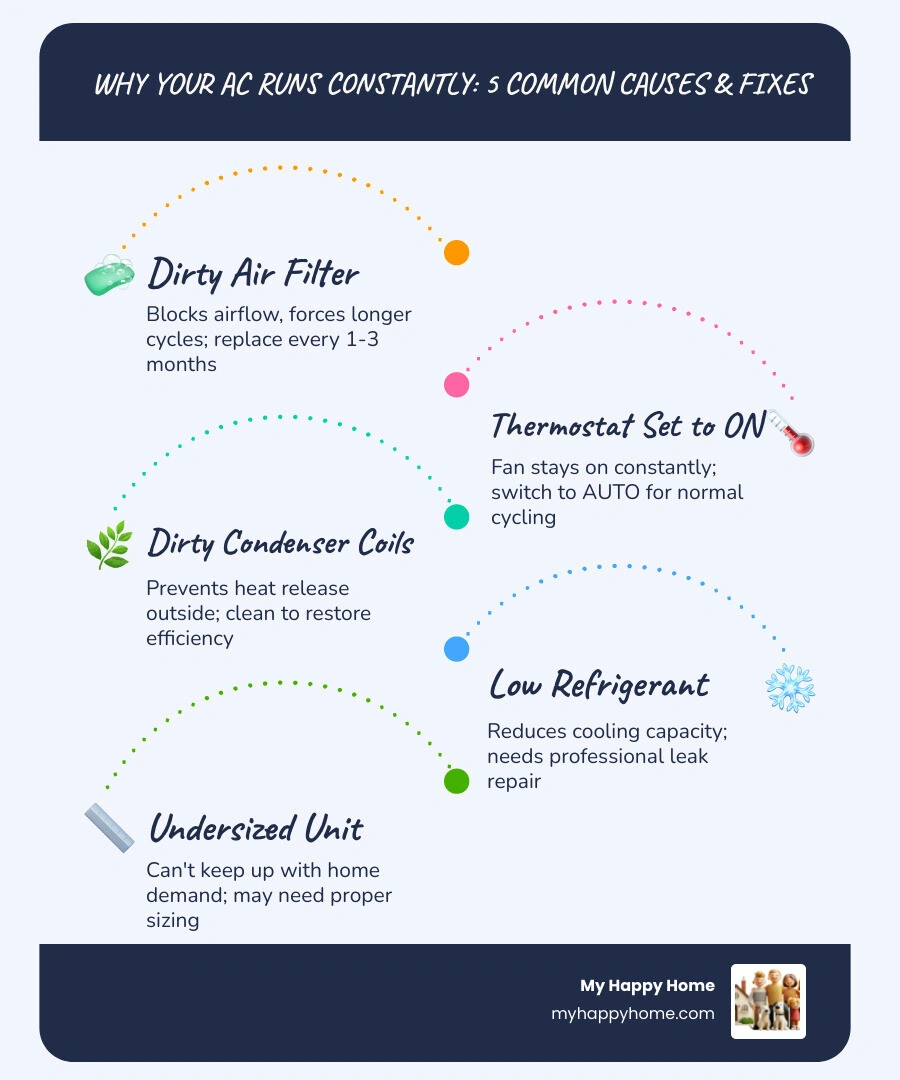
If you're wondering why your AC runs constantly and what to do about it, here are the most common causes and first steps to take:
Most common reasons your AC runs nonstop:
- Dirty air filter - Restricts airflow and forces longer run cycles; replace every 1-3 months
- Incorrect thermostat settings - Fan set to ON instead of AUTO keeps it running indefinitely
- Dirty condenser coils - Prevents heat from releasing outside, slowing the cooling process
- Low refrigerant - Reduces cooling capacity; requires a licensed technician to repair
- Undersized AC unit - A unit too small for your home will run continuously without ever catching up
- Poor insulation or air leaks - Cooled air escapes before your home reaches the set temperature
- Extreme outdoor heat - On days above 95°F, longer run times can be completely normal
It's a frustrating feeling — your AC is humming away all day and night, your energy bill is climbing, and your home still doesn't feel as cool as it should. A properly functioning central air conditioner should cycle on and off roughly every 15 to 20 minutes, shutting off two to three times per hour. When it stops doing that, something is off — and the longer you ignore it, the more wear you put on the system and the higher your utility bills climb.
The good news is that many of the most common causes are surprisingly simple to fix yourself. Others do require a professional, but knowing which is which saves you time, money, and stress.
I'm Matthew Palmieri, founder of My Happy Home, and I've spent my career in HVAC repair, contractor operations, and home protection — helping homeowners understand exactly why their AC runs constantly and what to do before a minor issue turns into a costly breakdown. In the steps ahead, I'll walk you through a clear, practical troubleshooting process so you can get your system back to running efficiently.
Why Your AC Runs Constantly and What to Do: Normal vs. Problematic Runtime

Before we start tearing into the system, we need to establish a baseline. Is your air conditioner actually broken, or is it simply doing its job under intense pressure?
During extreme outdoor heat—such as those sweltering, humid summer afternoons we experience here in O'Fallon, MO—it is completely normal for an air conditioner to run for long, uninterrupted stretches. Standard central air conditioners are designed to cool indoor air by about 15 to 20 degrees compared to the outdoor temperature. If it is 98°F outside and you have your thermostat set to a chilly 70°F, your system is going to work overtime. It may run continuously for hours just to keep up with the intense heat load radiating through your roof and walls.
Additionally, if you have a modern variable-speed or multi-stage system, continuous operation is actually by design. Unlike older single-stage systems that turn on at 100% capacity and shut off abruptly, variable-speed systems are engineered to run for long periods at a lower, highly efficient speed. This constant, low-level operation provides superior humidity control, eliminates hot spots, and reduces overall energy consumption.
However, constant running becomes problematic when:
- The indoor temperature never actually reaches the setpoint on your thermostat.
- Your home feels humid, warm, or clammy despite the nonstop humming.
- Your monthly utility bills skyrocket far beyond normal seasonal increases.
- You notice physical warning signs, such as ice forming on the outdoor refrigerant lines or the indoor evaporator coil.
Ignoring a system that runs nonstop when it shouldn't is a recipe for trouble. Continuous operation accelerates system wear and tear, leading to premature component failure. Even worse, it can lower pressure in the cooling coil until it freezes over entirely, which can cause liquid refrigerant to flood back and destroy the compressor—the expensive "heart" of your air conditioning unit.
If you suspect your system is working too hard, you can begin diagnosing the issue using our AC Troubleshooting Tips Before Calling a Pro. If you already see frost or ice on your system, stop and read our guide on Ice Forming on Your AC Unit Causes and What to Do to prevent catastrophic compressor damage.
5 Simple Steps to Troubleshoot and Fix a Constantly Running AC
When an air conditioner refuses to shut off, we always recommend starting with the easiest, most cost-effective checks. You don't need to be an HVAC technician to rule out basic airflow and setting issues.
By following these five simple steps, you can quickly identify whether you are dealing with a simple DIY fix or an issue that requires professional attention. If your system is running constantly but you are only getting lukewarm air out of the registers, you may also want to review our checklist on Why Is My AC Blowing Warm Air Troubleshooting Steps.
Step 1: Check Thermostat Settings and Placement
The very first thing we look at is the thermostat. It acts as the brain of your HVAC system, and if it is getting incorrect information, it will keep your AC running indefinitely.
- Check the Fan Setting: Ensure your thermostat's fan setting is set to AUTO, not ON. When set to ON, the indoor blower fan will run 24/7, even when the cooling system is not actively running. This can easily trick you into thinking your AC is constantly cooling when it is actually just circulating air.
- Verify Placement: Is your thermostat installed in direct sunlight, near a drafty window, or close to heat-generating appliances like an oven or TV? If so, the localized heat will cause the thermostat to read a much higher temperature than the rest of the house, forcing the AC to run nonstop.
- Test Calibration: If the thermostat is older, its internal sensors may be out of calibration. Try resetting the thermostat by turning it off at the breaker or removing the batteries for five minutes, then turning it back on.
If your system isn't responding to thermostat changes at all, start your diagnosis with our guide on AC Not Turning On What to Check First.
Step 2: Inspect and Replace the Air Filter
A dirty, clogged air filter is the single most common cause of constant AC runtime. Your air conditioner needs a steady, unrestricted volume of air flowing over its indoor evaporator coil to absorb heat from your home.
When dust, pet dander, and pollen clog the filter, airflow drops significantly. This restriction increases static pressure within the ductwork, meaning the blower fan has to work twice as hard to move a fraction of the air. Because heat transfer slows to a crawl, your system has to run for hours on end just to lower the temperature a single degree.
We recommend replacing standard pleated filters every 1 to 3 months—and even more frequently during high-pollen seasons or in homes with multiple pets. Keeping a fresh filter in place is the easiest way to protect your overall HVAC system from unnecessary strain.
Step 3: Clear Blocked Vents and Return Grilles
For your air conditioner to cycle efficiently, air must circulate freely throughout your entire home. A common mistake we see is homeowners closing supply vents in unused rooms or pushing heavy furniture directly against return air grilles.
Closing supply vents does not save energy; instead, it creates a severe pressure imbalance within your ductwork. This imbalance restricts overall airflow, causing the system to work harder and run longer. Walk through your home and ensure that:
- Every supply register is fully open and unobstructed by curtains, rugs, or furniture.
- Large return air grilles (where air is pulled back into the system) are completely clear.
- Closed interior doors aren't trapping air; if your home lacks return vents in bedrooms, keeping doors slightly ajar can improve circulation.
Step 4: Clean the Outdoor Condenser Unit
The outdoor portion of your air conditioner—the condenser—is responsible for releasing the heat absorbed from inside your home out into the surrounding air. If the thin metal fins on the condenser are coated in dirt, mud, grass clippings, or fallen leaves, they act as an insulating blanket.
When heat dissipation is blocked, the refrigerant cannot cool down properly before returning indoors. As a result, your system cycles refrigerant that is still warm, forcing the AC to run continuously without ever reaching your target temperature.
To fix this, turn off the power to your AC unit at the outdoor disconnect box. Use a gentle garden hose (never a pressure washer, which can bend the delicate aluminum fins) to wash away accumulated debris. Ensure there is at least a two-foot clear perimeter around the entire outdoor unit, trimming back any bushes, tall grass, or weeds. For a thorough deep clean of your system's internal components, scheduling a professional AC Maintenance Tune-Up is always your best bet.
Step 5: Check for Frozen Coils and Let Them Melt
If airflow is restricted by a dirty filter or blocked vents for too long, the temperature of your indoor evaporator coil can drop below freezing. Moisture in the air will quickly freeze on the coil, forming a block of ice that completely blocks heat exchange.
Signs of frozen coils include:
- Warm air blowing from your vents.
- Active ice formation on the outdoor brass valves or indoor unit.
- Water pooling around your indoor furnace or air handler as the ice melts.
If you suspect your coils are frozen, do not keep running the AC. Turn the system completely off at the thermostat, or switch the setting to "Fan Only" to allow warm air to melt the ice. Running the system with frozen coils can cause your compressor to fail or cause your AC Circuit Breaker Keeps Tripping What It Means warning signs to flare up. Once the ice has completely melted, check your air filter and vents before attempting to restart the cooling cycle.
When Sizing and System Age Are the Real Culprits
Sometimes, a constantly running AC isn't caused by a maintenance oversight or a dirty filter. Instead, the issue lies in the physical characteristics of the equipment itself—specifically, its size relative to your home, or its age.
- AC Sizing Type: Undersized Unit; Typical Cycle Behavior: Runs continuously for hours without stopping; struggles to lower temperature.; Impact on Home Comfort: Rooms stay warm, high humidity levels, uneven cooling.; Long-Term System Risks: Frozen evaporator coils, premature compressor failure, high utility bills.
- AC Sizing Type: Oversized Unit; Typical Cycle Behavior: Cycles on and off rapidly (short cycling); runs for only 5-10 minutes.; Impact on Home Comfort: Clammy air, high indoor humidity, wide temperature swings.; Long-Term System Risks: Excessive wear on starter components, shortened system lifespan.
- AC Sizing Type: Correctly Sized; Typical Cycle Behavior: Cycles 2-3 times per hour; runs for 15-20 minutes per cycle.; Impact on Home Comfort: Consistent temperatures, balanced humidity, optimal comfort.; Long-Term System Risks: Minimal wear, maximum equipment lifespan, predictable energy costs.
To determine if your system is properly matched to your property, an HVAC professional must perform a detailed heat load calculation (often called a Manual J calculation). This calculation takes into account your home's total square footage, ceiling heights (such as cathedral ceilings), insulation quality, window placement, and local climate conditions.
If your system is simply too old or improperly sized, you can explore the long-term savings of upgrading by reviewing our guide on AC Replacement Return on Investment and discovering the New AC Benefits Beyond Comfort.
Why Your AC Runs Constantly and What to Do for Undersized Units
If an AC unit is too small for the home it is trying to cool, it simply lacks the cooling capacity (measured in BTUs or tons) to overcome the heat entering the building. A 2-ton unit, for example, is generally designed to cool around 1,000 to 1,200 square feet. If an installer incorrectly placed a 2-ton unit in a 1,500-square-foot home with cathedral ceilings, that system will run continuously during warm weather without ever reaching the thermostat's setpoint.
This continuous operation reduces pressure in the cooling coil, which can cause it to freeze over and eventually destroy the compressor. If you suspect your unit is undersized, the only permanent solution is to consult a professional about a proper AC Installation Replacement.
Why Your AC Runs Constantly and What to Do for Aging Systems
Like any mechanical system, air conditioners lose efficiency as they age. Most central AC units have a functional lifespan of 10 to 15 years. Over time, internal components wear down, compressor valves lose their tight seals, and coils corrode.
An aging system with a low SEER (Seasonal Energy Efficiency Ratio) rating will struggle to transfer heat as effectively as it did when it was new. It will have to run significantly longer cycles just to achieve the same cooling output, driving up your energy bills. If your system is approaching the end of its lifespan, it's worth considering how its condition might impact your property value; read more in our article on How AC Condition Affects Home Appraisals.
Frequently Asked Questions About AC Runtime
Is it normal for an AC to run all day when it is 95 degrees outside?
Yes, to a certain extent. On "design days"—the hottest days of the summer when temperatures climb to 95°F or higher—your AC is operating at its maximum design limit. Because central air conditioners are typically designed to maintain an indoor temperature 20 degrees cooler than the outdoor air, running continuously is normal as long as your home remains comfortable and eventually reaches your set temperature once the sun goes down. However, if your home stays warm and humid, or if the system runs nonstop even during mild evening hours, there is likely an underlying issue with your insulation, ductwork, or system capacity.
How does a dirty air filter cause my AC to run constantly?
A dirty air filter restricts the volume of air passing over the indoor evaporator coil. Because there is less warm air flowing over the freezing cold coil, heat transfer slows down dramatically. The system has to run much longer cycles to extract the same amount of heat from your home, putting immense strain on the blower motor and compressor while driving up your electric bill.
Can low refrigerant cause an AC to run nonstop?
Yes. Refrigerant is the medium your system uses to absorb heat from inside your home and carry it outside. If there is a leak in your refrigerant lines, the system's cooling capacity drops. The AC will run continuously because it lacks the chemical charge needed to absorb heat efficiently. Because refrigerant operates in a closed loop, low levels always indicate a leak. Repairing a leak requires specialized tools and must comply with strict EPA regulations, making it a job that must be handled by a professional AC Repair Service.
Conclusion
A constantly running air conditioner is more than just an annoyance—it's a clear warning sign that your system is struggling. While simple steps like replacing a dirty air filter, clearing blocked vents, and cleaning away outdoor debris can resolve many runtime issues, persistent problems require expert diagnostic tools to protect your equipment from catastrophic failure.
At My Happy Home, we believe homeownership shouldn't be stressful or filled with surprise repair bills. That’s why we offer comprehensive, subscription-based home protection plans that cover your HVAC, plumbing, electrical systems, and major appliances under one affordable monthly membership. When you are a member, you don’t have to worry about finding a vetted technician or facing unexpected costs; you simply request service, and we handle the rest.
To keep your system running efficiently and prevent constant runtime issues before they start, check out our guide on How Often Should You Schedule an AC Tune-Up and learn what to expect in our AC Tune-Up Guide What to Expect. You can also discover How a Tune-Up Improves Efficiency and Lowers Bills to see the immediate benefits of regular maintenance.
If your air conditioner is currently running nonstop and you need a licensed, vetted professional to diagnose the issue, contact My Happy Home today to schedule an expert AC Repair Service and get your home back to cool, worry-free comfort.