
In depth guide to refrigerant transition impact on your next AC purchase

How the Refrigerant Transition Affects Your Next AC Purchase in 2026
How the refrigerant transition affects your next AC purchase is something every homeowner needs to understand before signing off on a new system this year. Here is a quick summary of what has changed and what it means for you:
- New refrigerant standard: As of January 1, 2026, all new residential AC and heat pump systems must use low-GWP refrigerants — primarily R-454B or R-32 — instead of R-410A.
- You do not need to replace your current system immediately. Existing R-410A systems can still be serviced and repaired.
- Servicing your old system is getting more expensive. R-410A production has been cut significantly, and prices have roughly doubled since 2024.
- New systems cannot use your old refrigerant. R-410A and the new A2L refrigerants are completely incompatible — no retrofitting is possible.
- New systems are more efficient. A2L systems deliver roughly 10–15% better energy efficiency than their R-410A predecessors.
- New systems include built-in safety features. Mandatory leak detection systems automatically shut down the compressor and run the blower if a refrigerant leak is detected.
- Federal incentives exist. Qualifying heat pumps may be eligible for a federal tax credit up to $2,000, and central AC units up to $600.
If your system is working well and is under 12 years old, you likely have time before a replacement makes financial sense. If it is older, leaking, or breaking down frequently, the math is shifting fast in favor of upgrading now.
The shift away from R-410A did not happen overnight. The American Innovation and Manufacturing (AIM) Act of 2020 gave the EPA authority to phase down high-GWP refrigerants, setting a clear regulatory path that the HVAC industry has been preparing for ever since. Manufacturers stopped producing new R-410A residential equipment on January 1, 2025, and the installation deadline for remaining inventory passed on January 1, 2026. By mid-2026, virtually every new residential AC or heat pump system rolling off a truck uses either R-454B or R-32 — two refrigerants that dramatically reduce the climate impact of home cooling while introducing new safety features and installation requirements that homeowners should know about before making any decisions.
I'm Matthew Palmieri, founder of My Happy Home, and with a background spanning HVAC operations, home protection plans, and contractor management, I have spent years helping homeowners navigate exactly the kind of industry shifts that make how the refrigerant transition affects your next AC purchase so confusing and consequential. In this guide, I will break down everything you need to know — from refrigerant comparisons and safety features to repair-versus-replace decisions and the questions you should be asking any contractor before you commit.
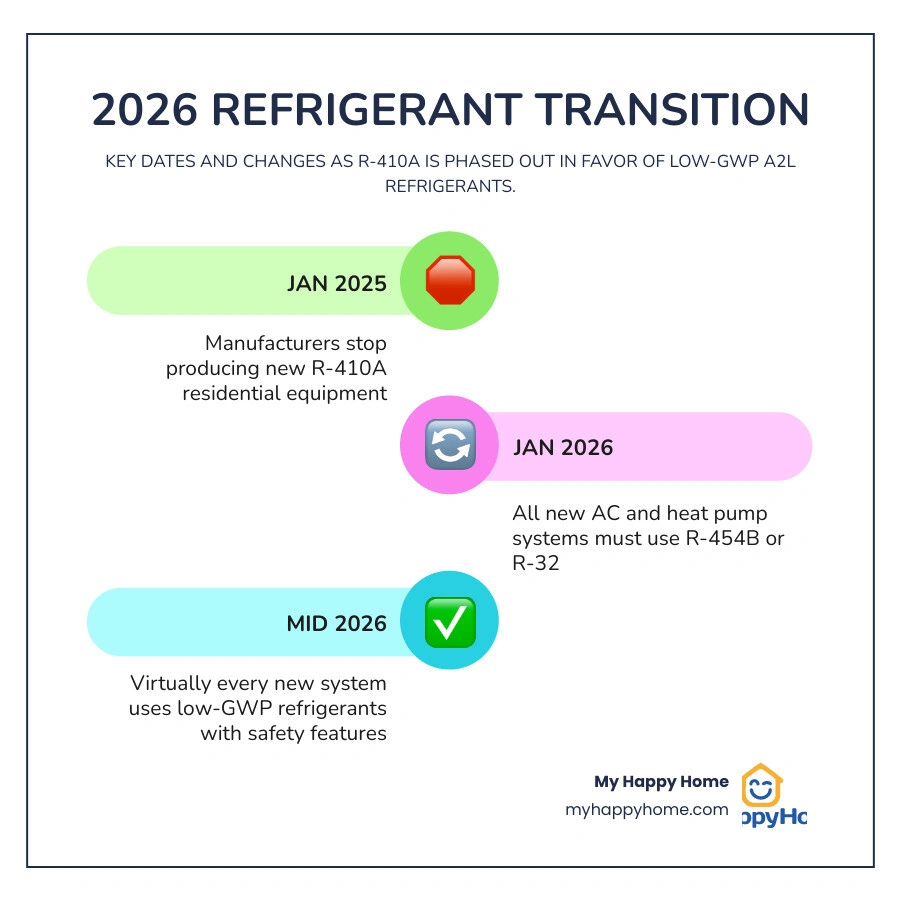
Understanding the 2026 A2L Refrigerant Shift
To understand why this change is happening, we have to look at how refrigerants are measured. The primary metric used by environmental agencies is Global Warming Potential (GWP). This scale measures how much heat a greenhouse gas traps in the atmosphere relative to carbon dioxide, which has a GWP of 1.
For decades, R-410A was the industry standard for residential air conditioning. However, R-410A has a GWP of 2,088. This means releasing one pound of R-410A into the atmosphere has the same warming impact as more than two thousand pounds of carbon dioxide. Under the EPA’s SNAP (Significant New Alternatives Policy) rules and the AIM Act, the government mandated that any new residential air conditioning systems manufactured or installed after the transition period must use refrigerants with a GWP of 700 or less.
This brings us to the new class of refrigerants: A2L refrigerants. The two primary options replacing R-410A in 2026 are:
- R-454B: This blend has a GWP of 466, representing a massive 78% reduction in environmental impact compared to R-410A. It is the choice of many major central air conditioning manufacturers.
- R-32: This single-component refrigerant has a GWP of 675, which is a 68% reduction compared to R-410A. It is widely used in ductless mini-split systems and by several prominent central HVAC brands.
For a deeper dive into how these chemical adjustments translate to your day-to-day life, check out our detailed guide on How AC Refrigerant Changes Affect Homeowners.
How the refrigerant transition affects your next ac purchase and system efficiency
One of the most immediate benefits of the transition to A2L refrigerants is the boost in energy efficiency. Because R-454B and R-32 have superior thermodynamic properties compared to R-410A, they transfer heat much more effectively. This means your air conditioner's compressor does not have to work as hard to cool your home.
This thermodynamic advantage translates directly into higher SEER2 (Seasonal Energy Efficiency Ratio) ratings. On average, new A2L systems are engineered to be 10% to 15% more energy efficient than their older R-410A predecessors. For homeowners in O'Fallon, MO, where hot, humid Midwestern summers can cause utility bills to skyrocket, this efficiency increase can lead to noticeable savings on monthly cooling costs.
Furthermore, this transition has a highly positive impact on heat pumps. Because heat pumps rely on transferring heat even in cold winter temperatures, the improved low-temperature performance of A2L refrigerants allows these systems to heat your home more efficiently during chilly Missouri winters without relying as heavily on auxiliary electric heat strips. You can explore these efficiency upgrades further in our article on New AC Benefits Beyond Comfort.
Safety features of new A2L systems
The "A2L" designation comes from ASHRAE Standard 34, which classifies refrigerants based on toxicity and flammability.
- A stands for low toxicity.
- 2L indicates that the refrigerant is "mildly flammable" with a slow flame propagation speed.
While the term "flammable" might sound alarming, A2L refrigerants are incredibly difficult to ignite. They require a highly concentrated volume in a confined space and a high-energy ignition source (such as an open flame) to combust. Common household items like hairspray, rubbing alcohol, and aerosol cooking sprays are far more flammable than R-454B or R-32.
To guarantee absolute safety, manufacturers have redesigned A2L systems with integrated protection mechanisms. If you purchase a new system in 2026, it will feature:
- Refrigerant Detection Systems (RDS): Built-in sensors constantly monitor the indoor coil and air handler cabinet for the presence of refrigerant.
- Mitigation Boards: If a leak is detected, the safety control board instantly shuts down the outdoor compressor to stop the flow of refrigerant.
- Automatic Blower Activation: The system automatically turns the indoor blower fan on to its maximum speed. Running the fan dilutes the leaking refrigerant with household air, safely dispersing it well below any concentration level that could pose a safety hazard.
How the refrigerant transition affects your next ac purchase
As you navigate the market for a new cooling system in 2026, you will find that the equipment landscape has completely shifted. Legacy R-410A units are no longer being manufactured, and remaining distributor inventories have largely been exhausted. This means your options will consist entirely of new A2L-compliant split systems, packaged units, and heat pumps.
Because these systems feature advanced safety controls, redesigned heat exchangers, and sensitive electronic mitigation boards, proper installation is more critical than ever. A2L systems require precise airflow and exact refrigerant charging to operate safely and efficiently. This makes professional planning essential. Working with an expert who understands load calculations ensures your system performs exactly as designed. To learn more about getting the perfect fit for your home, read about Why Correct System Sizing Matters for Your Home and explore our professional AC Installation Replacement services.
Retrofitting limitations for existing systems
A common question we hear from homeowners is whether they can simply swap out the refrigerant in their older system—for example, draining the R-410A and refilling it with R-454B or R-32.
The short answer is no. Retrofitting an existing R-410A system to use an A2L refrigerant is chemically and mechanically impossible, and attempting to do so is highly unsafe. The reasons for this strict limitation include:
- Pressure Differences: R-454B and R-32 operate at different pressures than R-410A, which would place unsafe stress on older copper coils and compressors.
- Lubricant Incompatibility: The synthetic POE (polyolester) oils used in A2L systems are formulated differently to match the chemical properties of the new refrigerants. Mixing them with older lubricants can cause compressor failure.
- Lack of Safety Controls: Older air handlers do not have the electrical wiring, sensors, or mitigation boards required to support a Refrigerant Detection System.
Upgrading to a new refrigerant standard requires replacing both the outdoor condenser unit and the indoor evaporator coil to ensure safety, compatibility, and warranty coverage.
How the refrigerant transition affects your next ac purchase regarding long-term service
If you choose to keep your existing R-410A system running, the transition will still impact your wallet through ongoing service and repair costs. The EPA has mandated a step-down schedule that slashes the production of R-410A by 40% in 2026, with an ultimate goal of an 85% reduction by 2036.
As the supply of virgin R-410A shrinks, wholesale prices are climbing rapidly. A simple refrigerant recharge that was relatively manageable a couple of years ago has now nearly doubled in cost. If your older system develops a significant refrigerant leak in 2026, repairing the leak and recharging the system with R-410A can quickly become an expensive gamble. While reclaimed and recycled R-410A will remain available for servicing older units for years to come, the premium price of the chemical means that every service call will carry a higher price tag. If you find yourself facing an unexpected breakdown, you can rely on our team for transparent diagnostics through our AC Repair Service.
Repair vs. Replace: Navigating Your Options in 2026
Deciding whether to patch up an aging air conditioner or invest in a new A2L system is one of the most significant choices you will face as a homeowner. To make an informed decision, we recommend weighing the age of your system, its repair history, and the projected future costs of keeping it running.
To help you visualize the differences, here is a comparative overview of how repair decisions stack up against replacement options in 2026:
- Feature/Factor: Refrigerant GWP; Existing R-410A System (Repair Option): 2,088 (High environmental impact); New A2L System (R-454B / R-32) (Replace Option): 466 – 675 (Low environmental impact)
- Feature/Factor: Refrigerant Cost; Existing R-410A System (Repair Option): High and rising rapidly due to production cuts; New A2L System (R-454B / R-32) (Replace Option): Standard market pricing for new chemicals
- Feature/Factor: System Efficiency; Existing R-410A System (Repair Option): Standard baseline efficiency; New A2L System (R-454B / R-32) (Replace Option): 10% to 15% more energy efficient
- Feature/Factor: Safety Technology; Existing R-410A System (Repair Option): None integrated (Standard pressure switches only); New A2L System (R-454B / R-32) (Replace Option): Built-in Leak Detection Sensors & Mitigation Boards
- Feature/Factor: Incentives & Credits; Existing R-410A System (Repair Option): None; New A2L System (R-454B / R-32) (Replace Option): Federal tax credits up to $2,000 for qualifying models
- Feature/Factor: Expected Lifespan; Existing R-410A System (Repair Option): Limited remaining years; New A2L System (R-454B / R-32) (Replace Option): 15 to 20 years with proper maintenance
If your system is more than 12 years old and requires a major repair—such as a new compressor or a coil replacement—the smart financial move is often to replace the unit. The money spent on a major R-410A repair is essentially being invested in a system that uses a phased-out, increasingly expensive chemical. You can read more about evaluating these timelines in our guide on How Long Does an AC Unit Last and calculate your long-term value with our analysis of AC Replacement Return on Investment.
Maximizing your current system's lifespan
If your current R-410A system is still in its prime (under 10 years old) and running reliably, there is no need to panic-buy a replacement. You can protect your investment and delay a costly replacement by focusing on proactive maintenance and leak prevention.
The most effective way to avoid expensive refrigerant recharges is to keep your system clean and properly calibrated. Small refrigerant leaks often start as tiny vibrations that rub copper lines together, or from acidic buildup on uncleaned coils. Regular professional tune-ups can catch these issues before they turn into major leaks. Schedule your seasonal service with our AC Maintenance Tune-Up team, and learn how routine care keeps your utility costs in check by reading How a Tune Up Improves Efficiency and Lowers Bills.
Frequently Asked Questions About the Refrigerant Transition
The shift to new HVAC standards naturally brings up many questions for homeowners. Here are the answers to the most common inquiries we receive in 2026.
Is A2L refrigerant safe for my home?
Yes, A2L refrigerants are incredibly safe. While they carry a "mildly flammable" classification, they require extremely specific, high-energy conditions to ignite that are virtually impossible to replicate in a residential setting. Furthermore, every new A2L system is equipped with mandatory safety sensors and mitigation controls that automatically shut down the system and dilute any leaking gas long before it can reach a concentration level that poses a hazard.
Can my old R-410A system be converted to use R-454B or R-32?
No. Older R-410A systems cannot be converted or retrofitted. The new refrigerants operate under different physical pressures, require different synthetic compressor oils, and require safety sensors and electronic controls that older systems simply do not have. Upgrading to the new standard requires a full system replacement.
What questions should I ask an HVAC contractor before buying a new system?
When shopping for a new air conditioner or heat pump in 2026, we highly recommend asking potential contractors the following questions:
- Are your technicians specifically certified to handle A2L refrigerants, and do they use spark-resistant tools?
- Does the quoted system include an integrated Refrigerant Detection System (RDS)?
- Will you pull all necessary local permits for the installation?
- Which qualifying systems do you offer that are eligible for federal tax credits or local utility rebates?
Conclusion
The 2026 refrigerant transition represents a major step forward for environmental sustainability and home energy efficiency, but it also changes how homeowners must approach HVAC repairs and replacements. Whether you are looking to keep your current system running efficiently for as long as possible or are ready to upgrade to a modern, high-efficiency A2L heat pump, having a trusted partner makes all the difference.
At My Happy Home, we specialize in taking the stress out of home maintenance. Our comprehensive home protection plans cover your vital home systems—including HVAC, plumbing, electrical, and major appliances—under one predictable, affordable monthly subscription. With access to licensed, vetted professionals and 24/7 support, you can enjoy absolute peace of mind knowing that sudden breakdowns won't lead to surprise repair bills.
Protect your comfort and your budget. Explore our HVAC Protection Plan options today, or contact us directly to schedule your next AC Repair Service. We are here to keep your home happy, comfortable, and ready for the future!