
How the right filter improves your AC efficiency
Why the Right AC Filter Is One of the Simplest Ways to Cut Energy Costs
Understanding how the right filter improves your AC efficiency can save you money every single month — and it starts with one small, overlooked component tucked inside your HVAC system.
Here is a quick breakdown of how filter choice directly affects your AC performance:
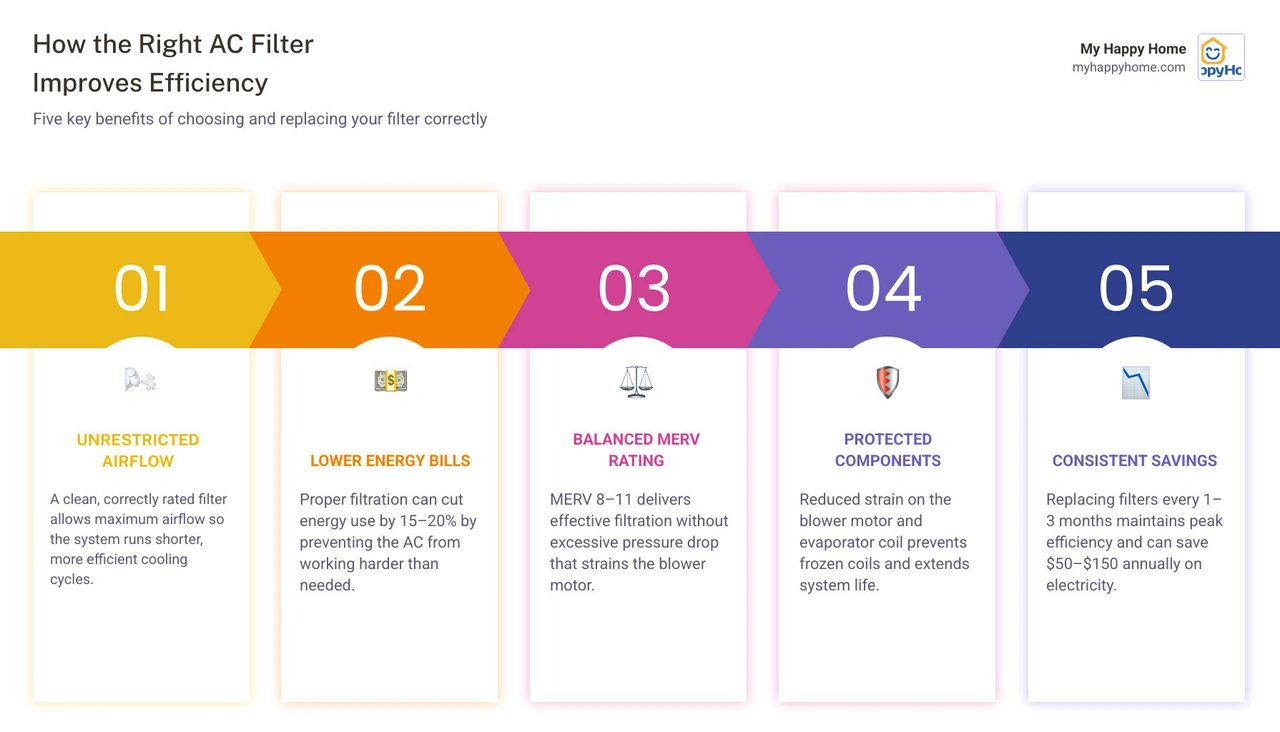
- Clean, correctly rated filter → unrestricted airflow → shorter cooling cycles → lower energy bills
- Dirty or clogged filter → restricted airflow → longer cooling cycles → energy use increases by 15–20%
- Wrong MERV rating (too high) → excessive pressure drop → strained blower motor → risk of frozen coils
- Right MERV rating (8–11 for most homes) → balanced filtration and airflow → protected equipment → longer system life
- Consistent replacement schedule → maintained efficiency → potential savings of $50–$150 per year on electricity
Nearly half of the energy used in a typical home goes toward heating and cooling. That means your HVAC system is one of the biggest drivers of your monthly utility bill — and your air filter is one of the few things you can control directly and easily.
Most homeowners spend a lot of time thinking about thermostats, equipment age, and smart home upgrades. But one of the most impactful efficiency factors is far simpler: a $10–$20 filter that needs to be swapped out every one to three months.
When a filter gets clogged with dust, pet dander, and debris, your AC has to work harder to pull air through it. The blower motor strains, cooling cycles run longer, and your energy bill quietly climbs. Swap in the right filter at the right time, and you restore airflow, reduce system stress, and bring those costs back down.
I'm Matthew Palmieri, founder of My Happy Home, and my background spans HVAC systems, contractor operations, and home protection planning — giving me a understanding of how the right filter improves your AC efficiency and why it is one of the most overlooked yet highest-impact maintenance habits a homeowner can build. In this guide, I'll walk you through everything you need to know to make a smart filter choice for your home.
Airflow and the Science of How the Right Filter Improves Your AC Efficiency
To truly understand how a simple square of fabric or fiberglass can dictate your monthly utility bills, we have to look at the physics of your air conditioner. An air conditioning system does not actually "create" cold air. Instead, it works by removing heat from the indoor air.
Your AC's blower motor pulls warm, humid air from your living spaces through the return vents, passes it over a freezing-cold evaporator coil, and then pushes the newly cooled air back through your supply ducts. The evaporator coil relies on a continuous, steady stream of warm air to keep it from getting too cold.
When you install a filter that is either heavily clogged or too restrictive for your system's design, you disrupt this entire process. This disruption is measured by HVAC professionals as static pressure—the amount of resistance air encounters as it moves through your ductwork.
When static pressure rises due to a restricted filter, the blower motor must work significantly harder to push and pull air. This extra work translates directly into higher electricity consumption.
Furthermore, because the airflow across the evaporator coil drops, the system cannot transfer heat efficiently. This results in longer cooling cycles, meaning your air conditioner runs for extended periods to reach the temperature set on your thermostat.
If you want to dive deeper into what happens when this cycle is neglected, read our comprehensive guide on How Dirty Air Filters Destroy Your AC Performance.
Balancing Filtration and Airflow: How the Right Filter Improves Your AC Efficiency
When homeowners shop for a new air filter, the natural instinct is to buy the one that promises to catch the absolute most particles. However, in residential HVAC, there is a delicate trade-off between clean air and proper airflow.
Air filters are rated using the MERV (Minimum Efficiency Reporting Value) scale, which ranges from 1 to 16 for standard residential and commercial systems.
- MERV 1 to 4: These are typically basic fiberglass filters. They are incredibly cheap and allow maximum airflow, but they do almost nothing for your indoor air quality. Their primary job is simply to keep large dust bunnies from damaging the fan motor.
- MERV 8 to 11: This is the "sweet spot" for most residential systems. These pleated filters capture pollen, mold spores, dust mites, and pet dander while maintaining a low pressure drop—meaning they do not excessively restrict airflow.
- MERV 13 to 16: These high-efficiency filters capture tiny particles, including smoke and bacteria. However, they are highly dense and create significant airflow resistance.
Using a filter with a MERV rating that is too high for your specific blower motor can lead to a massive drop in system efficiency. Unless your HVAC system was specifically designed or retrofitted to handle the static pressure of a MERV 13+ filter, sticking to a MERV 8 or 11 is almost always the best way to keep your AC running at peak performance.
Preventing System Strain: How the Right Filter Improves Your AC Efficiency
When your air conditioner has to fight against a restrictive or clogged filter, the consequences go far beyond a slight bump in your electric bill. The added strain accelerates wear and tear on critical components, most notably the compressor and the blower motor.
One of the most common service calls technicians make during hot Missouri summers involves frozen evaporator coils. When airflow is severely restricted, the temperature of the evaporator coil drops below freezing. The moisture that condense out of your indoor air freezes instantly on the coil, turning it into a solid block of ice. Once the coil freezes, your AC stops cooling entirely, and the system may short-cycle (turn on and off rapidly), putting immense stress on the compressor. Replacing a failed compressor is one of the most expensive repairs in the HVAC industry.
By choosing a filter that balances filtration with proper airflow, you protect these vital parts from premature failure. Regular maintenance keeps your system running smoothly, which is why we always recommend pairing proper filter habits with professional care. To learn more about how routine tune-ups keep your utility bills low, check out our guide on How a Tune-Up Improves Efficiency and Lowers Bills.
Choosing the Best Filter Type for Your Home
Walking down the home improvement aisle can be overwhelming. To help you make an informed decision, let’s look at the four most common filter types and how they stack up in terms of filtration, airflow, and overall AC efficiency.
- Fiberglass Filters: These are the flat, see-through filters often sold in multi-packs. While they offer excellent airflow, they provide virtually no filtration for airborne allergens. They clog quickly and must be changed every 30 days.
- Pleated Filters: Made from polyester or cotton folds, pleated filters have significantly more surface area than flat fiberglass. This design allows them to capture much smaller particles (MERV 8 to 11) without choking your system's airflow. They are the best all-around choice for residential efficiency.
- HEPA Filters: True HEPA filters capture 99.97% of particles down to 0.3 microns. While this sounds amazing for allergies, they are far too dense for standard residential HVAC systems. Installing one directly into your filter slot will choke your system's airflow and can cause immediate damage. If you need HEPA-level filtration, it is better to use a standalone air purifier.
- Electrostatic Filters: These filters use self-charging static electricity to attract particles. They come in both disposable and washable versions. While washable electrostatic filters seem convenient, they must be cleaned and allowed to dry completely before reinstallation. If reinstalled wet, they can promote mold growth inside your system. They also tend to lose their filtration efficiency over time.
- Media Filters: These are thick, deeply pleated filters (usually 4 to 5 inches deep) housed in a dedicated cabinet. Because they have massive surface areas, they can offer high filtration (MERV 11 to 13) with very low airflow resistance, and they only need to be replaced once or twice a year.
- Filter Type: Fiberglass; Typical MERV Rating: MERV 1–4; Airflow Friendliness: Excellent; Replacement Frequency: 30 days; Best For: Budget-conscious, low-use systems
- Filter Type: Pleated; Typical MERV Rating: MERV 8–11; Airflow Friendliness: Good to Very Good; Replacement Frequency: 60–90 days; Best For: Standard homes, pets, mild allergies
- Filter Type: Media (4-5"); Typical MERV Rating: MERV 11–13; Airflow Friendliness: Excellent; Replacement Frequency: 6–12 months; Best For: Superior air quality without airflow loss
- Filter Type: Electrostatic; Typical MERV Rating: MERV 4–6; Airflow Friendliness: Moderate; Replacement Frequency: Wash monthly; Best For: Reducing waste (reusable)
- Filter Type: HEPA; Typical MERV Rating: MERV 17–20; Airflow Friendliness: Extremely Poor (No-Go); Replacement Frequency: N/A; Best For: Dedicated standalone purifiers only
When and How Often to Replace Your AC Filter
How often should you replace your filter? While the packaging might say "lasts up to 90 days," the real answer depends on several unique factors in your household.
For standard 1-inch pleated filters, a good rule of thumb is to replace them every 60 to 90 days. However, you should inspect your filter monthly and change it sooner if it looks grey or dusty.
Here is how different household factors impact your replacement schedule:
- Pets: If you have dogs or cats, their hair and dander will clog a filter much faster. Plan to replace your filter every 30 to 60 days.
- Allergies or Asthma: To keep indoor air pristine and prevent respiratory triggers, change your filter every 30 to 45 days.
- Climate Factors: Here in O'Fallon, MO, our seasons are highly pronounced. During our hot, humid summers and freezing winters, your HVAC system runs almost constantly. More runtime hours mean more air passing through the filter, which means it will load up with dust much faster than it would during mild spring or autumn months.
- Wildfire Smoke: If seasonal winds carry smoke or fine particulate matter into our region, your filter will work double-time. Inspect it weekly during these events and swap it out immediately once the air clears.
To understand how filter checks fit into a broader preventative maintenance routine, take a look at our AC Tune-Up Guide: What to Expect.
Signs Your HVAC Filter Needs Immediate Replacement
You do not have to wait for your calendar reminder to tell you it is time for a fresh filter. Your home and your AC system will drop several clear hints when airflow is being restricted.
- Visibly Dirty Filter: The easiest test is the light test. Pull your filter out and hold it up to a bright light or window. If you cannot see any light passing through the pleats, it is completely clogged and needs to go.
- Weak Airflow from Vents: If you notice that the air blowing out of your supply registers feels weaker than usual, a clogged filter is the most likely culprit.
- Dust Accumulating Quickly on Surfaces: When a filter is full, the air pressure can force dust and particles around the edges of the filter frame or straight through the worn material, sending it right back into your living areas.
- An Unexplained Spike in Your Utility Bill: If your energy costs are climbing but your daily habits haven't changed, your AC is likely running longer cycles to compensate for a dirty filter.
- Short-Cycling: If your air conditioner turns on, runs for just a few minutes, shuts off, and then repeats the cycle, it may be overheating due to restricted airflow.
Regularly checking for these signs can save you from a complete system breakdown. For more information on how often your system needs professional eyes to prevent these issues, read How Often Should You Schedule an AC Tune-Up.
Frequently Asked Questions About AC Filters
What MERV rating is best for residential AC systems?
For the vast majority of residential HVAC systems, a MERV 8 or MERV 11 filter is the ideal choice. A MERV 8 filter captures about 70% of particles between 3 and 10 microns, which is plenty for standard dust and pollen control. If you have pets or mild allergies, upgrading to a MERV 11 filter provides better capture of fine pet dander and smoke without putting excessive static pressure on your blower motor. Always check your system's manual to ensure compatibility before stepping up to higher ratings.
Can the wrong air filter damage my air conditioner?
Yes, absolutely. If you install a filter that is too restrictive (such as a MERV 13+ in an older system not designed for it) or if you let a standard filter get completely clogged, you create high static pressure. This starves the system of air, which can cause the evaporator coil to freeze, overheat the blower motor, and ultimately lead to compressor failure.
How often should I change my filter in a hot climate like Florida?
While extremely hot climates like Florida require frequent changes due to year-round cooling demands, homeowners in O'Fallon, MO face similar challenges during our peak summer months. When temperatures soar and humidity rises, your system runs for 10 to 15 hours a day. During these high-use periods, you should check your filter every 30 days and replace it immediately if it shows signs of heavy dust buildup.
Conclusion
At the end of the day, understanding how the right filter improves your AC efficiency is one of the most empowering things you can do as a homeowner. It is a simple, cost-effective task that directly protects your indoor comfort, lowers your monthly energy bills, and extends the lifespan of your cooling system.
However, even the best filter habits cannot replace the need for professional system care. Over time, dust can still find its way onto your evaporator coils, electrical connections can loosen, and refrigerant levels can drift.
That is where we come in. At My Happy Home, we believe homeownership should be stress-free. Our comprehensive HVAC Protection Plan and Home Protection Plan are designed to give you ultimate peace of mind. For one predictable monthly membership, you get complete coverage for your heating, cooling, plumbing, electrical, and major appliances.
If you are ready to ensure your system is running at peak efficiency ahead of the next seasonal shift, let us help. Explore our AC Maintenance Tune-Up services today, and take the first step toward a happier, more efficient home.
Looking for comprehensive protection against unexpected HVAC, plumbing, or appliance breakdowns? Explore My Happy Home membership plans today and say goodbye to surprise repair bills!