
Don't get burned by your choice of home heating
Is a Heat Pump Better Than a Furnace for Your Home? Here's What You Need to Know
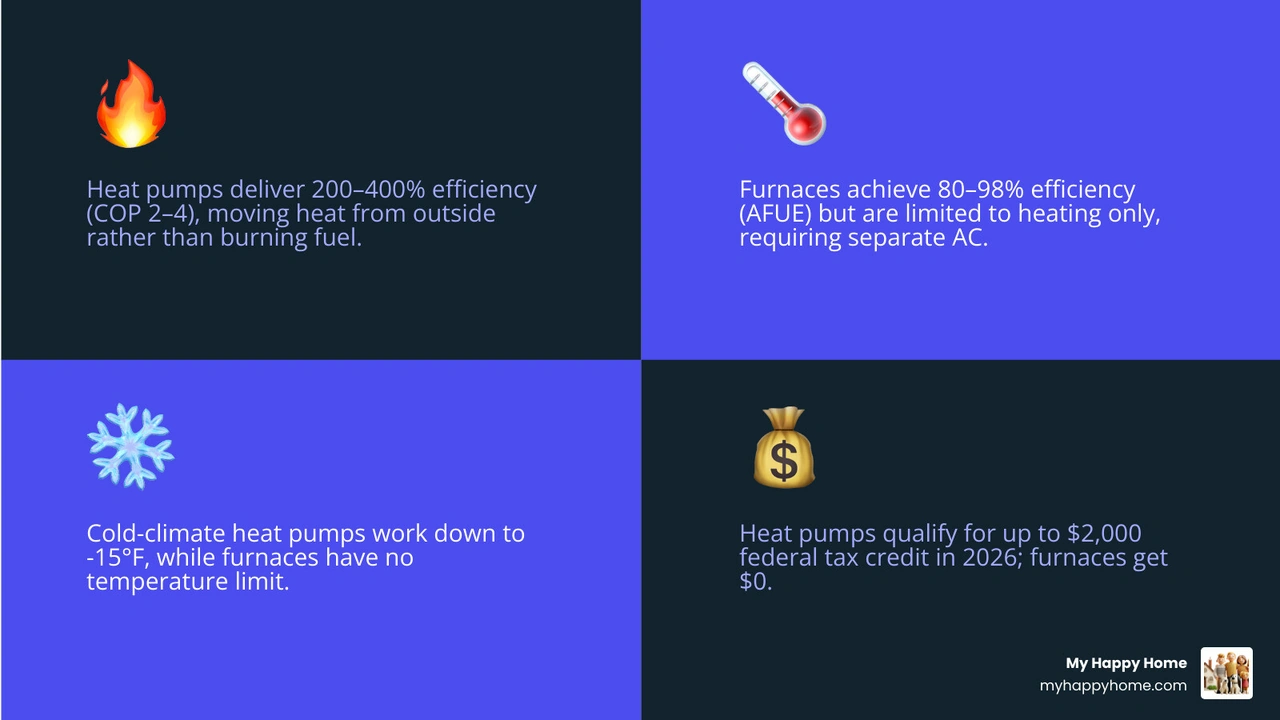
Is a heat pump better than a furnace for your home? For most U.S. homeowners, yes — but it depends on your climate, utility rates, and existing home setup. Here's a quick breakdown:
Quick Answer:
- Factor: Energy efficiency; Heat Pump: 200–400% (COP 2–4); Gas Furnace: 80–98% (AFUE)
- Factor: Best climate; Heat Pump: Mild to moderately cold; Gas Furnace: All climates, including extreme cold
- Factor: Heating AND cooling; Heat Pump: Yes — one system does both; Gas Furnace: No — heating only
- Factor: Environmental impact; Heat Pump: Lower carbon footprint; Gas Furnace: Burns fossil fuels
- Factor: Cold weather limit; Heat Pump: Down to -15°F (cold-climate models); Gas Furnace: No temperature limit
- Factor: Federal tax credit (2026); Heat Pump: Up to $2,000; Gas Furnace: $0
Home heating accounts for nearly a third of the average U.S. utility bill. That's a big number — and when it's time to replace or upgrade your system, the stakes feel even higher. You want to make the right call, not just for this winter, but for the next 15 to 20 years.
The good news? The heat pump vs. furnace debate is simpler than the HVAC industry sometimes makes it seem. Both systems keep your home warm. But they work in very different ways, and that difference matters a lot when it comes to your monthly bills, your family's comfort, and the long-term health of your home.
Research from the National Renewable Energy Laboratory found that more than 90% of U.S. homes would save money by switching to a new heat pump. At the same time, there are real situations where a gas furnace — or a combination of both — still makes the most sense.
This guide breaks it all down so you can make a confident, informed decision.
Understanding the Mechanics: How Heat Pumps and Furnaces Differ
When we talk about home heating, we’re really talking about thermodynamics—the science of moving energy. While both systems end with warm air blowing out of your vents, the "how" couldn't be more different.
A furnace is a "heat creator." It uses a fuel source—most commonly natural gas or electricity—to generate heat from scratch. In a gas furnace, a burner ignites the fuel, which warms up a component called a heat exchanger. Air from your home blows across that hot exchanger and then travels through your ducts. It’s a straightforward process that has kept homes in places like O'Fallon, MO, warm for generations.
A heat pump, on the other hand, is a "heat mover." It doesn't actually create heat; it just relocates it. Using a refrigerant cycle similar to your refrigerator (but in reverse), it absorbs thermal energy from the outdoor air—even when it's cold outside—and pumps it into your home. Because it moves heat rather than burning fuel to create it, it is significantly more efficient.
One major mechanical advantage of the heat pump is its versatility. In the summer, the process simply reverses. It takes the heat from inside your house and dumps it outside, acting as a high-efficiency air conditioner. This dual-purpose nature is why many homeowners choose a Heat Pump Repair Service to keep their year-round system in top shape.
The Physics of Moving vs. Creating Heat
To understand why is a heat pump better than a furnace for your home, we have to look at the physics of energy transfer. Furnaces are limited by the laws of combustion. Even the most advanced gas furnace can never be more than 100% efficient because you can't get more energy out of a flame than the fuel itself contains. Most high-efficiency furnaces reach about 95% to 98% AFUE (Annual Fuel Utilization Efficiency).
Heat pumps break the 100% barrier because they aren't converting fuel to heat; they are using electricity to power a compressor and fan that move existing heat. This is measured by the Coefficient of Performance (COP). A COP of 3.0 means that for every one unit of electricity used, the system delivers three units of heat. That’s 300% efficiency!
Whether you have a traditional furnace or a modern heat pump, keeping these mechanical components clean is vital. Dust on an evaporator coil or a cracked heat exchanger can tank your efficiency. If you ever hear strange clanking or notice a drop in performance, reaching out for a Furnace Repair Service or heat pump inspection is the best way to prevent a small mechanical hiccup from becoming a total system failure.
Is a heat pump better than a furnace for your home in terms of efficiency?
In the efficiency category, the heat pump is the undisputed heavyweight champion. Because it leverages the physics of energy transfer, an air-source heat pump can provide up to three times more heat energy than the electrical energy it consumes.
Let's look at the numbers for May 2026. A standard electric furnace has a COP of 1.0—it's 100% efficient, but it uses a lot of power to get there. A gas furnace usually sits below 1.0. Modern variable-speed heat pumps, however, typically boast a COP between 2.0 and 4.0. This means they are 2 to 4 times more efficient than electric resistance heating.
For homeowners in Missouri, this efficiency translates directly to lower utility needs. Research from Lawrence Berkeley National Laboratory suggests that heat pumps can reduce a home’s heating-related electricity needs by about 50% compared to furnaces. If you're currently using an older system, upgrading to an energy-efficient heat pump could save you up to 50% on your total heating and cooling bills.
To keep that efficiency high, regular maintenance is a must. A Heat Pump Maintenance Tune-Up Austin TX (or in any of our service areas) ensures that the refrigerant levels are correct and the airflow is unobstructed, which is critical for maintaining those high COP ratings.
Maximizing Energy Savings in 2026
As we move further into 2026, the "efficiency" conversation is also an "environmental" one. Heat pumps are the cleanest option available for home climate control. Residential heat pumps can reduce a home's carbon footprint by 38% to 53% when they replace a gas furnace.
One of the most exciting developments in 2026 is the synergy between heat pumps and home solar panels. Since heat pumps run on electricity, pairing them with a solar array can potentially eliminate your heating and cooling costs entirely. Unlike natural gas, which is subject to global market price fluctuations, electricity generated on your own roof provides a stable, predictable energy source.
Even without solar, the seasonal performance of modern units is impressive. Variable-speed technology allows the system to "sip" energy, running at lower speeds to maintain a constant temperature rather than constantly cycling on and off at full blast like an old-fashioned furnace. This not only saves money but also reduces the wear and tear on your equipment. If you do stick with a furnace for now, ensuring it’s running at peak performance with a Furnace Maintenance Tune-Up Cincinnati OH is the best way to keep your fuel consumption as low as possible.
Performance in Cold Climates and Extreme Weather
The biggest myth we hear is that heat pumps don't work in the cold. While that might have been true in the 1980s, the technology in 2026 is a different beast entirely. Modern "cold-climate" heat pumps are designed specifically for regions that see freezing temperatures.
In a place like O'Fallon, MO, where winters can get biting, performance matters. Standard variable-speed heat pumps can deliver 100% heating capacity down to about 27°F. However, specialized cold-climate models maintain 100% capacity down to 5°F and can continue to provide effective heat (around 70% capacity) all the way down to -13°F or even -25°F in some high-end models.
When the temperature drops below the system's "balance point"—the temperature where the heat pump can no longer pull enough heat from the outside air to keep up with the home's heat loss—the system uses "auxiliary heat." This is usually an electric resistance coil. While auxiliary heat is less efficient, it ensures you stay warm during those rare extreme cold snaps. If your backup heat isn't kicking in, you might need a Furnace Repair Service Salt Lake City UT or local equivalent to check your air handler's heating elements.
Is a heat pump better than a furnace for your home in cold weather?
For many, the "best" option isn't one or the other—it's both. This is called a dual-fuel or hybrid system. In this setup, an electric heat pump handles the heating during the "shoulder seasons" (spring and fall) and most of the winter. When the temperature drops below freezing (typically around 32°F to 35°F), the system automatically switches over to a gas furnace.
This "best of both worlds" approach is incredibly popular in the Midwest. It allows you to take advantage of the heat pump's incredible efficiency when it's 40°F outside, but gives you the "poker-hot" air of a gas furnace when a polar vortex hits. Gas furnaces typically output air at 130°F to 140°F, whereas heat pumps provide a gentler, more humid warmth at around 90°F to 110°F.
If you live in a climate like Boston, where winters are long and damp, a Heat Pump Maintenance Tune-Up Boston MA can ensure your system's defrost cycle is working correctly. This cycle prevents ice from building up on the outdoor coils, which is essential for maintaining airflow and heating capacity during a snowy Missouri winter.
Comparing Long-Term Value and Maintenance Needs
When deciding is a heat pump better than a furnace for your home, you have to look past the first year and consider the next two decades.
Furnaces generally have a longer lifespan than heat pumps. A well-maintained gas furnace can last 15 to 30 years. This is because a furnace only runs for about half the year. A heat pump, however, works year-round to provide both heating and cooling. Because it has more "miles" on it, a heat pump typically lasts about 10 to 15 years, though with meticulous care, many reach the 20-year mark.
Maintenance requirements are similar but distinct. Both need regular filter changes (every 1-3 months). However, because a heat pump is more complex—containing a reversing valve, refrigerant, and an outdoor compressor—it generally benefits from two professional check-ups a year: once before the cooling season and once before the heating season. For those in the Northeast, a Heat Pump Maintenance Tune-Up Philadelphia PA is a standard part of winter prep.
Is a heat pump better than a furnace for your home's air quality?
Air quality is an often-overlooked factor in the furnace vs. heat pump debate. Furnaces, particularly gas models, are known for producing very dry air. This is because the combustion process naturally removes moisture. This dry air can lead to static electricity, dry skin, and respiratory irritation during the winter. Many furnace owners find they need to install a whole-home humidifier to compensate.
Heat pumps provide a gentler airflow with higher humidity levels. Because they don't burn fuel, they don't dry out the air as aggressively. This can make the home feel warmer at a lower temperature because humid air holds heat better than dry air.
Safety is another consideration. Gas furnaces carry a small but real risk of carbon monoxide leaks if the heat exchanger cracks or the flue becomes blocked. Heat pumps are all-electric, eliminating the risk of CO poisoning or gas leaks in the home. Regardless of which system you choose, regular safety inspections are vital. A Furnace Maintenance Tune-Up Minneapolis MN always includes a check of the heat exchanger and venting system to ensure your family stays safe.
Making the Switch: Infrastructure and Incentives
If you’re thinking about switching from a furnace to a heat pump, there are a few infrastructure items we need to check first.
- The Electrical Panel: Heat pumps require a dedicated 30–60 amp circuit. If your home has an older 100-amp panel, you might need an upgrade to handle the new electrical load.
- Ductwork: Most heat pumps work perfectly with existing furnace ducts. However, if you have a home without ducts (like those with baseboard heat or boilers), a "ductless mini-split" heat pump is a fantastic alternative that avoids the need for expensive renovations.
- Venting: If you’re sticking with a high-efficiency gas furnace, you’ll need proper PVC venting to handle the condensation.
The good news is that the government wants you to choose the more efficient option. Under the Inflation Reduction Act, homeowners can qualify for a federal tax credit of noticeably of the cost of a heat pump, capped at $2,000 per year. In contrast, most standard gas furnaces currently receive $0 in federal tax credits. When you factor in these incentives and the long-term energy savings, the "payback period" for a heat pump is often much shorter than people expect. For those looking at a Heat Pump Installation Replacement Houston TX, these credits can significantly offset the initial investment.
When to Replace Your Current System
We generally recommend evaluating your system once it hits the 10-to-12-year mark. If your furnace is frequently breaking down, or if you’re facing a repair that costs more than 30% of a new unit, it’s time to look at a replacement.
In O'Fallon, MO, the decision often comes down to your current setup. If you already have a functional air conditioner and your furnace dies, you might just replace the furnace. But if both your AC and furnace are aging, replacing them both with a single heat pump system is often the most cost-effective move. It simplifies your home's mechanical systems and ensures you have a matched, high-efficiency setup for both seasons. If you're in a city like Chicago, a Furnace Installation Replacement Chicago IL might be the priority, but many residents are now opting for hybrid systems to handle the lakefront's variable weather.
Frequently Asked Questions About Home Heating
Can a heat pump completely replace a gas furnace?
Yes, especially in 2026. Modern cold-climate heat pumps are designed to be the sole heating source even in northern climates. However, in regions with frequent sub-zero temperatures, many homeowners prefer a dual-fuel system for that extra peace of mind and the "hotter" air feel of a furnace during extreme cold.
How long does a heat pump last compared to a furnace?
Typically, a furnace lasts 15–25 years, while a heat pump lasts 10–15 years. This is simply because the heat pump does double duty, running all year long, whereas the furnace gets a "vacation" during the summer months. Regular maintenance can significantly extend the life of a heat pump.
Do heat pumps require more maintenance than furnaces?
They don't necessarily require more work, but they require it more frequently. Since they operate year-round, we recommend a professional tune-up twice a year. A furnace generally only needs one professional inspection per year, usually in the autumn before the first big freeze.
Conclusion
Choosing between a heat pump and a furnace doesn't have to be a stressful "either/or" ultimatum. For the majority of homeowners, especially those looking to lower their carbon footprint and take advantage of 2026 tax incentives, the heat pump is the clear winner for efficiency and long-term savings. However, for those in extreme climates or with low natural gas rates, a furnace or a hybrid system remains a reliable, powerful choice.
The most important factor in your home's comfort isn't just the box in the basement—it's the care that goes into it. Unexpected HVAC repairs can be a major headache, which is why we believe in a proactive approach. With a My Happy Home membership, you can stop worrying about surprise repair bills and focus on enjoying your home. Our plans provide comprehensive coverage for your HVAC, plumbing, and electrical systems, ensuring that whether you choose the high-tech efficiency of a heat pump or the reliable roar of a furnace, your home stays exactly the way it should be: happy.
Explore comprehensive HVAC protection plans and give yourself the peace of mind you deserve.