
How clogged drains lead to bigger plumbing problems and smaller bank accounts
Why Understanding How Clogged Drains Lead to Bigger Plumbing Problems Could Save Your Home
How clogged drains lead to bigger plumbing problems is something most homeowners discover the hard way — usually after a minor slow drain turns into a flooded bathroom or a sewage smell that won't go away.
Here's the short answer:
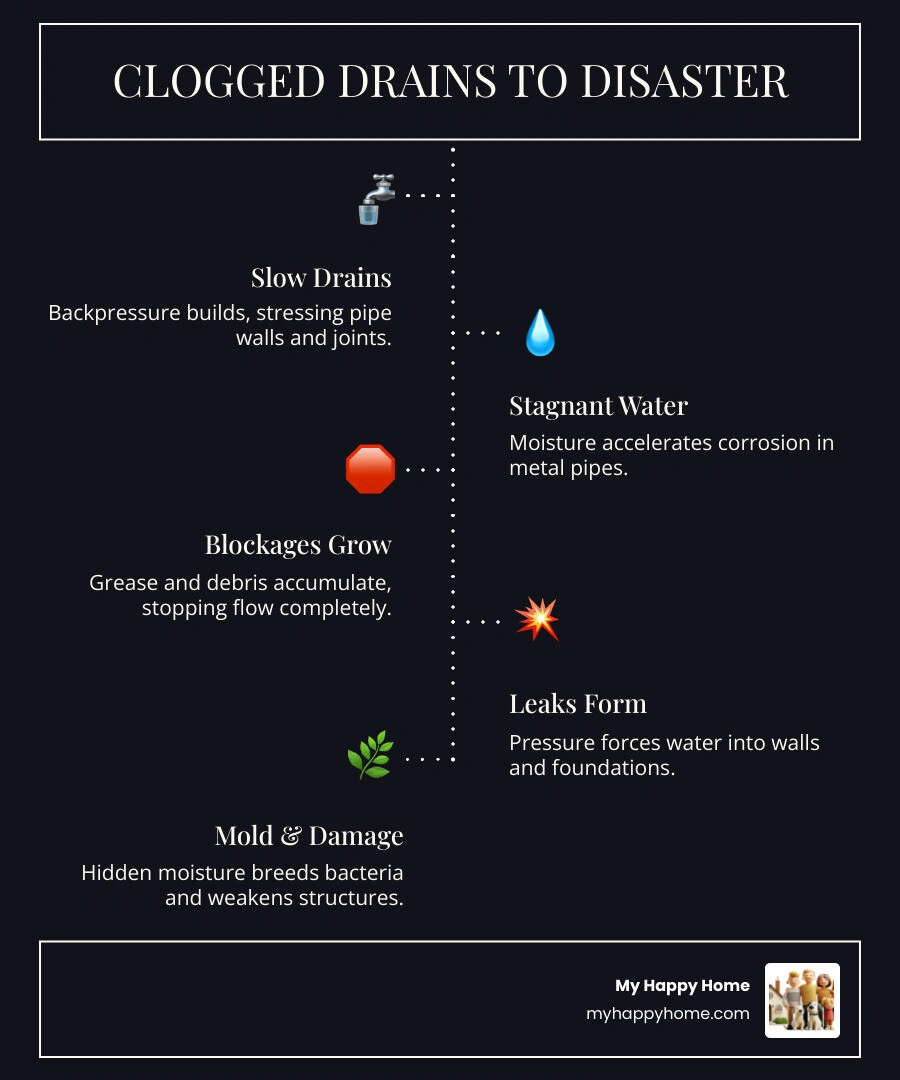
- Slow drains build backpressure — water sitting behind a blockage puts stress on pipe walls and joints
- Stagnant water accelerates corrosion — trapped moisture breaks down metal pipes from the inside out
- Partial blockages grow — grease, hair, and mineral scale keep accumulating until flow stops completely
- Pressure forces water sideways — leaks form at weak joints, seeping into walls, floors, and foundations
- Sewer line strain causes backups — a household clog left untreated can migrate to the main line, pushing raw sewage back into your home
- Mold and bacteria follow moisture — hidden leaks from chronic clogs create ideal breeding conditions behind walls
- Structural damage compounds quietly — subfloors, ceiling joists, and even foundations can weaken before you see a single visible sign
A slow-draining sink or tub might feel like a small inconvenience — something to deal with later. But in many homes, that sluggish drain is actually an early warning signal of a hidden plumbing issue already in progress. According to industry data, roughly half of the 400,000 sewer blockages reported every year in the U.S. are caused by grease alone. And the average household already wastes close to 10,000 gallons of water annually from leaks — many of which trace back to pressure and pipe damage caused by ignored clogs.
The pattern is almost always the same: a minor blockage gets dismissed, a DIY fix buys a few weeks of relief, and then the problem returns — worse, deeper, and more expensive to fix.
This guide breaks down exactly what happens inside your pipes when a clog is left alone, why common fixes often backfire, and what it takes to actually solve the problem before it costs you far more than a simple drain cleaning would have.
How Clogged Drains Lead to Bigger Plumbing Problems Over Time
When we see a sink draining slowly in April 2026, our first instinct might be to reach for a plunger and call it a day. However, it’s important to understand that a clog isn't just a "plug" in the pipe; it’s a catalyst for a chain reaction.
The primary issue is backpressure. Your home’s plumbing is designed to handle water moving at a specific velocity. When a clog forms, water sits stagnant. This weight and pressure put immense stress on the pipe’s structural integrity. Over months, this pressure can cause joints to loosen or older metal pipes to develop "pinhole" leaks.
Furthermore, stagnant water is a playground for corrosion. In metal pipes, like cast iron or galvanized steel common in many older homes, trapped moisture leads to oxidation. Even in modern PVC, a chronic clog can lead to the buildup of a biofilm—a sticky layer of bacteria that can actually eat away at seals and contribute to pitting. If you’re noticing these issues, seeking a professional Plumbing Repair Service early on can prevent a total pipe collapse.
Recognizing How Clogged Drains Lead to Bigger Plumbing Problems in the Kitchen
The kitchen is the heart of the home, but it’s also the headquarters for grease-related disasters. As of April 2026, grease remains the leading cause of residential blockages. We often think that running hot water while pouring bacon grease down the drain "washes it away." In reality, that grease cools as it travels deeper into your plumbing, solidifying on the pipe walls.
Once a layer of grease is established, it acts like flypaper, catching every food particle, coffee ground, and grain of rice that follows. This creates a "fatberg" within your walls. This buildup doesn't just slow your sink; it increases the pressure on your garbage disposal and dishwasher. If the dishwasher cannot drain properly due to a kitchen clog, you might find yourself with a flooded kitchen floor and a fried appliance motor. For residents in North Carolina, specialized Drain Cleaning & Repair Raleigh NC services are often necessary to scour these hardened fats from the line.
How Clogged Drains Lead to Bigger Plumbing Problems in Main Sewer Lines
If you think a slow kitchen sink is annoying, a main sewer line issue is a true nightmare. When clogs migrate past the individual fixtures and into the main line, the consequences escalate.
Two major factors often turn a simple clog into a sewer crisis:
- Tree Roots: Roots are naturally drawn to the moisture and nutrients inside your sewer pipes. They can enter through microscopic cracks and, once inside, they act as a net, catching toilet paper and waste.
- Pipe Bellies: Over time, the ground under your home can shift. This causes a section of the pipe to sag, or "belly." Water and solids pool in this low spot, creating a recurring clog that a simple snake cannot fix.
The warning signs are hard to miss: multiple fixtures backing up at once, gurgling sounds from the toilet when you run the laundry, and a distinct sewage odor in the yard. These are signs that you need a Sewer Line Repair Service Charlotte NC to investigate before raw sewage ends up in your basement.
The Engineering Behind Your Pipes: Why Size Matters
We often hear homeowners ask, "Why aren't drain pipes just bigger? If they were six inches wide, they’d never clog!" It’s a logical question, but plumbing engineering relies on some very specific physics.
Pipes are sized to maintain flow velocity. If a pipe is too large for the amount of water moving through it, the water won't have enough "push" to carry solids along. Instead, the water would flow around the debris, leaving it behind to dry and harden. This is why a bathroom sink uses a 1.25-inch pipe, while a toilet requires a 3-inch line.
Standard Pipe Diameters and Clog Prevention
The system is also designed to be "vented." Air must follow the water to prevent a vacuum from forming (which would cause that annoying "glug-glug" sound).
- P-Traps: That U-shaped pipe under your sink is designed to hold a small amount of water to block sewer gases from entering your home. It’s also designed to be the "sacrificial" spot for clogs. It’s much easier to clean a P-trap than a pipe buried behind a wall.
- The Toilet Throat: Most toilets have a 2-inch "throat." This is intentionally smaller than the 3 or 4-inch waste line it connects to. The goal is that if something unflushable (like a toddler’s toy) is going to get stuck, it gets stuck in the toilet where it can be reached, rather than deep in the main line.
When these engineering balances are disrupted by years of buildup, you need professional Drain Cleaning & Repair to restore the original flow dynamics. If you’re in the West Coast area, our Plumbing Repair Service Los Angeles CA can help ensure your system meets these critical engineering standards.
Hidden Dangers: From Slow Drains to Structural Damage
The most terrifying aspect of how clogged drains lead to bigger plumbing problems is the damage you can’t see. When a pipe is partially blocked, the water finds the path of least resistance. Often, that means seeping through gaskets or microscopic cracks in the pipe.
Stagnant water behind a clog is a breeding ground for harmful bacteria, including E. coli and Salmonella. If a backup occurs, these pathogens can coat your surfaces. Furthermore, the constant moisture from a slow leak leads to mold and mildew growth within 24 to 48 hours. This doesn't just ruin your drywall; it poses a significant health risk to anyone in the home with respiratory issues or allergies. If you suspect a deep blockage is causing these hidden leaks, a Sewer Line Repair Service is essential to protect your home's health.
Long-Term Consequences of Neglect
If ignored, a "simple" clog can lead to a total structural failure. Here is what we see when clogs are left to fester:
- Subflooring Rot: Slow leaks from a clogged shower drain can rot the wooden subfloor, eventually causing the shower or tub to sag or even fall through the floor.
- Foundation Erosion: If a main sewer line leaks due to a clog-induced crack, the water can wash away the soil supporting your foundation, leading to "foundation heave" or cracks in your home's slab.
- Ceiling Stains: That mysterious yellow circle on your living room ceiling? It’s often a direct result of a clogged upstairs toilet or sink that has been leaking slowly for weeks.
- Pest Infestations: Cockroaches and drain flies are attracted to the rotting organic matter trapped in clogs.
Addressing these issues early with comprehensive Plumbing Services is the only way to avoid a massive renovation bill later.
Why DIY Fixes Often Worsen the Blockage
We get it — those colorful bottles of liquid "drain opener" at the hardware store look like a cheap and easy fix. But in professional plumbing, we often call these "liquid pipe killers."
The way most chemical cleaners work is through an exothermic reaction—meaning they generate intense heat to melt through grease and hair. While this might clear a small hole in the clog, it’s rarely a complete fix. Instead, it often creates a small tunnel through the debris, leaving the rest of the "gunk" to catch more waste tomorrow. Even worse, the chemicals are heavy. If they don't clear the clog, they sit on top of it, eating away at your pipes.
The Risks of Chemical Drain Cleaners
- PVC Damage: The heat generated by these chemicals can soften and deform PVC pipes, leading to permanent leaks.
- Pipe Pitting: In metal pipes, the harsh acids or bases cause pitting and accelerated corrosion.
- Biofilm Retention: Chemicals rarely remove the sticky biofilm, meaning the clog will return faster than before.
- Safety Hazards: If the chemical fix fails and you eventually call a plumber, that pipe is now filled with caustic acid that can burn the technician’s skin or eyes.
Instead of risking your pipes, consider a Plumbing Maintenance & Inspection to find the root cause. This is especially important for maintaining your home's efficiency, much like how you would schedule a Water Heater Repair Service to keep your hot water flowing.
Professional Solutions for Long-Term Pipe Health
When the plunger fails, it’s time to bring in the heavy hitters. Modern plumbing technology allows us to see exactly what’s happening inside your walls without tearing them down.
One of the most effective tools we use is the waterproof camera inspection. We can run a fiber-optic camera through your lines to identify if the problem is a simple hairball, a shifted pipe, or a family of tree roots. Once we know what we're dealing with, we can use Hydro-jetting. Unlike a snake, which just pokes a hole in the clog, hydro-jetting uses high-pressure water to "pressure wash" the inside of your pipes, removing grease, scale, and roots entirely.
For older pipes that are starting to fail, we can often perform pipe lining. This involves inserting a resin-coated sleeve into the existing pipe and inflating it, creating a brand-new, seamless pipe inside the old one. This is a great way to "future-proof" your home, and it's often covered under a Drain Protection Plan.
When to Call a Professional Plumber
Not every clog is an emergency, but knowing the difference can save you thousands.
- Symptom: Single sink drains slowly; Likely Issue: Localized hair/soap clog; Action Needed: Plunger or P-trap cleaning
- Symptom: Multiple slow drains; Likely Issue: Main line blockage; Action Needed: Professional Inspection
- Symptom: Gurgling toilets; Likely Issue: Venting or sewer line issue; Action Needed: Professional Inspection
- Symptom: Sewage backup in tub; Likely Issue: Main line failure; Action Needed: EMERGENCY CALL
- Symptom: Recurring clog (monthly); Likely Issue: Pipe belly or root intrusion; Action Needed: Camera Inspection
Frequently Asked Questions About Clogged Drains
What are the most common causes of clogged drains?
Most household clogs are caused by a combination of hair, soap scum (which acts like glue), and cooking grease. In the bathroom, "flushable" wipes are a major culprit; despite the label, they do not break down like toilet paper and frequently snag on pipe imperfections. Hard water minerals (calcium and magnesium) also build up over time, narrowing the pipe's diameter.
What are the early warning signs of a clogged drain?
The most common sign is slow drainage, but you should also listen for gurgling noises, which indicate air is trapped. Foul odors (like rotting eggs or old food) are a sign that organic matter is trapped and decaying. If you find yourself needing to plunge the same toilet every week, you aren't fixing the clog — you're just moving it.
Why do DIY fixes like chemical drain cleaners often fail?
They usually only tackle the "symptoms" by burning a small hole through the center of a clog. They don't remove the sticky residue on the pipe walls that caused the clog in the first place. Furthermore, they can mask structural issues like tree roots or sagging pipes, allowing the problem to get much worse (and more expensive) before you realize you need help.
Conclusion
Understanding how clogged drains lead to bigger plumbing problems is the first step toward a "Happy Home." A minor inconvenience today can quickly escalate into a structural nightmare and a significant financial burden.
At My Happy Home, we believe homeownership shouldn't be a source of stress. Our membership plans are designed to protect you from the "smaller bank account" syndrome that comes with unexpected plumbing disasters. Whether you are in O'Fallon, MO, or anywhere else across the country, our vetted professionals are ready to ensure your pipes stay clear and your home stays dry.
Don't wait for the puddle on the floor. Protect your home's future and your peace of mind by investing in a comprehensive Drain Cleaning & Repair plan today. With My Happy Home, expert help is always just a click away, ensuring your home remains the sanctuary it was meant to be.