
What happens during an electrical panel installation
What to Expect During an Electrical Panel Upgrade: A Step-by-Step Overview
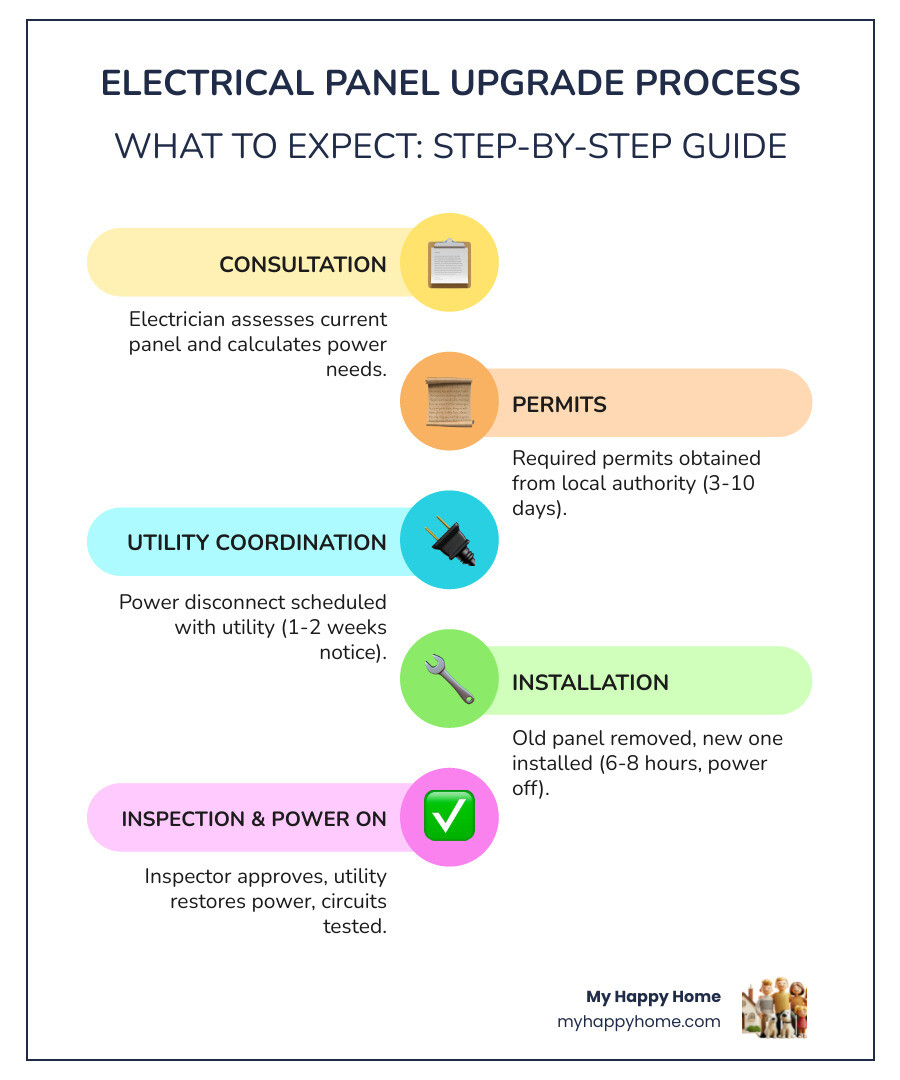
Understanding the electrical panel upgrade process what to expect can save you a lot of stress. Here's a quick summary:
- Consultation and load calculation - A licensed electrician assesses your current panel and power needs.
- Permit application - Your electrician pulls the required permits from your local authority (takes 3-10 days).
- Utility company coordination - Power disconnect is scheduled in advance (allow 1-2 weeks).
- Installation day - Your power will be off for roughly 6 to 8 hours while the old panel is removed and the new one is installed.
- Municipal inspection - An inspector verifies the work meets current electrical code before power is restored.
- Power restoration - The utility company re-energizes your service after inspection approval.
- Testing and labeling - Every circuit is tested and clearly labeled on your new panel.
The full process, from your first consultation to final inspection approval, typically takes one to three weeks.
Your home's electrical panel is the central hub of everything that runs on power — every light, outlet, appliance, and device depends on it. Most people never think about it until something goes wrong. But if your home was built before 1990 and still has its original panel, or if you're noticing flickering lights and tripping breakers, the panel is likely sending you a signal worth paying attention to.
An electrical panel upgrade is not a small job. It involves your electrician, your local municipality, and your utility company — all working in a specific sequence. Knowing what each step looks like helps you plan ahead, reduces surprises, and makes the whole experience far less stressful for your household.
This guide walks you through every stage of the process, from the first phone call to the moment your power comes back on.
Recognizing the Need for an Electrical Panel Upgrade
Think of your electrical panel as the heart of your home. Just as a heart pumps blood to your extremities, the panel pumps electricity to every room. However, if the heart is too small for the body, the system fails. Many older homes in the O'Fallon area were built with 60-amp or 100-amp service. While that was plenty of juice for a few lamps and a refrigerator in the 1970s, it’s often insufficient for today’s high-tech lifestyles.
Today, a 200-amp service is the modern standard. If your home is still operating on a fuse box or an undersized breaker box, you aren't just dealing with an inconvenience; you might be facing a safety hazard. If you're constantly dealing with power issues, it might be time for a professional Electrical Repair Service to evaluate your system.
Signs your home needs an electrical panel upgrade process what to expect
How do you know if your panel is waving a white flag? There are several telltale signs that suggest your current system is overmatched:
- Frequent Tripping: If you can’t run the microwave and the hair dryer at the same time without a trip to the basement to flip a switch, your circuits are overloaded.
- Physical Damage: Rust, corrosion, or scorch marks on the panel are major red flags.
- Odd Noises and Smells: A buzzing sound coming from the box or the smell of burning plastic indicates arcing or overheating wires.
- Hazardous Brands: If your home has a Federal Pacific or Zinsco panel, you should prioritize an upgrade. Independent testing has shown that these breakers fail to trip in up to 25% of overload situations, which is a significant fire risk.
- Age: Electrical panels generally have a 25 to 40-year lifespan. If yours is older than 25 years, a comprehensive Electrical Maintenance Inspection is highly recommended.
Future-proofing for modern electrification
Beyond immediate safety, many homeowners in O'Fallon choose to upgrade to prepare for the future. We are seeing a massive shift toward home electrification. Whether you are planning to install a Level 2 EV charger, switch to a high-efficiency heat pump, or add a solar array, these additions require significant electrical "headroom." Upgrading now ensures that when you're ready for that induction stove or smart home system, your infrastructure is ready to support it.
The Pre-Installation Phase: Permits and Planning
Once we decide that an upgrade is necessary, the "behind-the-scenes" work begins. This isn't just a matter of swapping a box; it requires meticulous planning and regulatory compliance.
First, your electrician performs a "load calculation" according to NEC Article 220. This is a mathematical assessment of every appliance and outlet in your home to determine exactly how much amperage you need. Following this, we handle the permit application with the local Authority Having Jurisdiction (AHJ). In O'Fallon and surrounding areas, permitting is a non-negotiable safety step. It ensures that the work will be inspected and verified as code-compliant, which protects your home’s value and your insurance status. You can learn more about the scope of these improvements through our Electrical Installation Upgrade page.
Coordinating with the utility company for an electrical panel upgrade process what to expect
The most critical part of the planning phase is coordination with your utility company. Because the main power lines coming into your home must be disconnected, the utility company must be involved.
We typically provide the utility company with a 48-72 hour notice, though scheduling the actual appointment can take 1-2 weeks. During this time, the electrician also assesses the service entrance cables and the meter base. If you are moving from 100-amp to 200-amp service, the wires coming from the street to your house may also need to be replaced to handle the increased load.
Step-by-Step: What Happens on Installation Day
When installation day arrives, it’s helpful to have a "game plan." Here is exactly what the day looks like:
- Power Shut-off: The utility company or the electrician (depending on local rules) pulls the meter to "kill" the power to the house. Expect to be without electricity for 6 to 8 hours.
- Old Panel Removal: We carefully disconnect and label every single wire before removing the old, outdated box.
- Mounting the New Load Center: The new panel is mounted. We ensure it meets all clearance requirements mandated by the National Electrical Code (NEC).
- Rewiring and Grounding: This is the most technical part. We land the wires on the new breakers and update the grounding system. Per NEC Article 250, modern code usually requires two ground rods driven eight feet into the earth, plus a connection to your home’s cold water pipe. This ensures that if there is a surge, the excess electricity has a safe path into the ground rather than through your appliances.
During this process, we also prioritize Electrical Protection by ensuring every connection is torqued to manufacturer specifications.
Installing modern safety features and breakers
One of the biggest benefits of the electrical panel upgrade process what to expect is the addition of modern safety technology. Current 2023 NEC standards require much more than just standard breakers:
- AFCI (Arc-Fault Circuit Interrupters): These detect dangerous "arcing" (sparks) behind walls caused by damaged wires or loose connections and shut off the power before a fire starts.
- GFCI (Ground-Fault Circuit Interrupters): Essential for areas near water, like kitchens and bathrooms, to prevent electric shock.
- Whole-Home Surge Protection: We often install a dedicated surge protector directly into the panel to shield your expensive electronics and appliances from external power spikes.
Post-Installation: Inspection and Power Restoration
Once the last wire is secured, the work isn't quite finished. We move into the verification phase. In most jurisdictions around O'Fallon, a municipal inspector must visit the site to "green tag" the job. They check the grounding, the wire sizing, and the breaker types to ensure everything is 100% safe.
After the inspector gives the thumbs up, we contact the utility company to re-energize the service. This is the moment your lights come back on! Once power is restored, we don't just pack up and leave. We enter the final phase of our Electrical service checklist.
Final steps in the electrical panel upgrade process what to expect
The final hour of the job is dedicated to ensuring your home is running perfectly:
- System Testing: We check outlets and major appliances to ensure everything is functioning correctly.
- Circuit Labeling: This is often the homeowner's favorite part. We provide a clear, easy-to-read directory on the panel door so you know exactly which breaker controls which room.
- Cleanup: We remove all debris and the old panel, leaving your utility area cleaner than we found it.
- Documentation: We provide you with copies of the permits, inspection reports, and warranty information for your new equipment.
How to Prepare Your Home for the Upgrade
Since you will be without power for most of the day, a little preparation goes a long way. Use the following table and tips to get ready:
- Task: Clear Access; Estimated Time: 30 mins; Why it Matters: Electricians need a 3-foot clearance around the panel.
- Task: Path Clearance; Estimated Time: 15 mins; Why it Matters: Ensure there is a clear path from the entrance to the panel.
- Task: Device Charging; Estimated Time: Night before; Why it Matters: You won't have outlets for 6-8 hours.
- Task: Computer Backup; Estimated Time: Night before; Why it Matters: Protect your data from the power-down/power-up cycle.
Pro-Tips for Homeowners:
- Refrigerator Safety: Keep your fridge and freezer closed! A closed fridge will keep food safe for about 4 hours, and a full freezer for 48 hours.
- Internet Disruption: Your Wi-Fi will be down. If you work from home, you may want to head to a local coffee shop or library for the day.
- Pet Arrangements: The sounds of drilling and the presence of workers can be stressful for pets. Consider keeping them in a quiet room or at a neighbor's house.
- Bathroom Access: Let the crew know which guest bathroom they are welcome to use.
Frequently Asked Questions About Panel Upgrades
How long will my power be out during the installation?
For a standard residential upgrade, you should plan for the power to be off for 6 to 8 hours. In more complex cases, such as if the panel needs to be relocated or if the service entrance cables are difficult to reach, it could take up to 10 or 12 hours. We always aim to have your power back on by dinner time.
Can I add an EV charger without a panel upgrade?
It depends on your current "load." If you have a 100-amp panel and already run central air and an electric dryer, you likely won't have the capacity for a Level 2 charger. We perform a load calculation to see if "smart" circuit-sharing devices can help you avoid an upgrade, but in many older homes, a 200-amp upgrade is the safest and most reliable path.
How long does a new electrical panel last?
A high-quality, professionally installed electrical panel typically lasts 25 to 40 years. Its longevity depends on the environment (dry vs. damp) and how much load is consistently put on the system. Regular maintenance can help extend this lifespan significantly.
Conclusion
Upgrading your electrical panel is one of the smartest investments you can make in your home's safety and future value. While the electrical panel upgrade process what to expect involves several moving parts, working with a professional team makes it a smooth, stress-free experience.
At My Happy Home, we believe homeownership shouldn't be a source of anxiety. Our modern home service membership is designed to take the sting out of unexpected repairs and essential upgrades. With our "Happy Home Promise," you get access to vetted, licensed technicians who treat your home with the care it deserves.
Whether you're looking for a comprehensive Electrical Protection Plan or you're ready to Get started with your Electrical Installation Upgrade, we are here to help. Say goodbye to flickering lights and surprise repair bills — join My Happy Home today and experience the peace of mind that comes with predictable, professional home care.